Search Results for "choral" – Page 4
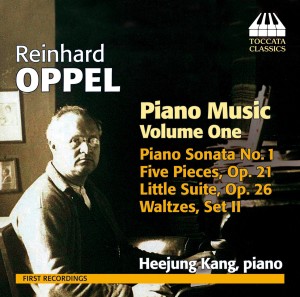
Reinhard Oppel: Piano Music, Volume One
Reinhard Oppel (1878–1941) was a major figure in inter-War Germany, as composer, teacher and theoretician. His rich, late-Romantic music encompasses symphonies, chamber and choral music, songs and works for piano. His music went underground in East Germany – literally: after World War II, when his family fled west from the occupying Russian army, they hid his music under the garden shed and there it remained, unknown, until the fall of Communism, when his son was able to return and retrieve it. This first CD of his heart-warming, Dvořákian piano music begins a series of releases intended to win Oppel’s music the audience it deserves.
Heejung Kang, piano
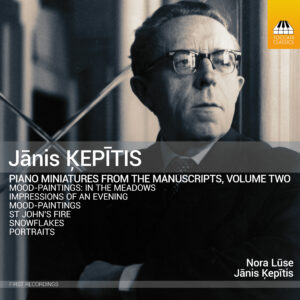
Jānis Ķepītis: Piano Miniatures from the Manuscripts, Volume Two
The Latvian composer Jānis Ķepītis (1908–89) has a fairly low profile even in his home country, never mind beyond its borders. His output was nonetheless substantial, with no fewer than six symphonies to his name, ten concertos, a number of large-scale choral-orchestral pieces, countless songs and choruses and a voluminous body of chamber music – almost all of it unknown. Ķepītis was himself a gifted pianist, and his hundred or so compositions for piano show a predilection for the miniature. The works here, most of them discovered among his manuscripts, inhabit a world downstream from Skryabin and Rachmaninov, with a gentle hint of Debussy, an occasional wisp of Latvian folk-music,
and, here and there, just a hint of jazz.
Nora Lūse, piano
Jānis Ķepītis, piano (Track 30, rec. 1935)
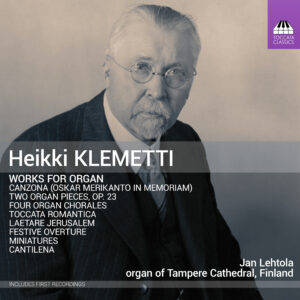
Heikki Klemetti: Organ Music
Heikki Klemetti (1876–1953) was one of the most important figures in the Finnish music of his day: author, organiser, musicologist, editor, educator, folksong collector and, above all, choral composer. His work as an organist and composer for the organ has largely been forgotten, an omission this first-ever album of his organ music seeks to correct. The influence of Ostrobothnian folksong can readily be heard, and there are obvious points of contact with the musical language of Sibelius, not least in the unemphatic dignity and nobility of the style, with the modal harmonies occasionally calling to mind another of Klemetti’s contemporaries: Vaughan Williams.
Jan Lehtola, organ of Tampere Cathedral, Finland
Jānis Ķepītis: Complete Music for Solo Piano, Volume One
The Latvian composer Jānis Ķepītis (1908–89) has a fairly low profile even in his home country, never mind beyond its borders. His output was nonetheless substantial, with no fewer than six symphonies to his name, ten concertos, a number of large-scale choral-orchestral pieces, countless songs and choruses and a voluminous body of chamber music – almost all of it unknown. Ķepītis was himself a gifted pianist, and his hundred or so compositions for piano show a predilection for the miniature. The works here, discovered among his manuscripts, inhabit a world downstream from Skryabin and Rachmaninov, with a gentle hint of Debussy and an occasional wisp of Latvian folk-music.
Nora Lūse, piano
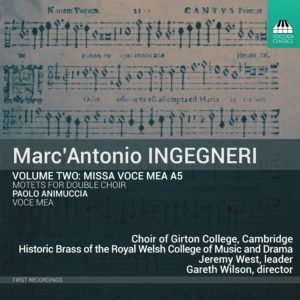
Marc’Antonio Ingegneri: Volume Two: Missa Voce Mea A5, Motets for double choir
The Cremonese composer Marc’Antonio Ingegneri (c. 1535/36–92) is chiefly remembered as the teacher of Claudio Monteverdi, while, for well-nigh 500 years, his own achievements were left to sit in the shadows. This second in a series of pioneering recordings from the Choir of Girton College, Cambridge, reveals Ingegneri to have been one of the masters of his age, writing music of breathtaking richness and beauty: the works heard here combine learned, intricate counterpoint with the kind of sheer sonic thrill that brings a shiver of physical excitement. It is, of course, religious music, but it is also extraordinarily passionate, to a degree not previously heard, nor for centuries to come, until the rise of the great Romantic choral works.
Choir of Girton College, Cambridge (Tracks 1–3, 5–8, 10, 12–14)
Historic Brass of the Royal Welsh College of Music and Drama (Tracks 1, 3–14)
Jeremy West, leader
Gareth Wilson, director
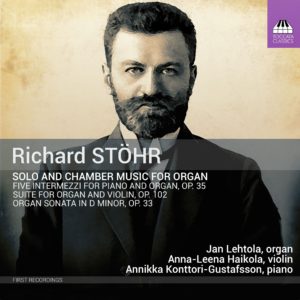
Richard Stöhr: Solo and Chamber Music for Organ
Like Korngold, Toch, Schoenberg, Zeisl and Zemlinsky, Richard Stöhr (1874–1967) was one of many Austrian composers driven into American exile by the Nazis. His generous output of music, being rediscovered at last in these Toccata Classics recordings, includes seven symphonies, much chamber music, songs, and choral and piano pieces. His output for organ is not extensive, but its quality is high: the instrument plays an important role in a number of Stöhr’s orchestral works, and here Stöhr presents the organ in two thoroughly attractive duos and an imposing solo sonata. The Sonata and Intermezzi sit downstream from Brahms in the tradition of Viennese classicism; the chromatic touches in the later Suite lean towards the language of Korngold.
Jan Lehtola, organ
Anna-Leena Haikola, violin
Annikka Konttori-Gustafsson, piano
First recordings
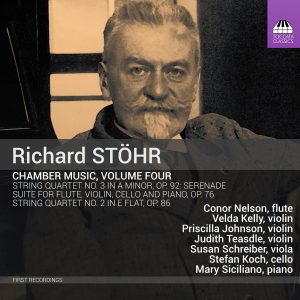
Richard STÖHR: Chamber Music, Volume Four
Like Korngold, Toch, Schoenberg, Zeisl and Zemlinsky, Richard Stöhr (1874–1967) was another Austrian composer driven into American exile by the Nazis. His generous output of music, being rediscovered at last in these Toccata Classics recordings, includes seven symphonies, much chamber music, songs, and choral and piano pieces. These chamber works, from his first years in the United States, show him in surprisingly relaxed mood, the Viennese lyricism of his native city maintained in his US refuge.
Stefan Koch, cello
Conor Nelson, (Tracks flute 1 – 4)
Velda Kelly, (Tracks violin 1 – 4)
Priscilla Johnson, (Tracks violin 5 – 9)
Judith Teasdle, (Tracks violin 5 – 9)
Susan Schreiber, (Tracks viola 5 – 9)
Mary Siciliano (Tracks 1 – 4)
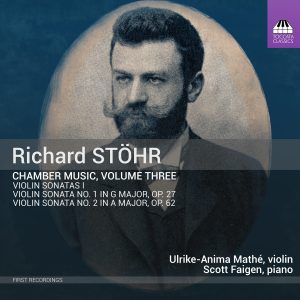
Richard Stöhr: Chamber Music, Volume Three: Violin Sonatas I
Like Korngold, Schoenberg, Toch, Zeisl and Zemlinsky, Richard Stöhr (1874–1967) was another Austrian composer driven into American exile by the Nazis. His generous output of music, being rediscovered at last in these Toccata Classics recordings, includes seven symphonies, much chamber music, songs, and choral and piano pieces. The first two of his fifteen violin sonatas offer a seamless outpouring of fin de siècle Viennese lyricism, with one good tune following another, in a style somewhere between Brahms and Korngold.
Ulrike-Anima Mathé, violin
Scott Faigen, piano
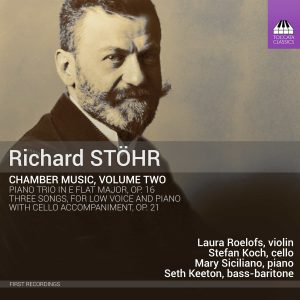
Richard Stöhr: Chamber Music, Volume Two
Like Korngold, Toch, Schoenberg, Zeisl and Zemlinsky, Richard Stöhr (1874–1967) was another Austrian composer driven into American exile by the Nazis. His generous output of music – ripe for rediscovery – includes seven symphonies, fifteen violin sonatas among much other chamber music, songs, and choral and piano pieces. His expansive E flat Piano Trio of 1905 sits firmly in the Viennese Romantic tradition downstream from Schubert and Brahms, with one lovely tune following another, whereas the Three Songs, written only four years later, look forward to the lyrical intensity of Korngold.
Laura Roelofs, violin (Tracks 1-4)
Stefan Koch, cello
Mary Siciliano, piano
Seth Keeton, bass-baritone (Tracks 5-7)