Search Results for "choral" – Page 2
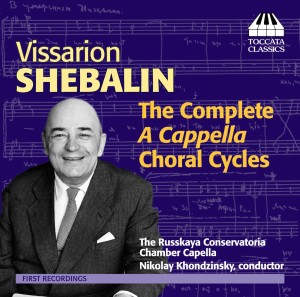
Vissarion Shebalin: The Complete A Cappella Choral Cycles
The Siberian-born Vissarion Shebalin (1902-63) is best known for his instrumental music, which includes five symphonies and nine string quartets, some of which have been heard on CD, but this is the first recording of the eight delightful, and very Russian, choral cycles he wrote from 1949. Shebalin had to endure much hardship: along with Shostakovich, a close friend and colleague, he was one of the composers condemned in the infamous 1948 Party congress in Moscow; and in later life he fought to overcome a series of crippling strokes. These tribulations he faced with understated but unshakable optimism, as these touching choruses reveal.
Russkaya Conservatoria Chamber Capella, choir
Nikolay Khondzinsky, conductor
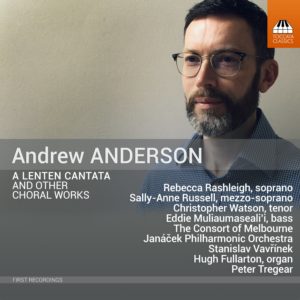
Andrew Anderson: A Lenten Cantata and Other Choral Works
In spite of the differences of time and distance, the choral works of the Australian composer Andrew Anderson (born in Melbourne in 1971) further the English cathedral tradition of such composers as Finzi and Howells, in music concerned particularly with lyricism and with clarity and directness of expression.
Rebecca Rashleigh, soprano (Track 5)
Sally-Anne Russell, mezzo-soprano (Tracks 3, 17)
Christopher Watson, tenor (Track 3)
Eddie Muliaumaseali’i, bass (Track 7)
The Consort of Melbourne (Tracks 2, 4, 6, 8, 9–16)
Janáček Philharmonic Orchestra (Tracks 1-3, 5-8, 17)
Pavel Doležal, violin (Track 4)
Stanislav Vavřínek, conductor (Tracks 1–3, 5–8, 17)
Hugh Fullarton, organ (Tracks 9, 15, 16)
Peter Tregear, choirmaster (Tracks 2, 4, 6, 8), conductor (Tracks 9–16)
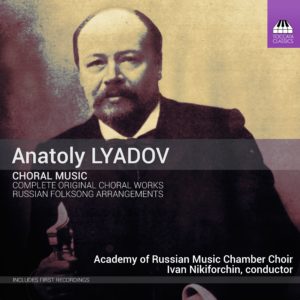
Anatoly Lyadov: Choral Music
Lyadov’s handful of orchestral works have become concert favourites, but his choral music is as good as unknown. It falls into three main categories: religious chants, folksong arrangements and original compositions. All three confirm Lyadov’s status as a kind of Fabergé of music: they blend exquisite craftsmanship and delicate beauty.
The Academy of Russian Music Chamber Choir
Ivan Nikiforchin, choirmaster and conductor
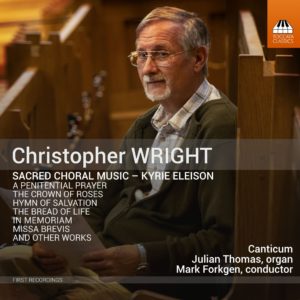
Christopher Wright: Sacred Choral Music
The English composer Christopher Wright, born in Suffolk in 1954, declares that he is ‘not fettered by fashion, style, ideology or gimmickry or some insatiable desire to be original’; instead, he writes music that aims to communicate directly with the listener – although it can also be thorny and challenging. This first-ever album of his sacred choral music reveals it to be in the British-cathedral tradition of composers like Benjamin Britten, William Mathias, Bernard Rose and Malcolm Williamson: the melodic lines may on occasion be angular and the harmonies sometimes tart, but Wright’s concern with immediacy of expression ensures that the ‘personal prayers’ embodied in these pieces can be readily understood and appreciated.
Canticum
Julian Thomas, organ
Mark Forkgen, director
First recordings
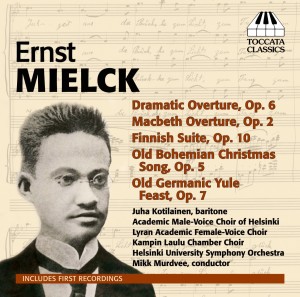
Ernst Mielck: Orchestral and Choral Works
The early death of the Finnish composer Ernst Mielck, in October 1899, two days before his 22nd birthday, robbed music of an extraordinarily gifted musician — he was also a fine pianist — and perhaps one of the major voices of the next generation: the rapid evolution in his language in the three years covered by this CD is striking. The two overtures and cantatas make clear that he was already a gifted composer in the post-Schumann Romantic tradition, and the Finnish Suite written in the last year of his life brings a striking simplification of his textures and what seems to have been a nascent nationalism.
Juha Kotilainen, baritone
Academic Male-Voice Choir of Helsinki, choir
Lyran Academic Female-Voice Choir, choir
Kampin Laulu Chamber Choir, choir
Kari Turunen, chorus-master
Helsinki University Symphony Orchestra, orchestra
Mikk Murdvee, conductor
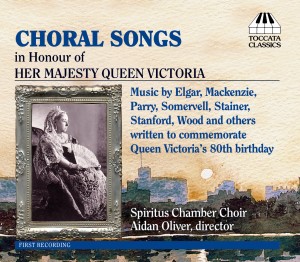
Choral Songs in honour of Her Majesty Queen Victoria
In celebration of Queen Victoria’s 80th birthday in 1899, thirteen of the leading composers and poets of the day collaborated on a collection of partsongs to rival their Elizabethan model, The Triumphs of Oriana. Published in a limited edition of only 100 copies, this superb sequence, studded with musical gems, provides a fascinating snapshot of the British musical renaissance on the eve of the twentieth century.
Spiritus Chamber Choir, choir
Aidan Oliver, director
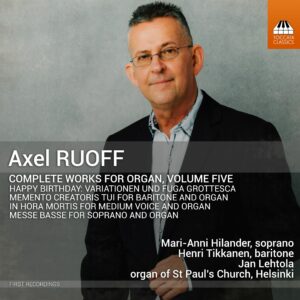
Axel Ruoff: Complete Works for Organ, Volume Five
This final instalment of the organ compositions of Axel Ruoff (born in Stuttgart in 1957) presents two starkly contrasted sides of his musical personality: three of them, for voice and organ, are concerned with the spiritual – two even addressing head-on the issue of death itself – and are thus solemn and hieratic, whereas the concluding work is a whimsical, tongue-in-cheek set of variations on ‘Happy Birthday’, written as a present for Ruoff’s publisher on his 80th birthday.
Mari-Anni Hilander, soprano
Henri Tikkanen, baritone
Jan Lehtola, organ of the St. Paul’s Church, Helsinki
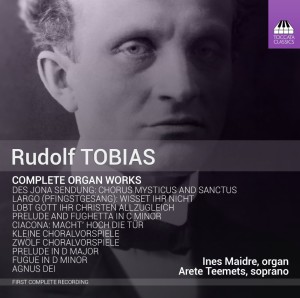
Rudolf Tobias: Complete Organ Works
Rudolf Tobias (1873-1918) founded the classical-music tradition in Estonia almost single-handledly, writing the first Estonian orchestral piece, the first Estonian string quartet, first Estonian piano concerto and the first Estonian oratorio, the monumental Des Jona Sendung, from which Ines Maidre has now transcribed for organ the blazingly powerful Sanctus. Although Tobias was himself an outstanding organist, he wrote little music for his own instrument and most of it is modest in scale, but its quirky craftsmanship reveals the hand of a master.
Ines Maidre, organ; Arete Teemets, soprano;
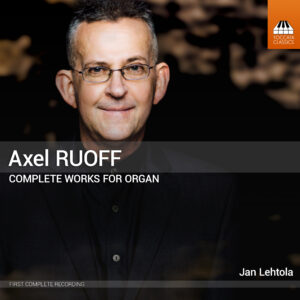
Axel Ruoff: Complete Works for Organ
The organ works of Axel Ruoff, born in Stuttgart in 1957, constitute one of the most important contributions to the literature for the instrument by any composer since Messiaen. Stylistically, his music unites the French cathedral tradition of composers like Langlais, Dupré and Guillou with the concern with counterpoint and logic heard in Reger and later German figures. Ruoff uses the unparalleled resources of the modern symphonic organ not produce music of freewheeling energy and uncompromising power.
Jan Lehtola, organ
5 CD Box Set Includes:
TOCC0567 – Axel Ruoff: Complete Works for Organ, Vol. 1
TOCC0596 – Axel Ruoff: Complete Works for Organ, Vol. 2
TOCC0610 – Axel Ruoff: Complete Works for Organ, Vol. 3
TOCC0672 – Axel Ruoff: Complete Works for Organ, Vol. 4
TOCC0709 – Axel Ruoff: Complete Works for Organ, Vol. 5
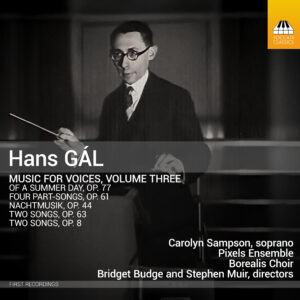
Hans Gál: Music for Voices, Volume Three
Whether in his original home of Vienna, as a conservatoire director in Mainz, or as an émigré in Edinburgh, where he became one of the mainstays of musical life, Hans Gál (1890–1987) championed choral singing as a way of directly involving people in making music: he founded and conducted a number of choirs and provided an extensive output of choral compositions. This third album of his choral music offers a vivid cross-section of music for chamber choir, featuring mixed voices, women’s voices and male-voice choir, a cappella, with solo soprano, with piano and with chamber accompaniment.
Carolyn Sampson, soprano
Pixels Ensemble
Borealis Choir
Bridget Budge, director
Stephen Muir, director
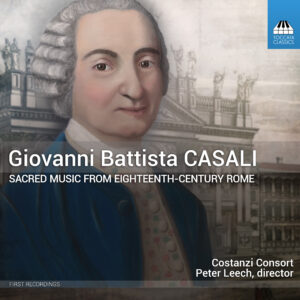
Giovanni Battista Casali: Sacred Music from Eighteenth-Century Rome
The history of music-making in Rome tends to focus on Renaissance polyphony, with an occasional nod to the Baroque thereafter. But thanks to composers like Giovanni Battista Casali (1715–92), choral music continued to flourish in Roman churches and other religious establishments in the eighteenth century, too, until Napoleon’s occupation broke many of its traditions. Casali’s music, though, is as good as unknown, and this pioneering recording reveals a composer at home in the galant style – with a surprising fondness for the occasional dissonance.
Costanzi Consort
Peter Leech, director
Marc’ Antonio Ingegneri, Volume Three: Missa Susanne un jour a5
The Cremonese composer Marc’Antonio Ingegneri (c. 1535/36–92) is chiefly remembered as the teacher of Claudio Monteverdi while, for well nigh 500 years, his own achievements were left to sit in the shadows. This third in a series of pioneering recordings from the Choir of Girton College, Cambridge, reveals Ingegneri to have been one of the masters of his age, writing music of breathtaking richness and beauty: the works heard here combine learned, intricate counterpoint with the kind of sheer sonic thrill that brings a shiver of physical excitement. It is, of course, religious music, but it is also extraordinarily passionate, to a degree not previously heard, nor for centuries to come, until the rise of the great Romantic choral works.
Choir of Girton College, Cambridge (1, 2, 4–6, 9–12, 16)
Historic Brass of the Royal Welsh College of Music and Drama (1–7, 9–14)
Jeremy West, leader (3)
Emily Nott, organ (8)
Felix Elliott, organ (15)
Gareth Wilson, director
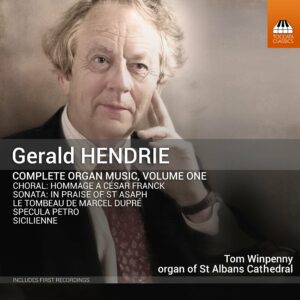
Gerald Hendrie: Complete Organ Music, Volume One
The organ music of Gerald Hendrie – born in England in 1935 but resident in France since 1996 – encompasses a huge range of influences, among them the organist-composers who went before him (not least Franck, Dupré and Messiaen), dodecaphony, mediaeval plainchant and modality and jazz. The resulting works are as varied as the styles that fed into them, from grandiose to gentle, from severe to whimsical, from lyrical to lively.
Tom Winpenny
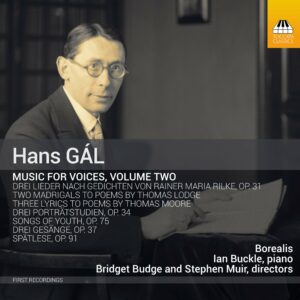
Hans Gál: Music for Voices, Volume Two
Whether in his original home of Vienna, as a conservatoire director in Germany, or as an émigré in Edinburgh, where he became one of the mainstays of musical life, Hans Gál (1890–1987) championed choral singing as a way of directly involving people in making music: he founded and conducted a number of choirs and provided an extensive output of choral compositions. This second album of Gál’s choral music offers a vivid cross-section of his music for chamber choir, featuring mixed voices, women’s voices and male-voice choir, both a cappella and with piano, and ranging across four decades
Borealis
Ian Buckle, piano (Tracks 1–3, 15–17, 23–25)
Bridget Budge, director (Tracks 1–17, 23–25)
Stephen Muir, director (Tracks 18–22)
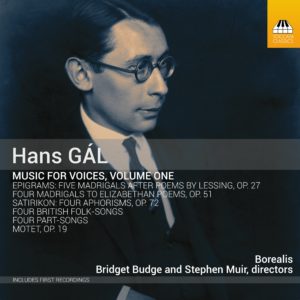
Hans GÁL: Music for Voices, Volume One
Whether in his original home of Vienna, as a conservatoire director in Germany, or as an émigré in Edinburgh, where he became one of the mainstays of musical life, Hans Gál (1890–1987) championed choral singing as a way of directly involving people in making music: he founded and conducted a number of choirs and provided an extensive output of choral compositions. This first volume in a long-term project to record his choral music presents a rich variety of works for a cappella voices, ranging from demanding eight-part choruses to charming folksong settings.
Borealis
Bridget Budge (1 –14, 19–22)
and Stephen Muir (15–18), directors
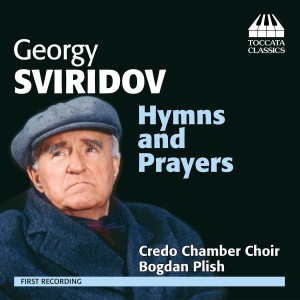
Georgy Sviridov: Hymns and Prayers
Gyorgy Sviridov (1915-98) saw himself as part of the thousand-year continuum of Russian culture, giving its resonance full expression in the monumental choral cycle Hymns and Prayers, written over a ten-year period from 1987 to 1997; he completed it only weeks before he died. Extraordinarily beautiful and profoundly moving, Hymns and Prayers is perhaps the most important Russian choral composition since the liturgies of Tchaikovsky and Rachmaninov. At this time of tension between Russia and Ukraine, here a Ukrainian choir sings a Russian masterpiece.
Credo Chamber Choir, cond. Bogdan Plish; Ivanna Bondaruk, soprano; Yuliya Zuveya, mezzo soprano; Roman (Podlubnyak), celibate deacon, tenor; Roman Pachashynsky, tenor; Nazar Yakobenchuk, baritone; Tarasiy (Mudrak), archdeacon, bass;