Search Results for "silvia silly a lhe cunar diverdade" – Page 3
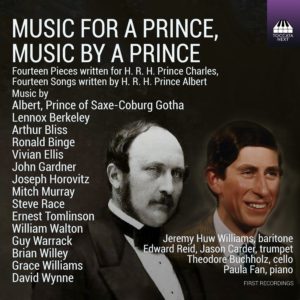
Music for a Prince, Music by a Prince: Fourteen Pieces written for H. R. H. Prince Charles, Fourteen Songs written by H. R. H. Prince Albert
This unusual recording brings princely offerings of two different kinds. In 1970 Prince Charles – who had studied cello and trumpet – was presented with a leather-bound volume containing pieces written for his entertainment by the composers on the council of the Performing Right Society. These fourteen bonnes bouches are complemented by fourteen German Lieder written by Prince Charles’ great-great-great-grandfather, Prince Albert, the Prince Consort, whose style owed something to that of his good friend, Felix Mendelssohn.
Jeremy Huw Williams, baritone (Tracks 15, 18–31)
Theodore Buchholz, cello (Tracks 1, 2, 4, 6-9, 11-14, 17)
Edward Reid, trumpet (Tracks 3, 4, 5, 8, 10, 11, 14)
Jason Carder, trumpet (Track 16)
Paula Fan, piano (Tracks 1-7, 10, 12, 14-31)
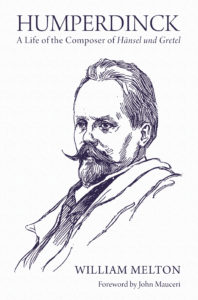
Humperdinck: A Life of the Composer of ‘Hänsel und Gretel’
by William Melton
Foreword by John Mauceri
Royal octavo (253 mm x 158 mm)
456pp
81 illustrations
61 music exx.
Catalogue of Works
Bibliography
Format: Hardback
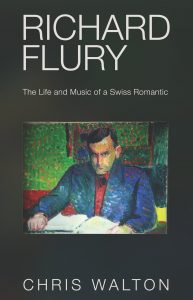
Richard Flury: The Life and Music of a Swiss Romantic
Author: Chris Walton
Extent: 328 pages
Size: 16 x 24 cm
Published: March 2017
Illustrations: 22 colour illustrations; 51 b/w illustrations
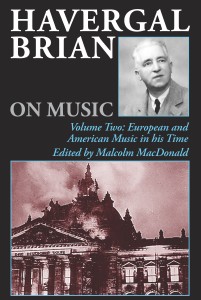
Havergal Brian on Music: Volume Two: European and American Music in his Time
Edited by Malcolm MacDonald
Extent: 458 pages
Composition: Demy octavo ~ Index
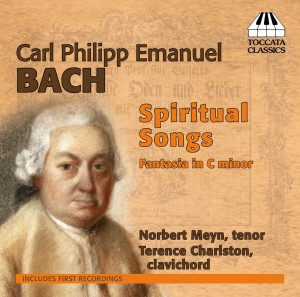
C. P. E. Bach: Spiritual Songs
C. P. E. Bach's two collections of religious songs, published in 1758 and 1780-81, were among the most popular eighteenth-century Lieder publications. Here a selection of them is recorded for the first time with complete texts and accompanied with the clavichord, the composer's favourite instrument, underlining their intimate nature, intended more for private devotional use than for public performance. The recording includes the 'Hamlet Fantasy' that resulted when the poet Heinrich Wilhelm von Gerstenberg imposed his paraphrase of Hamlet's soliloquy on one of C. P. E. Bach's keyboard pieces.
Norbert Meyn, tenor
Terence Charlston, clavichord
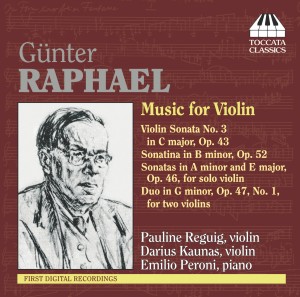
Günter Raphael: Music for Violin
In the first part of his career Günter Raphael (1903-60) enjoyed performances of his music by Germany's leading musicians, among them the Busch Quartet and Wilhelm Furtwängler. But declared a 'half-Jew' by the Nazis in 1934, he was forced from his prestigious teaching position in Leipzig. Confined to hospital by tuberculosis during the War years, he continued to compose while his doctors protected him from persecution. These violin works — strongly melodic and rhythmically vital — continue the mainstream of German Romanticism as refracted through Hindemith; the two solo sonatas have echoes of Bach.
Pauline Reguig, violin
Darius Kaunas, violin
Emilio Peroni, piano
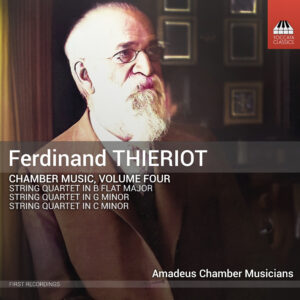
Ferdinand Thieriot: Chamber Music, Volume Four
The Hamburg-born Ferdinand Thieriot (1838–1919) not only shared a teacher – Eduard Marxsen – with Brahms; both composers, who remained friends in later years, use a similar musical language, one which is richly melodic and effortlessly contrapuntal. The musicologist Wilhelm Altmann wrote that ‘Thieriot’s chamber music is without exception noble and pure. He writes with perfect command of form and expression’ – as the works on this fourth Toccata Classics volume prove, in their exquisite balance of depth and beauty, of Brahmsian richness and Schubertian spontaneity.
Amadeus Chamber Musicians
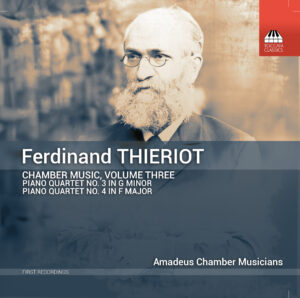
Ferdinand Thieriot: Chamber Music, Volume Three
The Hamburg-born Ferdinand Thieriot (1838–1919) not only shared a teacher – Eduard Marxsen – with Brahms; both composers use a very similar musical language, one which is richly melodic and effortlessly contrapuntal. The musicologist Wilhelm Altmann wrote that ‘Thieriot’s chamber music is without exception noble and pure. He writes with perfect command of form and expression’ – as the works on this third Toccata Classics volume prove, in their exquisite balance of depth and beauty.
Amadeus Chamber Musicians
Dmitriy Daniel Askerov, violin
Jenny Joelson, viola
Luzi Dubs, cello
Rebecca Ineichen, piano
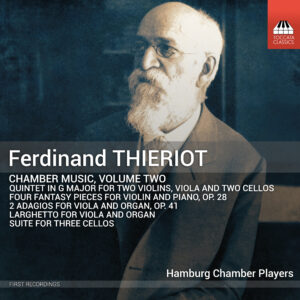
Ferdinand Thieriot: Chamber Music, Volume Two
The Hamburg-born Ferdinand Thieriot (1838–1919) not only shared a teacher – Eduard Marxsen – with Brahms; both composers use a very similar musical language, one which is richly melodic and effortlessly contrapuntal. The musicologist Wilhelm Altmann wrote that ‘Thieriot’s chamber music is without exception noble and pure. He writes with perfect command of form and expression’ – as the works on this second Toccata Classics volume prove, in their exquisite balance of depth and beauty.
Hamburg Chamber Players
Ian Mardon, violin
Matthias Brommann, violin
Julia Mensching, viola
Olga Dowbusch-Lubotsky, cello
Suren Anisonyan, cello
Clovis Michon, cello
Andrea Merlo, piano
Alexander Bürkle, organ
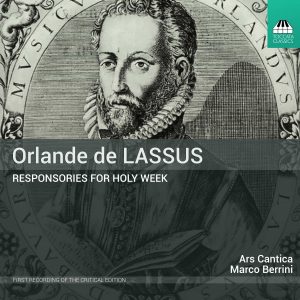
Orlande De Lassus: Responsories for Holy Week
Around 1580 Lassus composed a four-voice setting of the eighteen Responsories for the second and third Nocturnes of Holy Week, probably intended for the services in the private chapel of his employer, Wilhelm V, Duke of Bavaria. In these miniature dramas Lassus skilfully supports the text, as was then required by the Council of Trent, illustrating the human tragedy of the Easter story with exquisite music that is all the more moving for its restraint.
Ars Cantica
Marco Berrini, conductor
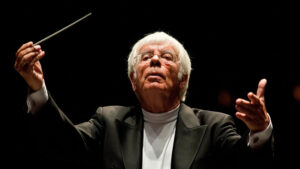
Helmut Rilling in Conversation, in 1998
The death of Helmut Rilling, on 11 February 2026, reminded me that we had had a thoroughly enjoyable conversation 28 years earlier, as the basis…
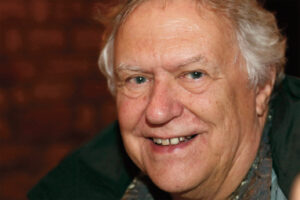
Thym for a Song
Music: A Connected Art/Die Illusion der absoluten Musik: A Festschrift for Jürgen Thym on his 80th BirthdayVerlag Valentin Koerner, Baden-Baden, 2023Reviewed by Niall Hoskin Jürgen Thym…