Search Results for "silvia silly a lhe cunar diverdade" – Page 2
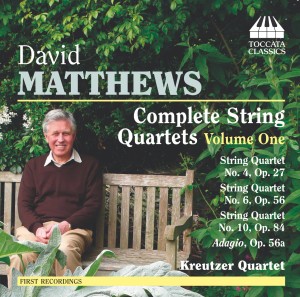
David Matthews: Complete String Quartets, Volume One
To date David Matthews (b. 1943) has written seven symphonies and eleven string quartets. 'I have continued’, he explains, 'along a path similar to that taken by Tippett and Britten: one rooted in the Viennese Classics – Beethoven above all – and also in Mahler, Sibelius and the early twentieth-century modernists. I have always been a tonal composer, attempting to integrate the musical language of the present with the past, and to explore the rich traditional forms.’ This first volume of his complete string quartets presents works written between 1981 and 2001.
Kreutzer Quartet, string quartet
Peter Sheppard Skærved, violin
Mihailo Trandafilovski, violin
Morgan Goff, viola
Neil Heyde, cello
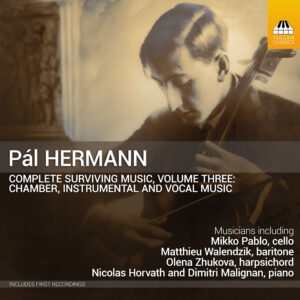
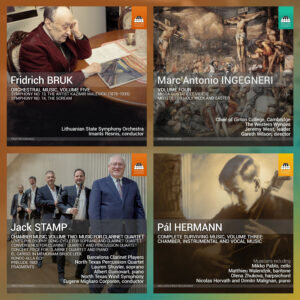
Pál Hermann: Complete Surviving Music, Volume Three – Chamber Instrumental and Vocal Music
Pál Hermann, born in Budapest in 1902, was not only one of the leading cellists of his generation; he was also an important composer, one of the major figures in Hungarian music in the generation after his teachers Bartók and Kodály. But since only two of his works were published before his early death – in 1944, at the hands of the Nazis – and many more of them were lost, he has not had the esteem that he deserves. The kaleidoscopic variety of the works on this third, and final, volume of his surviving compositions – biting Bartókian piano pieces, Neo-Baroque essays of considerable contrapuntal ingenuity, songs with a French Impressionist flavour, even a sly transcription of a foxtrot – underlines how much was lost with his murder.
Nicolas Horvath, piano
Dimitri Malignan, piano
Elizaveta Agrafenina, soprano
Sára Gutvill, mezzo-soprano
Irina Bedicova, mezzo-soprano
Paul van Gastel, tenor
Pierre Mak, baritone
Matthieu Walendzik, baritone
Reine-Marie Verhagen, soprano recorder
Inês d’Avena, alto recorder
Dante Jongerius, tenor recorder
Punto Bawono, Baroque lute
Olena Zhukova, harpsichord
Olena Matselyukh, organ
Jean-Pierre Dassonville, horn
Sadie Fields, violin
Mikko Pablo, cello
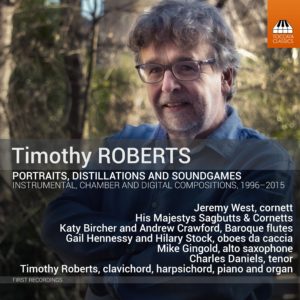
Timothy Roberts: Portraits, Distillations and Soundgames
Timothy Roberts, born in Hampstead, north London, in 1953, has been a mainstay of the early-music scene in Britain and further afield for decades. He is best known as a keyboard player, but in recent years composing has been of growing importance to him. Hardly surprisingly, his music refracts the Baroque and Classical world in which he is active, usually with a playful but respectful twist.
Jeremy West, cornett (tracks 1–13, 17–23)
Timothy Roberts, harpsichord (tracks 2–15), piano (tracks 11–16), clavichord (track 14), organ (track 22)
His Majestys Sagbutts & Cornetts (tracks 5–10)
Katy Bircher and Andrew Crawford, Baroque flutes (tracks 18–21)
Gail Hennessy and Hilary Stock, oboes da caccia (tracks 18–21)
Mike Gingold, alto saxophone (track 24)
Charles Daniels, tenor (track 27)
Digital compositions (tracks 24, 26–28)
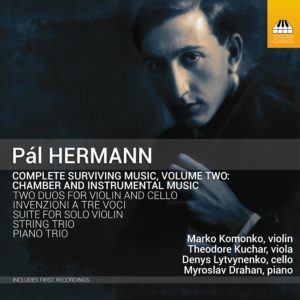
Pál Hermann: Complete Surviving Music, Volume Two
Pál Hermann, born in Budapest in 1902, was not only one of the leading cellists of his generation; he was also an important composer, one of the major figures in Hungarian music in the generation after his teachers Bartók and Kodály. But since only two of his works were published before his early death – in 1944, at the hands of the Nazis – and many more of them were lost, he has not had the esteem that he deserves. The works on this second volume of his surviving compositions – here mostly chamber works for strings, several in their first recordings – have the wiry humour, sprung and spiky rhythms and Hungarian melos that mark him out as a worthy successor to Bartók – and hints at how much was lost with his murder.
Marko Komonko, violin
Theodore Kuchar, viola (Tracks 9, 10, 15)
Denys Lytvynenko, cello (Tracks 1–3)
Myroslav Drahan, piano (Track 16)
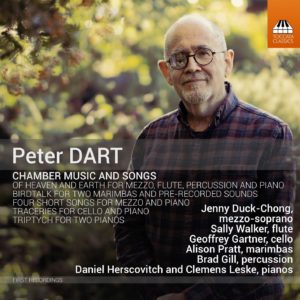
Peter Dart: Chamber Music and Songs
Painters sometimes talk about the intensity of the light they encounter in Australia. Peter Dart, born in Sydney in 1953, brings something of that brightness to his compositions, which are further animated by buoyant rhythms and a lively sense of humour, even mischief. They are, at the same time, anchored in a secure command of counterpoint, and given a timeless quality by his fondness for modal harmony. Most important of all, the technical mastery that gives these works their surefooted appeal is suffused with straightforward human warmth.
Daniel Herscovitch, piano (Tracks 1 – 12, 14 – 17)
Clemens Leske, piano (Tracks 1 – 3)
Jenny Duck-Chong, mezzo-soprano (Tracks 4 – 7, 14 – 17)
Sally Walker, flute (Tracks 15 – 16), piccolo (Tracks 14 – 17)
Geoffrey Gartner, cello (Tracks 8 – 12)
Brad Gill, percussion (Tracks 14 – 17)
Alison Pratt, marimbas (Track 13)
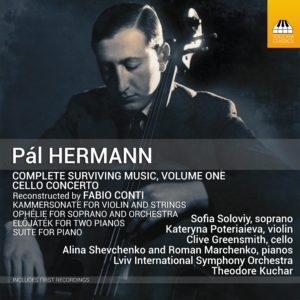
Pál Hermann: Complete Surviving Music, Volume One
Pál Hermann, born in Budapest in 1902, was not only one of the leading cellists of his generation: he was also an important composer, one of the major figures in Hungarian music in the generation after his teachers Bartók and Kodály. But since only two of his works were published before his early death, in 1944, at the hands of the Nazis, and many more of them were lost, he has not had the esteem that he deserves. This series will present all his surviving compositions, most of them in first recordings. The major work on this first album, Hermann’s Cello Concerto of 1925 in a reconstruction by the Italian composer Fabio Conti (b. 1967), sits somewhere between Bartók and Korngold and bids fair to become a staple of the cello repertoire.
Clive Greensmith, cello (Tracks 1-5)
Kateryna Poteriaieva, violin (Tracks 6-9)
Alina Shevchenko, piano (Tracks 10-13)
Roman Marchenko, piano (Track 10)
Sofia Soloviy, soprano (Track 14)
Lviv International Symphony Orchestra (Tracks 1-9, 14)
Theodore Kuchar, conductor (Tracks 1-9, 14)
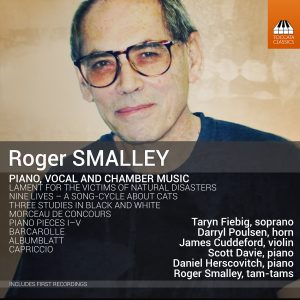
Roger SMALLEY: Piano, Vocal and Chamber Music
Roger Smalley (1943–2015) made his mark, first in his native Britain and then in Australia, as composer, pianist, conductor, writer, academic and teacher. Although as performer and commentator he was at the forefront of musical modernism, he was also very fond of nineteenth-century Romanticism, and much of his music bridges the gap between old and new, retaining its roots in the past while reflecting the concerns of his own time, as the works on this album demonstrate.
Taryn Fiebig, soprano (Tracks 2–10)
Darryl Poulsen, horn (Tracks 22)
James Cuddeford, violin (Tracks 11)
Daniel Herscovitch, piano (Track 1)
Scott Davie, piano (Tracks 2–10)
Roger Smalley, tam-tams (Track 22)
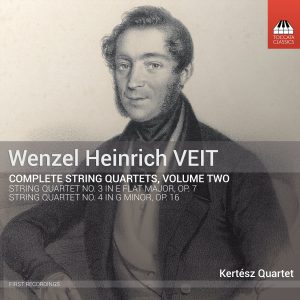
Wenzel Heinrich Veit: Complete String Quartets, Volume Two
The German-Bohemian composer Wenzel Heinrich Veit (1806–64) – Václav Jindřich Veit in Czech – is one of music’s most unjustly forgotten figures. As these first recordings of his four string quartets will show, he is not only the link between the Bohemian composers of the end of the Classical period and the wave of Czech Romanticism that began with Smetana but also an outstanding composer in his own right. His quartets trace the stylistic evolution of his time: they emerge from a debt to Haydn and Beethoven and embrace Mendelssohn and Schumann on their way to pre-echoes of Dvořák.
Kertész Quartet, playing on original instruments
Katalin Kertész and Jean Paterson, violins
Nichola Blakey, viola
Cressida Nash, cello
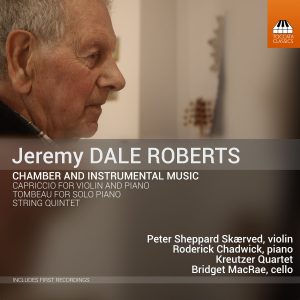
Jeremy Dale Roberts: Chamber and Instrumental Music
Jeremy Dale Roberts (1934–2017) was a unique figure on the British musical landscape: as a composer, he steered a path between traditional tonality and modernism, developing a language that can range from aching, pastoral lyricism to wild, freewheeling energy. This album – to which Dale Roberts referred as ‘a kind of testament’ – counterpoints works from the beginning and end of his career, all distinguished by his unmistakable sense of drama and poetry and his peerless technical command. The performers here worked intensely with the composer over a number of years, and he was involved with every aspect of these recordings, from initial rehearsals up to the final edits.
Peter Sheppard Skærved, violin (Track 1)
Roderick Chadwick, piano (Tracks 1 – 2)
Bridget MacRae, cello (Tracks 3 – 6)
Kreutzer Quartet (Tracks 3 – 6)
Peter Sheppard Skærved, Mihailo Tranda lovski, violins
Morgan Goff, viola
Neil Heyde, cello
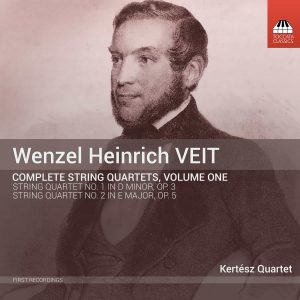
Wenzel Heinrich Veit: Complete String Quartets, Volume One
The German-Bohemian composer Wenzel Heinrich Veit (1806–64) – Václav Jindřich Veit in Czech – is one of music’s most unjustly forgotten figures. As these first recordings of his four string quartets will show, he is not only the link between the Bohemian composers of the end of the Classical period and the wave of Czech Romanticism that began with Smetana but also an outstanding composer in his own right. His quartets trace the stylistic evolution of his time: they emerge from a debt to Haydn and Beethoven and embrace Mendelssohn and Schumann on their way to pre-echoes of Dvořák.
Kertész Quartet, playing on original instruments
Katalin Kertész and Jean Paterson, violins
Nichola Blakey, viola
Cressida Nash, cello
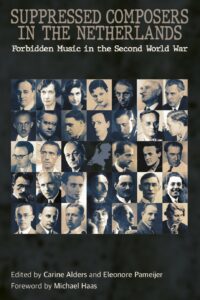
Suppressed Composers in the Netherlands
Forbidden Music in the Second World War
Edited by Carine Alders and Eleonore Pameijer
Foreword by Michael Haas
356 Pages
23.4 x 15.6 cm
Hardcover
11 colour and 61 b/w illustrations
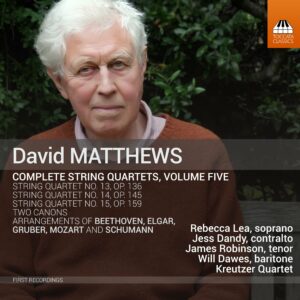
David Matthews: Complete String Quartets, Volume Five
The American critic Robert Reilly described the music on Volume One of this cycle of the complete string quartets of David Matthews (b. 1943) as ‘some of the most concentrated, penetrating writing for this medium in the past 30 years or more. It is musical thinking of the highest order and quartet writing in the great tradition of Beethoven, Bartók, Britten, and Tippett’. Matthews’ three most recent quartets call in a wide range of references. Birdsong – heard in Nos. 13 and 14 – is a standard Matthews topos; and the fugal No. 15 seems to find a middle ground between late Beethoven and folk-music. No. 13 presents the biggest surprise: it introduces four solo voices, siting the work somewhere between Berg’s Lyric Suite and Vaughan Williams’ Serenade to Music. Some touching arrangements and two canons for two Michaels – Tippett and Berkeley – complete the programme.
Rebecca Lea, soprano 8
Jess Dandy, contralto 8
James Robinson, tenor 8
Will Dawes, baritone 8
Kreutzer Quartet
Peter Sheppard Skærved and Mihailo Trandafilovski, violins
Clifton Harrison, viola
Neil Heyde, cello