Search Results for "mukbang khỉ đầu chó" – Page 2
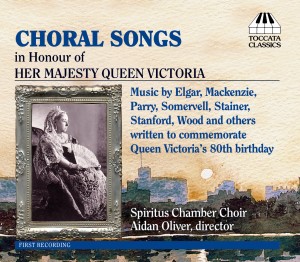
Choral Songs in honour of Her Majesty Queen Victoria
In celebration of Queen Victoria’s 80th birthday in 1899, thirteen of the leading composers and poets of the day collaborated on a collection of partsongs to rival their Elizabethan model, The Triumphs of Oriana. Published in a limited edition of only 100 copies, this superb sequence, studded with musical gems, provides a fascinating snapshot of the British musical renaissance on the eve of the twentieth century.
Spiritus Chamber Choir, choir
Aidan Oliver, director
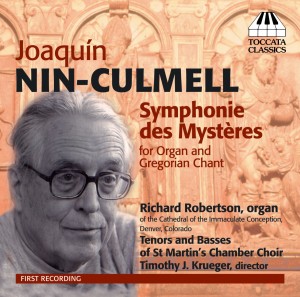
Joaquín Nin-Culmell: Symphonie des Mystères
Joaquín Nin-Culmell (1908–2004) was a student of Dukas and Falla and his early music reflects his Spanish background. The Symphonie des Mystères (1992–4) for alternating Gregorian chant and organ, is a product of the religious devotion of his old age, the chant sections setting in bold relief the austerely passionate organ commentaries, which have an affinity with Messiaen, as Nin-Culmell’s music traces a dramatic arch charting the birth, crucifixion and resurrection of Christ.
Richard Robertson, organ
St. Martin’s Chamber Choir, choir
Timothy J. Krueger, conductor
Marc’Antonio Ingegneri: Volume Four – Missa Gustate et videte; Motets for Holy Week and Easter
The Cremonese composer Marc’Antonio Ingegneri (c. 1535/36–92) is chiefly remembered as the teacher of Claudio Monteverdi while, for well-nigh 500 years, his own achievements were left to sit in the shadows. This fourth in a series of pioneering recordings from the Choir of Girton College, Cambridge, presents a sequence of music for Holy Week and Easter, confirming Ingegneri to have been one of the masters of his age. The striking range of moods heard here will confound conventional expectations of Renaissance polyphony: Ingegneri’s emotional palette extends from tender intimacy in some of these motets to dancing, celebratory jubilation in the Mass setting – all of it music of breathtaking richness and beauty.
Choir of Girton College, Cambridge
The Western Wyndes
Jeremy West, leader
Gareth Wilson, director
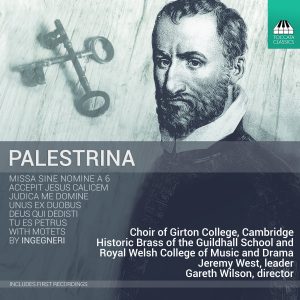
Palestrina: Missa sine nomine a6
Renaissance polyphony is generally held to be stately, calm, reassuring. But this pro- gramme of Palestrina’s six-part Missa sine nomine, complemented by five of his motets and three by Marc’Antonio Ingegneri (c. 1535/36–92), was recorded after the Choir of Girton College, Cambridge, had undertaken a tour of Israel and Palestine. There the music and its texts (‘How shall we sing the Lord’s song in a strange land?’) took on an extraordinary poignancy, with the dispossession and desperation of thousands of years ago animating the restrained dignity of Palestrina’s counterpoint with an unexpectedly topical intensity.
Choir of Girton College, Cambridge
Historic Brass of the Guildhall School and Royal Welsh College of Music and Drama
Jeremy West, leader
James Mitchell, organ (Track 8)
Lucy Morrell, organ (Track 13)
Gareth Wilson, director
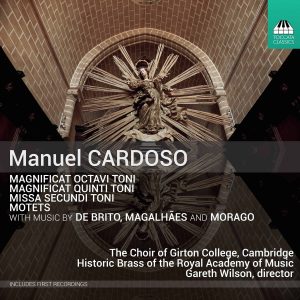
Manuel Cardoso: Missa Secundi Toni and Other Works
Manuel Cardoso (1566–1650) was one of the most important composers of the golden age of Portuguese polyphony around the turn of the seventeenth century. But modern choirs have been surprisingly slow to explore the rich legacy of his compositions: this is the first recording of his Missa Secundi Toni, and the first of any of his works with brass consort, its dark colours providing an effective contrast with the young voices of the Girton College Choir.
The Choir of Girton College, Cambridge (Tracks 1–2, 4–7)
Historic Brass of the Royal Academy of Music (Jeremy West, leader) (Tracks 1–5, 7 10–14, 16–17)
Lucy Morrell, organ (Tracks 1–5, 7–8, 10–13, 15–17)
Gareth Wilson, director (Tracks 1–7, 9–14, 16–17)
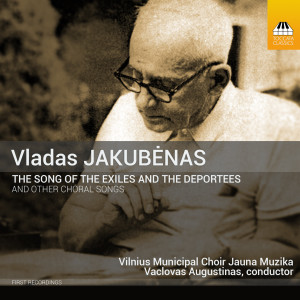
Vladas Jakubėnas: The Song of the Exiles and The Deportees and Other Choral Songs
The Lithuanian Vladas Jakubėnas (1904–78) is one of a lost generation of Baltic composers. A student of Schreker in Berlin, he returned home to help build the musical culture of his country. But the Nazi invasion and Soviet occupation drove him into exile and, after five years in refugee camps in Germany, he settled in Chicago, playing an important role in the Lithuanian diaspora in North America. These choral songs show the deep identification of his late-Romantic style with the folk-music of the land he was forced to leave behind.
Vilnius Municipal Choir Jauna Muzika
Jurgita Mintautiene, soprano
Gintautas Skliutas, tenor
Dainius Jozenas, piano
Vaclovas Augustinas, conductor
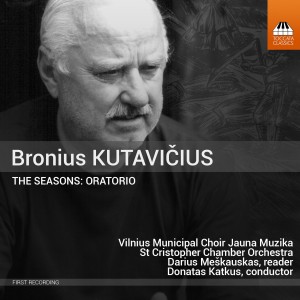
Bronius Kutavičius: The Seasons: Oratorio
Bronius Kutavičius’ oratorio The Seasons (2005–8) sets texts from a classic Lithuanian poem by the eighteenth-century pastor-poet Kristijonas Donelaitis which describes the lives of the peasants as they toil throughout the year. Kutavičius has long been fascinated with Lithuania’s folk-heritage, and The Seasons mixes musical modernism and primitivism in a powerful portrayal of the interaction of human activity and natural forces.
Vilnius Municipal Choir Jauna Muzika; St. Cristopher Chamber Orchestra; Darius Meškauskas, reader; Donatus Katkus, conductor;

Gregory Rose: Danse Macabre
The Danse macabre – the idea that Death comes for everyone regardless of status or importance – has fascinated musicians for centuries. In 2011, inspired by a vast sixteenth-century painting by Bernd Notke in the Niguliste, St Michael’s Church in Tallinn, the English composer Gregory Rose (b. 1948) set the mediaeval German texts which sit below each panel, turning Notke’s terrifying vision into a bleak but grimly humorous ritual.
Estonian Philharmonic Chamber Choir and Chamber Ensemble; Gregory Rose
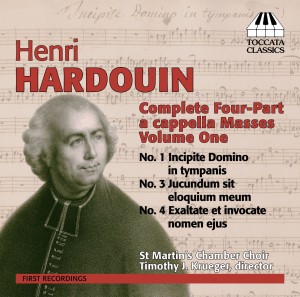
Henri Hardouin: Complete Four-Part a cappella Masses, Volume One
Henri Hardouin (1727-1808) was a chorister in Rheims Cathedral, rising swiftly through the ranks to become maître de chapelle — until the French Revolution disbanded religious establishments. As a priest he was in potential danger and seems to have gone into hiding until, in 1794, the death of Robespierre allowed him to resume his duties. Hardouin's six four-part masses, published in 1772, are unusual for their time in being a cappella, and they enjoyed wide circulation in pre-Revolutionary France. Since then they have been roundly neglected — an omission this two-CD survey intends to rectify.
St. Martin’s Chamber Choir
Timothy J. Krueger, conductor
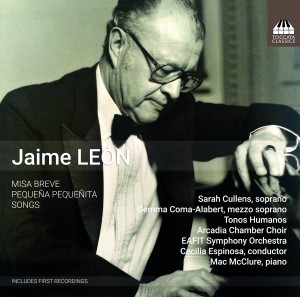
Jaime León: Vocal Music
Born in 1921, Jaime León is now the Grand Old Man of Colombian music. A vital figure in the development of Colombian art-music, León has been pianist (he is a grand-student of Clara Schumann), conductor, teacher, administrator and composer. His Misa breve has an innocent sincerity reminiscent of Poulenc's religious music, and although the word-setting in his songs is subtle and imaginative, they have the same melodic immediacy and uncomplicated appeal.
Sarah Cullens, soprano; Gemma Coma-Alabert, mezzo soprano; Tonos Humanos; Arcadia Chamber Choir; EAFIT Symphony Orchestra; Cecilia Espinosa, conductor; Mac McClure, piano
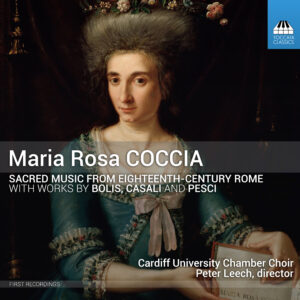
Maria Rosa Coccia: Sacred Music from 18th Century Rome
The Roman Maria Rosa Coccia (1759–1833) was a musical phenomenon of almost Mozartian precocity, becoming the first female composer to be awarded the professional distinction of maestra di cappella – at the age of fifteen. But the church could not contemplate the idea of a woman in charge of the music-making in a religious establishment, and so she hit a stained-glass ceiling; she seems to have given up composition in the mid-1780s, not yet 30. The freshness and buoyancy of her writing up to that point give an indication of what might have been.
Cardiff University Chamber Choir
Peter Leech, director
Robert Court, chamber organ
Manuel Cardoso: Complete Masses, Volume One
Manuel Cardoso (1566–1650) was one of the most important composers of the golden age of Portuguese polyphony around the turn of the seventeenth century. But history has not been kind to him: the 1755 Lisbon earthquake that ruined the Convento do Carmo, where he spent most of his working life, also resulted in the loss of the only attested image of the composer and a good deal of his music – and much of that which survived has been neglected, his Masses included. This series will shed long-overdue light on these forgotten masterpieces, beginning with two ‘parody’ Masses, so called because they are based on existing music, in this instance two Palestrina motets.
The Choir of the Carmelite Priory, London
Simon Lloyd, director
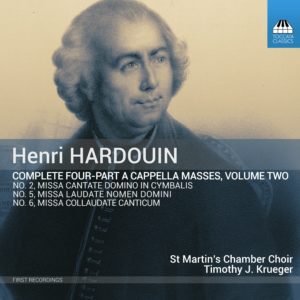
Henri Hardouin: Complete Four-Part Masses, Volume Two
Henri Hardouin (1727–1808) was a chorister in Rheims Cathedral, rising swiftly through the ranks to become maître de chapelle – until the French Revolution disbanded religious establishments. As a priest he was in potential danger and seems to have gone into hiding until, in 1794, the death of Robespierre allowed him to resume his duties. Hardouin’s six four-part masses, published in 1772, are unusual for their time in being a cappella, and they enjoyed wide circulation in pre-Revolutionary France. Since then they have been roundly neglected – an omission this first complete recording intends to rectify.
St Martin’s Chamber Choir
Timothy J. Krueger, director
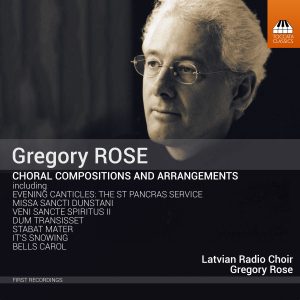
Gregory Rose: Choral Compositions and Arrangements
Gregory Rose (b. 1948) absorbed the English choral tradition from his father, the Oxford conductor and composer Bernard Rose, expanding that inheritance with the techniques of European and American modernism, acquired in part during his own conducting career. This conspectus of over four decades of choral music presents a vivid combination of original compositions and agreeable arrangements, sung here with exultant virtuosity by one of Europe’s leading choirs, conducted by Gregory Rose himself.
Latvian Radio Choir
Gregory Rose, conductor
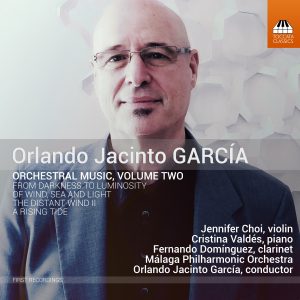
Orlando Jacinto García: Orchestral Music, Volume Two
Born in Havana in 1954, the Miami-based Orlando Jacinto García studied with Morton Feldman and has inherited some of Feldman’s concerns: his music likewise evolves gradually over slow-moving spans of time – here and there with an echo of West Coast minimalism. Like the still surface of the sea, the works on this album (three of them concertante pieces for virtuoso soloists) mirror the unhurried movement of natural phenomena, often in textures of considerable delicacy – and occasionally hinting at larger forces behind the apparent stasis.
Jennifer Choi, violin (track 1)
Cristina Valdés, piano (track 2)
Fernando Domínguez, clarinet (track 3)
Málaga Philharmonic Orchestra
Orlando Jacinto García, conductor
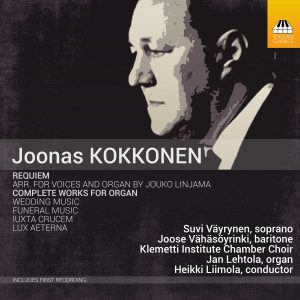
Joonas Kokkonen: Requiem; Complete Works for Organ
The music of Joonas Kokkonen (1921–96), one of the most important Finnish composers after Sibelius, radiates warmth and light. His limited output is largely introvert in character but also contains moments of grandeur and rhythmic energy. Kokkonen’s Requiem (1980–81), written in memory of his first wife, is both a powerful choral symphony and a tender, moving embodiment of consolation. Originally scored for large orchestra, the Requiem is heard here in a new version for organ intended to bring the work within the reach of smaller forces. This first recording is complemented by the first complete recording of Kokkonen’s four works for solo organ.
Suvi Väyrynen, soprano Tracks 3, 4, 6, 8-11
Joose Vähäsöyrinki, baritone Tracks 3, 4, 6, 8-11
Klemetti Institute Chamber Choir Tracks 3-11
Jan Lehtola, organ of Paavalinkirkko, Helsinki
Heikki Liimola, conductor Tracks 3-11