Search Results for "D-Day Operations Manual Battle of Normandy" – Page 5
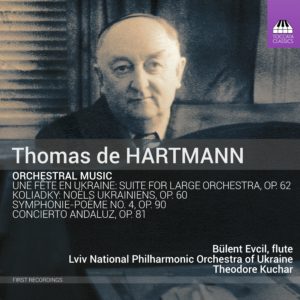
Thomas de Hartmann: Orchestral Music
Born in Ukraine, Thomas de Hartmann (1885–1956), a student of both Arensky and Taneyev, achieved fame as a composer in Russia in the early 1900s, and his concert music was later played by some of the major musicians of the day, primarily in Paris. Since his death, he has been remembered mainly for his association with the Caucasian mystic G. I. Gurdjieff, whom he met in 1916, and his output for the concert hall has fallen into obscurity. The four works receiving their first recordings here reveal a major late-Romantic voice, downstream from Tchaikovsky, contemporary with Rachmaninov, and alert to the discoveries of Stravinsky and Prokofiev
Bülent Evcil, flute (Track 11-13)
Lviv National Philharmonic Orchestra of Ukraine
Theodore Kuchar, conductor
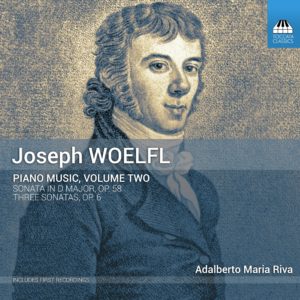
Joseph Woelfl: Piano Music, Volume Two
Joseph Woelfl (1773–1812), a friend of the Mozart family from childhood, was one of the best-known musicians of his day: he was regarded as a rival of Beethoven in Vienna and a worthy successor to Haydn in the musical life of London. His late-Classical piano music sits between Mozart, Haydn and Clementi and looks forward to Schubert and Mendelssohn. This first-ever project to examine it in any detail hopes to rescue Woelfl’s once starry reputation from the folds of history. The three sonatas which open this second volume are dedicated ‘à Mr L. Van Beethoven’.
Adalberto Maria Riva, piano
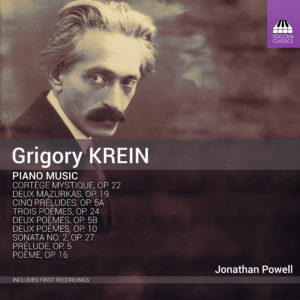
Grigory Krein: Piano Music
Grigory Krein (1879–1955), a member of an astonishing dynasty of Russian-Jewish musician-composers, was recognised by his contemporaries as one of the major composers of his day. His piano music charts a stylistic evolution from the early influence of Grieg, Reger (with whom he studied) and Debussy towards a more complex and chromatic language with harmonies that synthesise the sound-worlds of Skryabin and Szymanowski; there’s also an echo of the rhapsodic Celtic wildness of Bax. Indeed, all of these pieces are informed by a remarkable sense of energy – latent in some and given its head in others. .
Jonathan Powell, piano
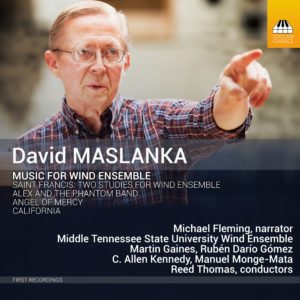
David Maslanka: Music For Wind Ensemble
Although the American composer David Maslanka (1943–2017) wrote in a wide range of genres, it is for his generous output of music for wind band that he is best known. Three of the works heard here are in effect symphonic poems, all three infused with that big-hearted sense of space found in the best of American music and the quiet dignity of those endless open landscapes, but also energised by a powerful sense of freewheeling drama. The fourth piece is a charming and hugely engaging presentation of the instruments of the symphonic wind ensemble, a latter-day Peter and the Wolf – likewise intended for children and similarly bubbling with good tunes. The composer himself was closely involved in the preparation for these recordings – the last major project involving his music before his death – which now stand as a testament to a man much-loved in American musical circles.
Middle Tennessee State University Wind Ensemble
Michael Fleming, narrator (Track 2)
Reed Thomas, conductor (Track 1)
Rubén Darío Gómez, conductor (Track 2)
C. Allen Kennedy, conductor (Track 3)
Manuel Monge-Mata, conductor (Track 4)
Martin Gaines, conductor (Track 5)
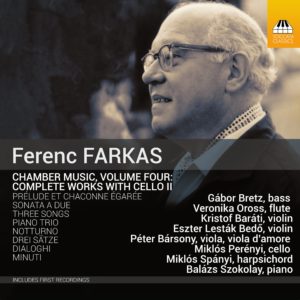
Ferenc Farkas: Chamber Music Volume Four: Works for Cello Volume Two
Toccata Classics continues its exploration of the music of the Hungarian composer Ferenc Farkas (1905–2000) with this second of two releases of his chamber works for cello. As with previous albums in this series, the music here features the characteristics that make Farkas’ music so appealing: catchy tunes, transparent textures, buoyant rhythms and a fondness for Baroque forms and folk-dances. Some of these pieces speak a tougher language that show Farkas to have been in touch with his times, but it is the infectious melodic appeal of most of the music here that carries the day.
Gábor Bretz, bass (Tracks 8–14, 18–20)
Veronika Oross, flute (Tracks 3–5, 21–23)
Kristóf Baráti, violin (Tracks 1–2, 6–7, 24–26)
Eszter Lesták Bedő, violin (Tracks 6–7)
Péter Bársony, viola (Tracks 1–2) , viola d’amore (Tracks 6–7)
Miklós Perényi, cello
Miklós Spányi, harpsichord (Tracks 3–5)
Balázs Szokolay, piano (Tracks 24–26)
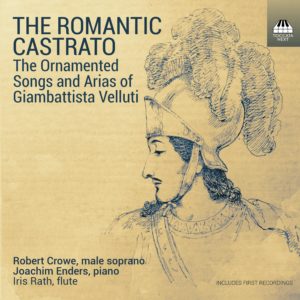
The Romantic Castrato
Giovanni Battista Velluti (1780–1861) was one of the last of the larger-than-life castrati who had dominated operatic life in the seventeenth and eighteenth centuries. Velluti, though, spent his career almost entirely in the Romantic era, singing the music of his day. His style of ornamentation attracted widespread admiration and set the standard for the prime donne who were emerging as the stars of their age in operas by such composers as Rossini, Bellini and Donizetti. Here the American male soprano Robert Crowe recreates Velluti’s extraordinary sound-world, in a recording that helps explain why such diverse luminaries as Stendhal, Mary Shelley and the Duke of Wellington admired Velluti as one of the most accomplished and inventive singers of his time.
Robert Crowe, male soprano
Iris Rath, flute (Track 21)
Joachim Enders, piano
ALL EXCEPT * FIRST RECORDINGS
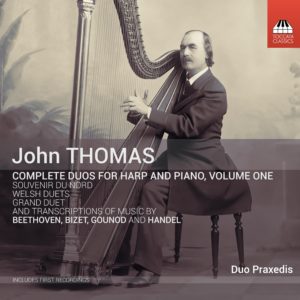
John THOMAS: Complete Duos for Harp and Piano, Volume One
Harpist to Queen Victoria, the Welsh composer John Thomas (1826–1913) was also a prolific composer for his own instrument, writing works both for solo harp and for duos of two harps or harp and piano – a combination where the different sounds of the two instruments enhances the clarity of the texture. Thomas’ original works use the elegant Romantic style of his own day, but he often drew on Welsh folksong for his inspiration and also left a generous legacy of transcriptions, especially of operatic favourites
Duo Praxedis: Praxedis Hug-Rütti (harp); Praxedis Geneviève Hug (piano)
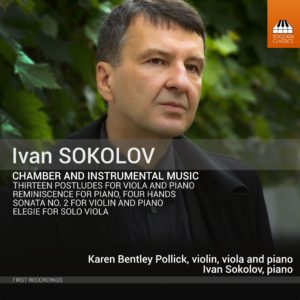
Ivan Sokolov: Chamber and Instrumental Music
Ivan Sokolov, born in Moscow in 1960, has made his mark both as composer and as pianist. His early compositions were avant-gardist, but he eventually rejected radicality in favour of a more traditional musical language, one with its roots in Tchaikovsky, Glazunov and Rachmaninov, flavoured, perhaps, with a hint of Shostakovich. Most of the works here were composed within the last few years and are couched in the unforced lyricism of his latter-day Romanticism.
Karen Bentley Pollick, violin, viola and piano
Ivan Sokolov, piano
First recordings
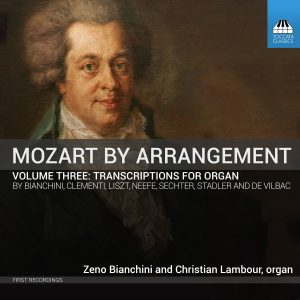
MOZART BY ARRANGEMENT: Volume Three: Transcriptions for Organ
Until the advent of recordings, the way you got to know the music of the masters was to play them yourself. The expansion of domestic music-making at the beginning of the nineteenth century generated a huge market for arrangements, most of them for piano solo or duet. Mozart was an especial favourite, and this programme extends the basic premise by adapting some of those arrangements for organ, as well as presenting some contemporary arrangements and completions, recorded on an organ from Mozart’s own day.
Zeno Bianchini (Tracks 5–7, 13, 14, 17); primo (Tracks 1–4, 9–12, 15, 16); secondo (Tracks 8, 18)
Christian Lambour, primo (Tracks 8, 18); secondo (Tracks 1–4, 9–12, 15, 16)
Organ of the former Benedictine Abbey of Neu St Johann in St Gallen Canton, Switzerland
FIRST RECORDINGS
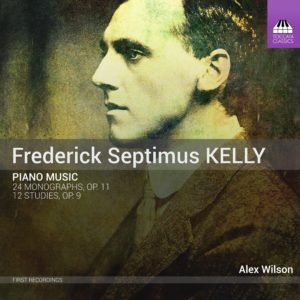
Frederick Septimus Kelly: Piano Music
Frederick Septimus Kelly, born in Sydney in 1881, was on the way to becoming one of Australia’s most important early composers when he was killed during the Battle of the Somme in 1916. His Twelve Studies and 24 Monographs are the most significant contributions to the Romantic piano literature by any Australian, although they have never been recorded in their entirety before now. The influence of Chopin and Skryabin is plain to hear, although the pastoral echoes of the gentler pieces suggest an affinity with his English contemporaries – men like Elgar, Ireland and Vaughan Williams – and the wild sweep of the more passionate numbers points to Kelly’s familiarity with the music of Brahms and Schumann. Each piece, though a ‘miniature’, contains a world of feeling and emotional resonance, suggesting that Kelly stood on the threshold of greatness.
Alex Wilson, piano
First recordings
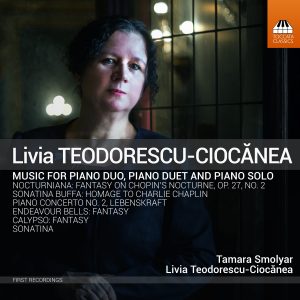
Livia Teodorescu-Ciocănea: Piano Music
Piano music forms a large part of the output of the Romanian composer Livia Teodorescu-Ciocănea (b. 1959), as you would expect of someone who has been playing the instrument since she was four. This first album of her music reveals a latter-day Impressionist, sensitive to half-light and petal-delicate tonal colour – but she can also generate powerful surges of energy, and her musical portrait of Charlie Chaplin testifies to an impish sense of humour.
Tamara Smolyar, piano solo (Tracks 1, 3-4, 8) and piano primo (Tracks 2, 5-7, 9-11)
Livia Teodorescu-Ciocănea, piano secondo (Tracks 2, 5-7, 9-11)
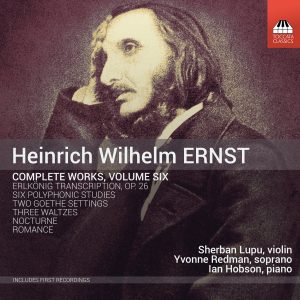
Heinrich Wilhelm Ernst: Complete Works, Volume Six
Heinrich Wilhelm Ernst (1812–65) was one of the leading musicians of his day, a friend of Berlioz, Chopin, Liszt and Mendelssohn, and for Joseph Joachim ‘the greatest violinist I ever heard’. This sixth album – in a series of seven presenting all his compositions for the first time – begins and ends with some of the most difficult music for solo violin ever composed: Ernst’s Six Polyphonic Studies and his transcription of Schubert’s song, Der Erlkönig. Between them comes less familiar fare: five Schubertian piano pieces, and two settings of Goethe.
Sherban Lupu, violin Tracks 1-12, 20
Yvonne Redman, soprano Tracks 18-19
Ian Hobson, piano Tracks 13-19
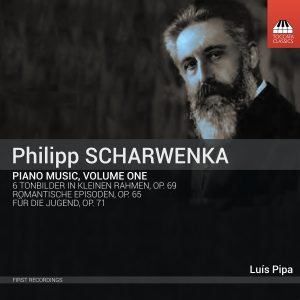
Philipp SCHARWENKA: Piano Music, Volume One
As composer, pianist and educationalist, the Prussian Philipp Scharwenka (1847–1917) was one of the most highly respected musicians of his day, although his star faded soon after his death. His music – more conservative and classical in orientation than that of his pianist-composer brother, Xaver – sits somewhere between Chopin and Brahms, with echoes of Schubert and Schumann. This first instalment of a survey of his piano music is intended to put these immediately attractive works before the public once again – for the first time in over a century.
Luís Pipa, piano
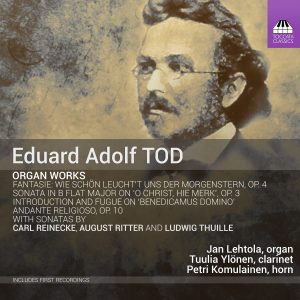
Eduard Adolf Tod: Organ Works
In his short life (1839–72) Eduard Adolf Tod garnered a reputation as one of the finest organists of the day: Liszt praised his playing, and he gave a recital in the Royal Albert Hall in the very year of its opening. Most of Tod’s handful of works for the organ – solo and as a duo partner – have not been recorded before; here they are joined by three other little-known German organ sonatas to give an overview of the genre as it evolved from its well-behaved Mendelssohnian origins into late-Romantic grandeur.
Jan Lehtola, organ of St John’s Church, Helsinki
Tuulia Ylönen, clarinet (Track 7)
Petri Komulainen, horn (Track 13)
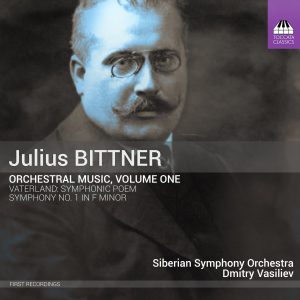
Julius BITTNER: Orchestral Music, Volume One
The name of the Austrian composer Julius Bittner (1874–1939) has been almost entirely lost from view, and yet he was one of the most successful composers of opera and operetta of his day, a mainstay of musical Vienna. Unusually, Bittner was also a practising lawyer; more unusually still, he was a double amputee, the result of the ravages of diabetes. None of his orchestral music has been recorded before – astonishingly, given the quality of the two works presented here. Vaterland is an expansive, Lisztian symphonic poem written on a patriotic impulse early in the First World War; and Bittner’s ambitious First Symphony, which has its starting point in Brahms and Bruckner, is a major piece of late- Romantic musical architecture, both tuneful and grandiose.
Siberian Symphony Orchestra
Dmitry Vasiliev, conductor
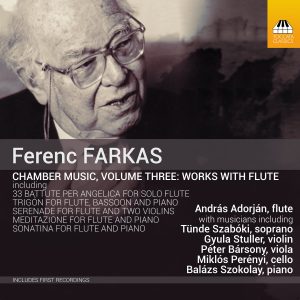
Ferenc Farkas: Chamber Music, Volume Three – Works with Flute
This tenth release in the Toccata Classics exploration of the music of Ferenc Farkas (1905–2000) puts his chamber music with flute in the spotlight. As with previous albums in this series, the music here highlights the characteristics that make Farkas’ music so appealing: catchy tunes, transparent textures, buoyant rhythms, a fondness for Baroque forms and a taste for the folk-music of his native Hungary that marks him out as a true successor to Bartók and Kodály. Some of these pieces speak a tougher language that shows Farkas to have been in touch with his times, but it is the infectious melodic appeal of most of the music here that carries the day.
András Adorján, flute
Tünde Szabóki,soprano (Tracks 9–10, 15–17, 25–27)
Lajos Rozman, clarinet (Tracks 11 – 13)
Andrea Horváth, bassoon (Tracks 11–13, 33–35)
Gergely Kovács, horn (Tracks 28 – 30)
Gyula Stuller, violin (Tracks 4 – 8, 19 – 24)
Márta Abrahám, violin (Tracks 4 – 8)
Péter Bársony, viola (Tracks 15–17, 25–30)
Miklós Perényi, cello (Tracks 15 – 17, 19 – 24)
András Csáki, guitar (Tracks 25 – 27, 31 – 32)
Balázs Szokolay, piano (Tracks 1 – 3, 33 – 35)