Search Results for "D-Day Operations Manual Battle of Normandy" – Page 4
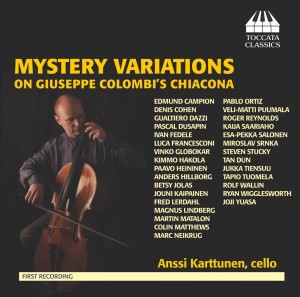
Mystery Variations on Giuseppe Colombi’s Chiacona
To celebrate the 50th birthday of the Finnish cellist Anssi Karttunen in 2010 his wife, Muriel von Braun, and colleague and countrywoman Kaija Saariaho wrote to a number of composers with whose music Karttunen had been working, asking each to write a variation on the Chiacona per basso solo by the Italian composer Giuseppe Colombi (1635-94) — perhaps the earliest work in the history of the cello. The composers were not told who else was involved in the project, and Karttunen agreed to perform the music before he had seen it — hence the title, Mystery Variations. These 31 variations thus link the very beginning of the cello repertoire with music by some of the most distinguished composers of the present day and, with their distant echo of Beethoven's 32 'Diabelli' Variations, provide a showcase for the extraordinary resourcefulness of contemporary cello technique.
Anssi Karttunen, cello
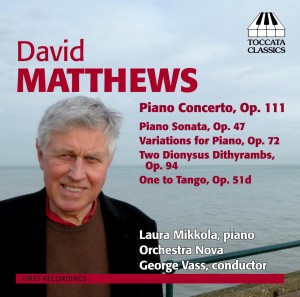
David Matthews: Music for Piano
In his piano music, as in his symphonies and string quartets, the English composer David Matthews (b. 1943) marries the idiom of classical tradition with that of his own day. His 2009 Piano Concerto, Mozartian in spirit, contains both a tango and a blues; his Piano Sonata of 1989 includes jazz elements, and his 1997 Variations feature both blues and a homage to Beethoven. The moods range from contemplative introspection to fiery, rhythmic energy, captured here in feisty performances by the Finnish pianist Laura Mikkola, whom the composer describes as 'a marvellous exponent of my music'.
Laura Mikkola, piano
Orchestra Nova, orchestra
George Vass, conductor
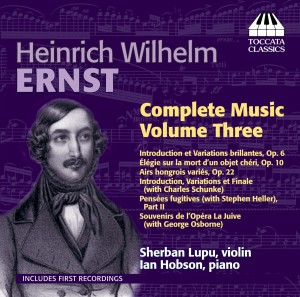
Heinrich Wilhelm Ernst: Complete Music, Volume Three
Heinrich Wilhelm Ernst (1812-65) was one of the leading musicians of his day, a friend of Berlioz, Chopin, Liszt and Mendelssohn, and for Joseph Joachim 'the greatest violinist I ever heard'. But the popular encore pieces by which Ernst is remembered today represent only a fraction of his output. This third CD — in a series of seven presenting all his compositions for the first time — shows the full range of his creativity and charm. The Élégie sur la mort d'un objet chéri is written in his most moving and melancholy vein, and the Airs hongrois variés push the virtuoso violin to its absolute limits. Between these extremes lie the lyricism of the Pensées fugitives, the inventiveness of his treatment of two Halévy operas and the high spirits of his fantasy on a Strauss waltz.
Sherban Lupu, violin
Ian Hobson, piano
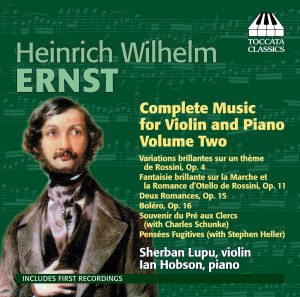
Heinrich Wilhelm Ernst: Complete Music for Violin and Piano, Volume Two
Heinrich Wilhelm Ernst (1812-65) was one of the leading musicians of his day, a friend of Berlioz, Chopin, Liszt and Mendelssohn, and for Joseph Joachim 'the greatest violinist I ever heard'. But the popular encore pieces by which Ernst is remembered today represent only a fraction of his output. This second CD — in a series of six presenting his complete violin works for the first time — combines brilliant display and expressive melody: the Otello Fantasy and Rossini Variations show Ernst developing Paganini's inheritance, and the Boléro, Two Romances and Pensées fugitives show why he was such a favourite in Parisian salons.
Sherban Lupu, violin
Ian Hobson, piano
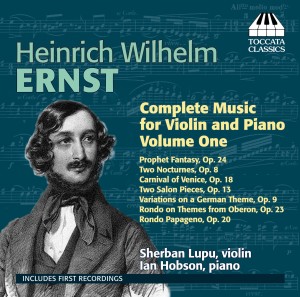
Heinrich Wilhelm Ernst: Complete Music for Violin and Piano, Volume One
Heinrich Wilhelm Ernst (1812-65) was one of the leading musicians of his day, a friend of Berlioz, Chopin, Liszt and Mendelssohn, and for Joseph Joachim 'the greatest violinist I ever heard'. But the popular encore pieces by which Ernst is remembered today represent only a fraction of his output. This series of six CDs presents his complete violin works for the first time, revealing one of the instrument's most accomplished and memorable composers. The first disc shows him in a range of moods, from the mystery and grandeur of the Prophet Fantasy and the Chopinesque poetry of the Two Nocturnes to the bizarre whimsy of The Carnival of Venice and infectious high spirits of the Rondo Papageno — the nineteenth-century virtuoso violin both in introspective melancholy and at its most dazzlingly flamboyant.
Sherban Lupu, violin
Ian Hobson, piano

Music from Malmö, Volume 1: Three New Concertos for Bass Clarinet
Concertos for bass clarinet are rare enough; this album brings three new ones to swell those limited ranks. It presents the fruit of a series of interlocking international co-operations, between orchestras in Sweden, the UK and USA, with American, British and Swedish composers and, at the heart of the undertaking, the bass clarinettist of the Malmö Symphony Orchestra, Carl-Johan Stjernström. All three composers exploit the huge range of colours the bass clarinet can offer, in music that ranges from the fierce and dramatic to the sunny and easy-going. The album also inaugurates a Toccata Next series providing a platform for the musicians of the Malmö Symphony Orchestra.
Carl Johan Stjernström, bass clarinet
Benjamin Schmid, violin
Musica Vitae
Malmö Symphony Orchestra
Joachim Gustafsson, conductor
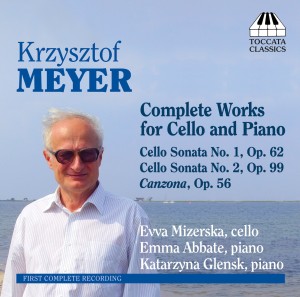
Krzysztof Meyer: Complete Works for Cello and Piano
Krzysztof Meyer, born in Kraków in 1943 and a student of Penderecki, Lutosławski and Nadia Boulanger, is one of the leading Polish composers of the day. His music marries a powerful sense of drama with a long-breathed lyricism in a largely tonal framework, placing him downstream from Shostakovich, who was a friend and supporter of the young composer. Of his two cello sonatas (1983 and 2004) and Canzona (1981), Meyer writes, 'I wanted the melody to be predominant — not a post-Romantic cantilena but absolutely contemporary. And the cello, like no other instrument, is perfect for that'.
Evva Mizerska, cello
Emma Abbate, piano
Katarzyna Glensk, piano
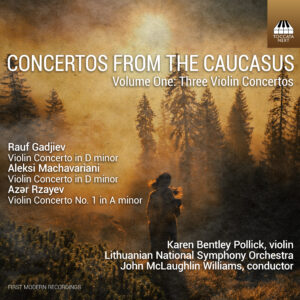
Concertos from the Caucasus, Volume One: Violin Concertos
In the early years of the twentieth century a first wave of composers in the Caucasus laid down the basis of their national schools by grafting the outlines of western classical music onto local folk traditions. By mid-century a second generation took up the challenge more thoroughly, their compositions confidently handling the large forms of the concert hall, though still drawing on regional idioms. The Soviet orthodoxy of the day expected its composers to abide by the rules, but the three composers heard here – two Azeris and a Georgian, all young men when they wrote the violin concertos on this album – brought something fresh and individual to the task, marrying east and west, form and freedom, tradition and originality.
Karen Bentley Pollick, violin
Lithuanian National Symphony Orchestra
John McLaughlin Williams, conductor
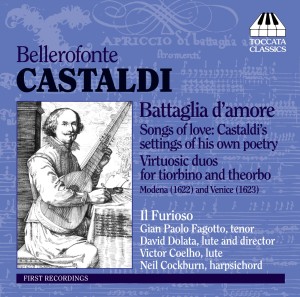
Bellerofonte Castaldi: Battaglia d’amore
The Modenese firebrand, lute virtuoso, composer, poet and artist Bellerofonte Castaldi (1580-1649) — the Bob Dylan and Leonard Cohen of his day — set his own poems to his own music in a lyrical style that captured the dynamism of the emerging Baroque. Castaldi's dance-songs and madrigals for one, two or more voices — drawn from his monody collection Primo mazzetto (Venice, 1623) and the manuscript Modena 239 (c. 1670) — framed his hopes, dreams and disappointments with fresh and unforgettable melodies. The duos for theorbo and tiorbino, a tiny theorbo that Castaldi himself invented, are contrapuntal showpieces from his Capricci a due stromenti (Modena, 1622), a highly unusual collection of theorbo solos and duos, songs and poetry that he himself engraved and decorated with his own freehand artwork.
Gian Paolo Fagotto, tenor
David Dolata, lute, director
Victor Coelho, lute
Neil Cockburn, harpsichord
Il-Furioso, ensemble
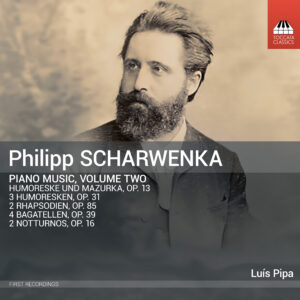
Philipp Scharwenka: Piano Music, Volume Two
As composer, pianist and educationalist, the Prussian Philipp Scharwenka (1847–1917) was one of most highly respected musicians of his day, although his star faded soon after his death. His music – more conservative and classical in orientation than that of his pianistcomposer brother, Xaver – sits somewhere between Chopin and Brahms, with echoes of Schubert and Schumann. This second instalment of a survey of his piano music is intended to put these immediately attractive works before the public once again – for the first time in over a century.
Luís Pipa, piano
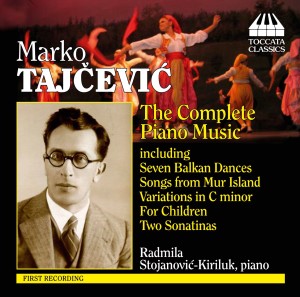
Marko Tajčević: The Complete Piano Music
Tajčević (1900-84) was the leading Serbian composer of his day. His feisty piano music, recorded here in its entirety for the first time, takes its inspiration from Balkan folk dances, blending irregular rhythms, modal harmonies and catchy tunes to produce a bouquet of sparkling miniatures, close in spirit to Bartók’s folk-inspired piano pieces and bursting with energy and wit.
Radmila Stojanović-Kiriluk, piano
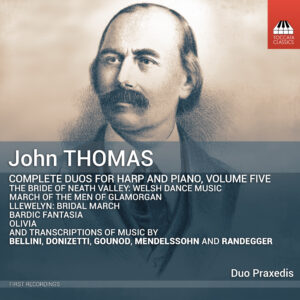
John Thomas: Complete Duos for Harp and Piano, Volume Five
The Welshman John Thomas (1826–1913), harpist to Queen Victoria, wrote prolifically for his own instrument, both for solo harp and for duos of two harps or harp and piano – a combination where the different sounds of the two instruments enhance the clarity of the texture. Thomas’ original works use the elegant Romantic style of his own day, but he often drew on Welsh folksong for his inspiration and left a generous legacy of transcriptions, especially of operatic favourites. Although some of his music was intended for the Victorian drawing room, other pieces require a virtuoso technique – and all of it has a thoroughly engaging melodic appeal. This fifth album of his duets for harp and piano ends a series that has seen the revival of music unheard for over a century and a half.
Duo Praxedis
Praxedis Hug-Rütti, harp
Praxedis Geneviève Hug, piano
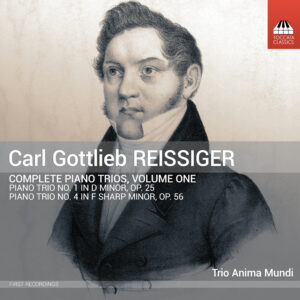
Carl Gottlieb Reissiger: Complete Piano Trios, Volume One
In his day the now-forgotten Carl Gottlieb Reissiger (1798–1859) was highly esteemed, both as conductor and composer; indeed, his presence in Dresden from 1826 made it one of the main operatic centres in Germany. He wrote nine operas himself, as well as a huge quantity of vocal music (including at least twelve Masses), and his large output of chamber music boasts no fewer than 27 piano trios. These two early exemplars in this first-ever complete recorded cycle of those trios have a Mendelssohnian elegance and clarity, deepened here and there by a touch of Beethovenian pathos. Schumann was an enthusiast: ‘When I think of Reissiger’s trios, the words lovely and jewel-like come to mind. These choice and lovely works remind one of a chain of flowers. […] His music never fatigues the ear, but holds our attention to the very end’.
Trio Anima Mundi
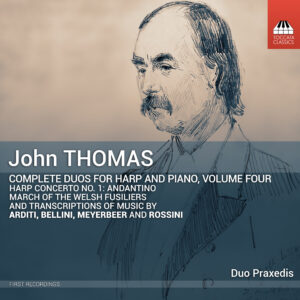
John Thomas: Complete Duos for Harp and Piano, Volume Four
Harpist to Queen Victoria, the Welsh composer John Thomas (1826–1913) also wrote prolifically for his own instrument, both for solo harp and for duos of two harps or harp and piano – a combination where the different sounds of the two instruments enhance the clarity of the texture. Thomas’ original works use the elegant Romantic style of his own day, but he often drew on Welsh folksong for his inspiration and also left a generous legacy of transcriptions, especially of operatic favourites. Although some of his music was intended for the Victorian drawing room, other pieces require a virtuoso technique – and all of it has a thoroughly engaging melodic appeal.
Duo Praxedis
Praxedis Hug-Rütti, harp
Praxedis Geneviève Hug, piano
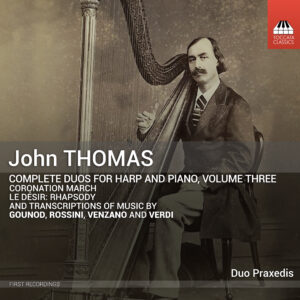
John Thomas: Complete Duos for Harp and Piano, Volume Three
Harpist to Queen Victoria, the Welsh composer John Thomas (1826–1913) also wrote prolifically for his own instrument, both for solo harp and for duos of two harps or harp and piano – a combination where the different sounds of the two instruments enhance the clarity of the texture. Thomas’ original works use the elegant Romantic style of his own day, but he also left a generous legacy of transcriptions, especially of operatic favourites. Although some of his music was intended for the Victorian drawing room, other pieces require a virtuoso technique – and all of it has a thoroughly engaging melodic appeal.
Duo Praxedis
Praxedis Hug-Rütti, harp
Praxedis Geneviève Hug, piano
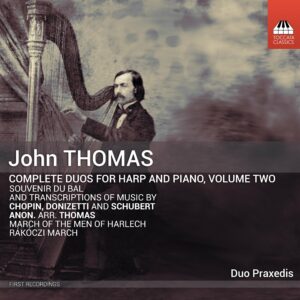
John Thomas: Complete Duos for Harp and Piano, Volume Two
Harpist to Queen Victoria, the Welsh composer John Thomas (1826–1913) wrote prolifically for his own instrument, both for solo harp and for duos of two harps or harp and piano – a combination where the different sounds of the two instruments enhance the clarity of the texture. Thomas’ own compositions use the elegant Romantic style of his own day, but he also left a generous legacy of transcriptions, with no fewer than fourteen Schubert songs recorded on this second volume of his complete duos for harp and piano. Although some of his music was intended for the Victorian drawing room, other pieces require a virtuoso technique – and all of it has a thoroughly engaging melodic appeal.
Duo Praxedis
Praxedis Hug-Rütti, harp
Praxedis Geneviève Hug, piano