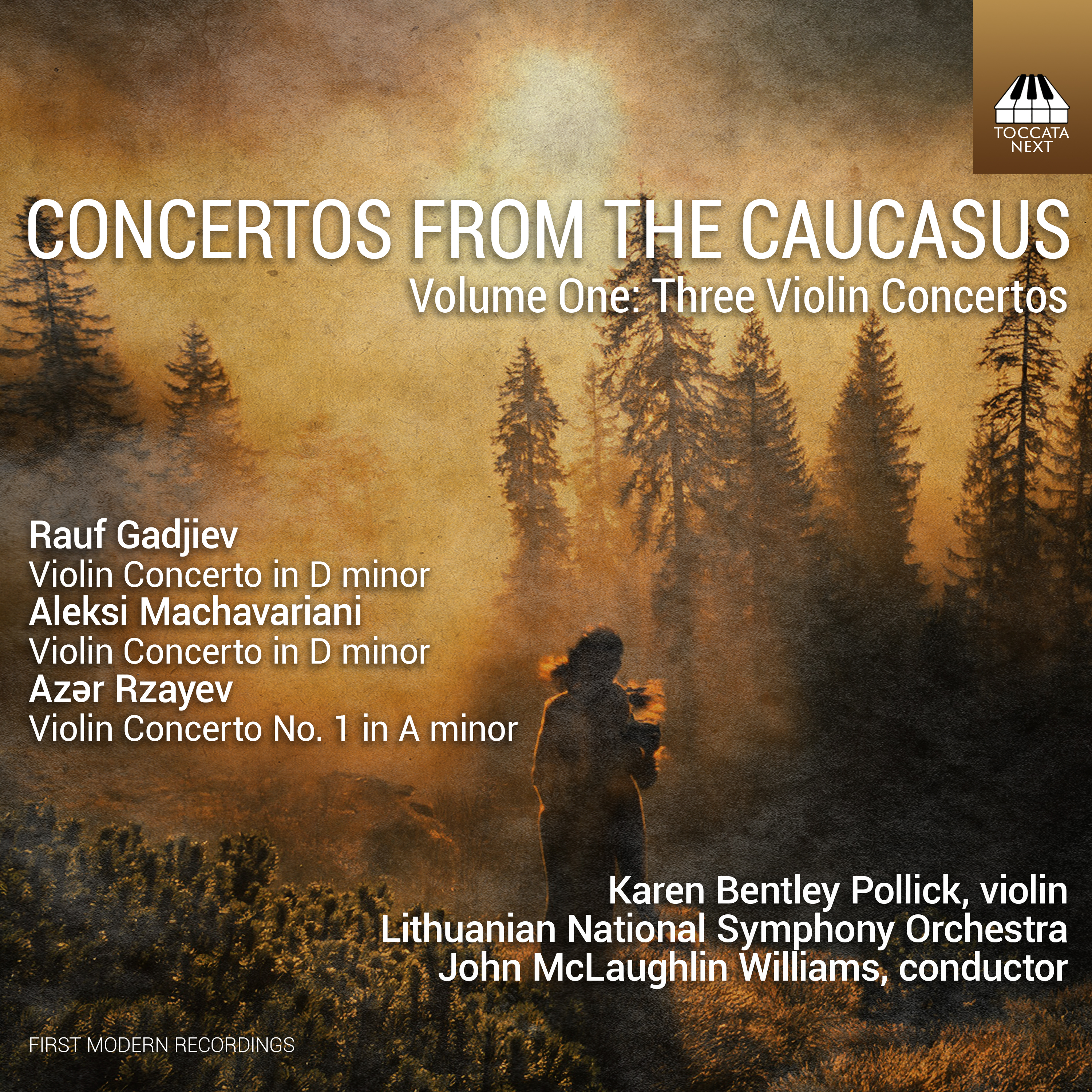
Concertos from the Caucasus, Volume One: Violin Concertos
In the early years of the twentieth century a first wave of composers in the Caucasus laid down the basis of their national schools by grafting the outlines of western classical music onto local folk traditions. By mid-century a second generation took up the challenge more thoroughly, their compositions confidently handling the large forms of the concert hall, though still drawing on regional idioms. The Soviet orthodoxy of the day expected its composers to abide by the rules, but the three composers heard here – two Azeris and a Georgian, all young men when they wrote the violin concertos on this album – brought something fresh and individual to the task, marrying east and west, form and freedom, tradition and originality.
Karen Bentley Pollick, violin
Lithuanian National Symphony Orchestra
John McLaughlin Williams, conductor
Aleksi Machavariani (1913-1995)
Violin Concerto in D Minor (1949) (35:04)
- I. Allegro (16:00)
- II. Andante sostenuto (10:04)
- III. Allegro vivo (9:00)
Azәr Rzayev (1930-2015)
Violin Concerto No. 1 in A Minor (1957) (26:55)
- I. Allegretto (12:53)
- II. Largo (6:53)
- III. Allegro (7:09)
Rauf Gadjiev (1922-1995)
Violin Concerto in D Minor (1952) (22:08)
- I. Allegro (9:28)
- II. Andante sostenuto (628)
- III. Allegro con brio (6:12)
First Modern Recordings

Pizzicato :
Immediately communicative and melodic character [of the works] makes them worth rescuing from oblivion. […] Because of their folk passion and energy as well as poetic passages, [these works] offer exciting listening approaches with an Eastern European Asian flair that is combined with great passion.
Violinist Karen Bentley Pollick presents these concertos with appropriate esprit. Technically, she succeeds in enhancing the musicality and special character of the works to such an extent that their essential characteristics become clear, ensuring that the qualities of the pieces can be experienced in modern sound technology.
With the Lithuanian National Symphony Orchestra and conductor John McLaughlin Williams, the soloist has an ensemble at her side that not only supports her interpretative approach, but also sets the necessary accents to emphasize the individual moods of the three pieces that can only be heard together with the orchestral landscape.
The extensive accompanying text provides an introduction to the life and work of the three composers, paying particular attention to the three concertos. The result is a worthwhile insight into forgotten works, including the technically clean realization.’
—Pizzicato
MusicWeb International :
‘[in Machavariani’s Concerto,] the soloist is pitched straight in and against the deftest of orchestration – light and refined – the solo violin negotiates a thread of expressive, terpsichorean figures, deeply lyric and romantic and full of folklore. […]
These mid-century concertos […] should appeal to those who admire the Khachaturian-Prokofiev axis with – here – a strong dose of ethnic colour and rhythms. They will certainly appreciate Karen Bentley Pollick’s fine performances with the Lithuanian National Symphony Orchestra under John McLaughlin Williams.’
—Jonathan Woolf, MusicWeb International
Fanfare :
‘Anyone who loves the Tchaikovsky Violin Concerto (which I do) will find the music here pleasurable and to their taste. […]
All the concertos here are in the standard three-movement (fast, slow, fast) format familiar from the Romantic era. They are all resolutely tonal, tuneful, and melodic. […] But just because it’s so retro doesn’t mean that it isn’t good. The pieces are all perfectly crafted by their composers and impeccably played by soloist Karen Bentley Pollick and the Lithuanian National Symphony under John McLaughlin Williams.
[…] this CD offers 84 minutes of warm, lovable, well-crafted music that pleases the ear, and if you like 19th-century violin concertos in general, you’ll like these even though they were written in the 20th century.’
—Mark Gabrish Conlan, Fanfare, March 2026
Fanfare :
‘This is exactly what Toccata (whether Classics, Next, or Books) excels at—finding music that simply should be heard no matter how obscure. And this is just volume one of Concertos from the Caucasus.’
—Colin Clarke, Fanfare, March 2026
Fanfare :
‘I found Machavariani’s Concerto (1949) a very effective and enjoyable essay in neo-Romanticism. […]
Karen Bentley Pollick proves to be a fine interpreter of these concertos. She has the technique to toss off the difficulties with ease, but far more important with this music, she has an excellent feel for the melodic line and an attractive tone. John McLaughlin Williams and the Lithuanian National Symphony provide solid support, the orchestra in good form. The sound projects a realistic concert hall perspective. […] Paul Conway’s notes are valuable, providing both historical background and extensive descriptions of each piece. […]
I enjoyed the disc, particularly the Machavariani piece.’
—Michael Vaillancourt, Fanfare, March 2026
Fanfare :
‘All three concertos were well received from a critical perspective, proved popular with audiences, and were recorded by Melodiya. Their neglect is more recent than that, and as this fine recording shows, unjustified. […]
On paper, then, three eminent composers and musical figures whose neglect since the early 1980s seems difficult to understand. That incomprehension becomes far more vivid once one hears the pieces themselves. Karen Bentley Pollick is the best possible advocate. She has a strikingly luminescent tone with real vibrancy and depth of feeling to her playing. Above all she is a superb communicator. We hear the individual voices of the composers clearly and winningly in all three concertos. In the Machavariani Concerto, she manifests a heart-stopping yearning in the middle movement Andante sostenuto, while authoritative in the rhetorical statements of the opening movement Allegro, and virtuosically alive to all of the ear-catching technical demands of the finale. She approaches the Rzayev with an apparently instinctive understanding of the composer’s sinuous lines, playing the weaving chromatic melodies of the first movement Allegretto with lyricism and flair. She again shows her reflective side in the Largo which follows, playing beautifully with the woodwind of the Lithuanian National Symphony Orchestra before launching with a rhythmic exuberance into the Allegro finale, whose dazzling coda she clearly relishes. The Gadjiev concerto shows its folk influences to delightful effect, and Pollick leans into their varied inflections with exquisite judgment: at times martial and introspective, melancholic and zestful, she is dazzling here, her account of the joyful Allegro con brio finale played with a real rhythmic snap. In each concerto, the orchestra under the impeccable direction of John McLaughlin Williams is with her every step of the way. Perhaps what is most remarkable to note of all the musicians involved—but particularly so in Pollick’s case—is that their playing exudes the sort of familiarity one might expect when hearing an account of one the Prokofiev or Shostakovich concertos. Yet one assumes these works were prepared with these recordings expressly in mind.
A really fine achievement, then, even by Toccata’s standards. I really hope that these performances, the first digital recordings of all three works, can be widely heard, a catalyst for further exploration. The liner notes by Paul Conway are exemplary. I’ve obviously drawn on them for this review to try and give a snapshot of the context, but his writing is a goldmine of learning and information which anybody interested in the period will snap up eagerly. I hope there is more to come from the music of this place and period.’
—Dominic Hartley, Fanfare, March 2026