Search Results for "2008年出生 2026年多大"
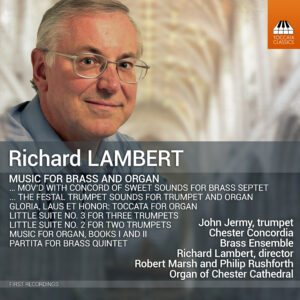
Richard Lambert: Music for Brass and Organ
Richard Lambert, born in Bath in the English West Country in 1951, grew up with the sounds of organ and brass among his earliest musical experiences: he played cornet and trumpet as a boy and was soon taking organ lessons in Bath Abbey. His own compositions for brass and organ – many of them written to mark special occasions in the lives of friends and acquaintances – range in mood from the tender and intimate to the bold and heraldic, in a language downstream from Walton and Poulenc.
Chester Concordia Brass Ensemble
Richard Lambert, director
Philip Rushforth and Robert Marsh, organ of the Chester Cathedral
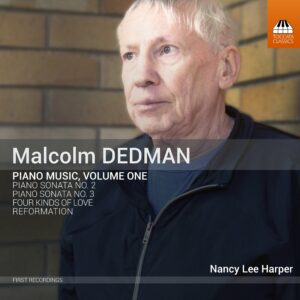
Malcolm Dedman: Piano Music, Volume One
A number of diverse influences have helped shape the musical language of Malcolm Dedman (born in London in 1948 but resident in provincial South Africa since 2007), among them Bartók and Messiaen, his Bahá’í Faith and, more recently, his new South African homeland. Points of contact with other composers can be heard, too, not least Debussy, Ravel, Barber and Ginastera. These piano works embody a wide range of moods, from gentle introspection to energetic, dissonant vigour.
Nancy Lee Harper, piano


George Enescu: The Unknown Enescu, Volume Two
Although Enescu gave opus numbers to only 33 of his works, he left an enormous number of pieces in varying stages of composition, from sketches and draft outlines to isolated movements and some scores that are almost complete. Working with a handful of composers and musicologists – fellow Romanians with specialist knowledge of Enescu’s style – the violinist Sherban Lupu has produced performing editions of a number of previously unknown works, heard here in the context of other Enescu rarities. One of these ‘rescued’ pieces, hiding behind the modest title of Caprice Roumain, is nothing less than a major violin concerto.
Sherban Lupu, violin
Ian Hobson, piano (Track 1), conductor (Tracks 8–11)
Viorela Ciucur, piano (Tracks 3–7)
Sinfonia da Camera (Tracks 8–11)
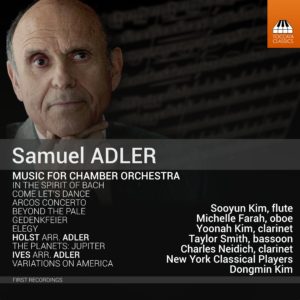
Samuel Adler: Music for Chamber Orchestra
The music of Samuel Adler – born in Mannheim in 1928 but long since one of the leading figures of American music – has its roots in the Neo-Classical clarity of composers like Copland and Hindemith, who were among his teachers. The works on this album arose from a range of impulses: a Neo-Baroque concerto grosso and a tribute to Bach encase a series of tributes to lost individuals and traditions; and two jeux d’esprit – Ives’ tongue-in-cheek Variations on America and Holst’s ‘Jupiter’ from The Planets – both bring jollity in Adler’s idiomatic arrangements for string orchestra.
Sooyun Kim, flute (Tracks 1–4)
Michelle Farah, oboe (Tracks 1–4)
Yoonah Kim, clarinet (Tracks 1–4)
Taylor Smith, bassoon (Tracks 1–4)
Charles Neidich, clarinet (Track 6)
New York Classical Players
Dongmin Kim, leader and conductor
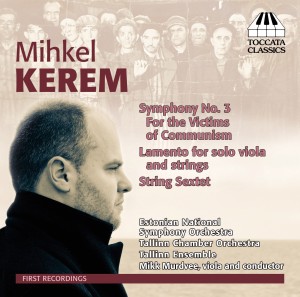
Mihkel Kerem: Orchestral and Chamber Music
The Estonian violinist Mihkel Kerem (born in Tallinn in 1981) is familiar as a performer in Britain as well as at home; he is also a prolific composer, with over one hundred works to his credit, three symphonies among them. The three-movement Third (2003) and the Lamento for viola and strings (2008-9) lie downstream from Shostakovich and Boris Tishchenko, whereas the String Sextet (2004), cast in a single half-hour span, has its musical starting-point and initial poetic impulse in Schoenberg's Verklärte Nacht but also manifests the polyphonic lyricism of Strauss' Metamorphosen. All three works are concerned with the expression of human emotions in music, in the Third Symphony and Lamento with the struggle of the individual voice against oppressive ideology.
Estonian National Symphony Orchestra, orchestra
Tallinn Chamber Orchestra, chamber orchestra
Tallinn Ensemble, ensemble
Mikk Murdvee, viola, conductor
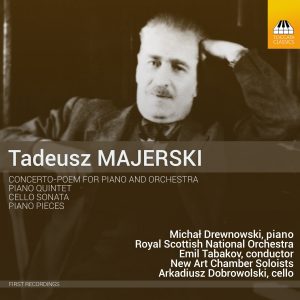
Tadeusz Majerski: Concerto-Poem and Other Works
The Polish pianist-composer Tadeusz Majerski (1888–1963), who spent his life in Lwów (now Lviv in Ukraine), has been entirely lost from sight. But he wrote some of the most interesting Polish music of his day, bringing together late-Romantic sensitivity and the modern outlook of the new age. This first album dedicated to his work presents one of his major scores, the rhapsodic Concerto-Poem for piano and orchestra, as well as two powerful chamber works and a number of representative piano miniatures.
Michał Drewnowski, piano
Royal Scottish National Orchestra (Track 1)
Emil Tabakov, conductor (Track 1)
New Art Chamber Soloists (Tracks 2–11)
Arkadiusz Dobrowolski, cello (Tracks 12-13)
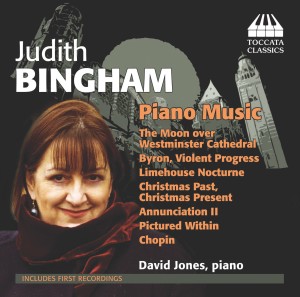
Judith Bingham: Piano Music
Judith Bingham (born in Nottingham in 1952 and London-based since 1970) spent several years as a member of the BBC Singers, which may help explain the lyricism of her music. But the works on this CD also reveals her strong response to poetry and to place, a keen instinct for drama, an ear for keyboard colour and a Busonian sense of space and atmosphere.
David Jones, piano
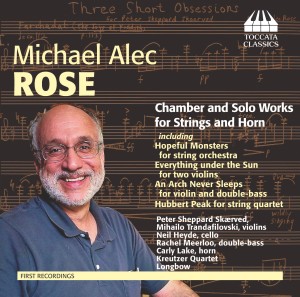
Michael Alec Rose: Chamber and Solo Works for Strings and Horn
In 2004 the American composer Michael Alec Rose (born in 1959 in Philadelphia) met the English violinist Peter Sheppard Skærved. That meeting sparked off a productive friendship: Rose has since written a number of works for Sheppard Skærved and his musician colleagues, pieces marked by striking emotional directness, balancing warm lyricism and mordant wit.
Michael Alec Rose, bell
Peter Sheppard Skærved, violin, director
Mihailo Trandafilovski, violin
Morgan Goff, viola
Neil Heyde, cello
Kreutzer Quartet, string quartet
Rachel Meerloo, double-bass
Carly Lake, horn
Longbow, ensemble
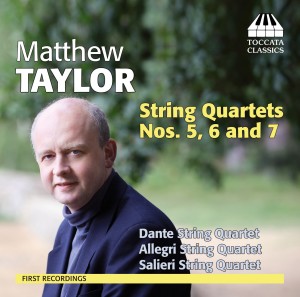
Matthew Taylor: String Quartets Nos. 5, 6 and 7
Matthew Taylor's sense of musical architecture — extending the symphonic tradition of Sibelius and Nielsen into the modern age — can be felt in his chamber music no less than in his orchestral output. Though his String Quartets Nos. 5, 6 and 7 were written in close succession, they are fundamentally different in design and feeling. Quartet No. 5 adopts a pacifying process as a volatile Allegro unfolds into a spacious fugue before easing into a delicate lullaby. The core of the Sixth Quartet is a Romanza which Taylor wrote for his wife on their wedding. And the Classical clarity of the Seventh Quartet pays tribute to Haydn and Mendelssohn, two composers whom Taylor much admires.
Dante String Quartet, string quartet
Allegri String Quartet, string quartet
Salieri String Quartet, string quartet

Singing Into Space: Spatially Conceived Music for Men’s Voices
The two composers heard on this album, Giovanni Gabrieli (1553–1612) and Giovanni Bonato (born in 1961) have more in common than their first names: both hail from the Veneto in north-east Italy – there is no documentation of Gabrieli’s birth, but he was probably Venetian, and Bonato was born in nearby Schio. Their music, too, is conceived in terms of its sound in space, with Gabrieli using the cori spezzati that sang from the opposing galleries of St Mark’s Basilica in Venice, and Bonato employing cori spazzializati to build a spatial dimension into the music itself. Juxtaposed, their styles offer a striking contrast, with Gabrieli’s bold declamations set against Bonato’s shifting, timeless suspensions.
Estonian National Male Choir
Mikk Üleoja, conductor
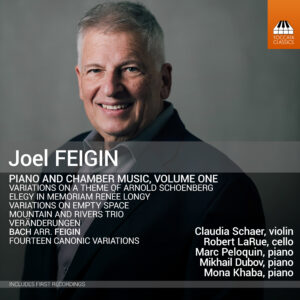
Joel Feigin: Piano and Chamber Music, Volume One
Over the past century or so, composers have tended to see themselves as either traditionalists or modernists. The music of Joel Feigin (born in New York in 1951) bridges both worlds, combining the resources of tonality and atonality with equal relish, naturally extending the styles of the recent past. Its freewheeling energy is often tempered by an elegant restraint, sometimes revealing the warm, humanist impulse behind his sound-world. This first volume of his piano and chamber music follows a lusty piano trio and a moving tribute to a much-missed teacher with four sets of variations, three by Feigin and one an arrangement of Bach, the composer who Feigin says is the root of all his music.
Claudia Schaer, violin
Robert LaRue, cello
Marc Peloquin, piano
Mikhail Dubov, piano
Mona Khaba, piano