Robin Stevens: Orchestral Music, Volume One
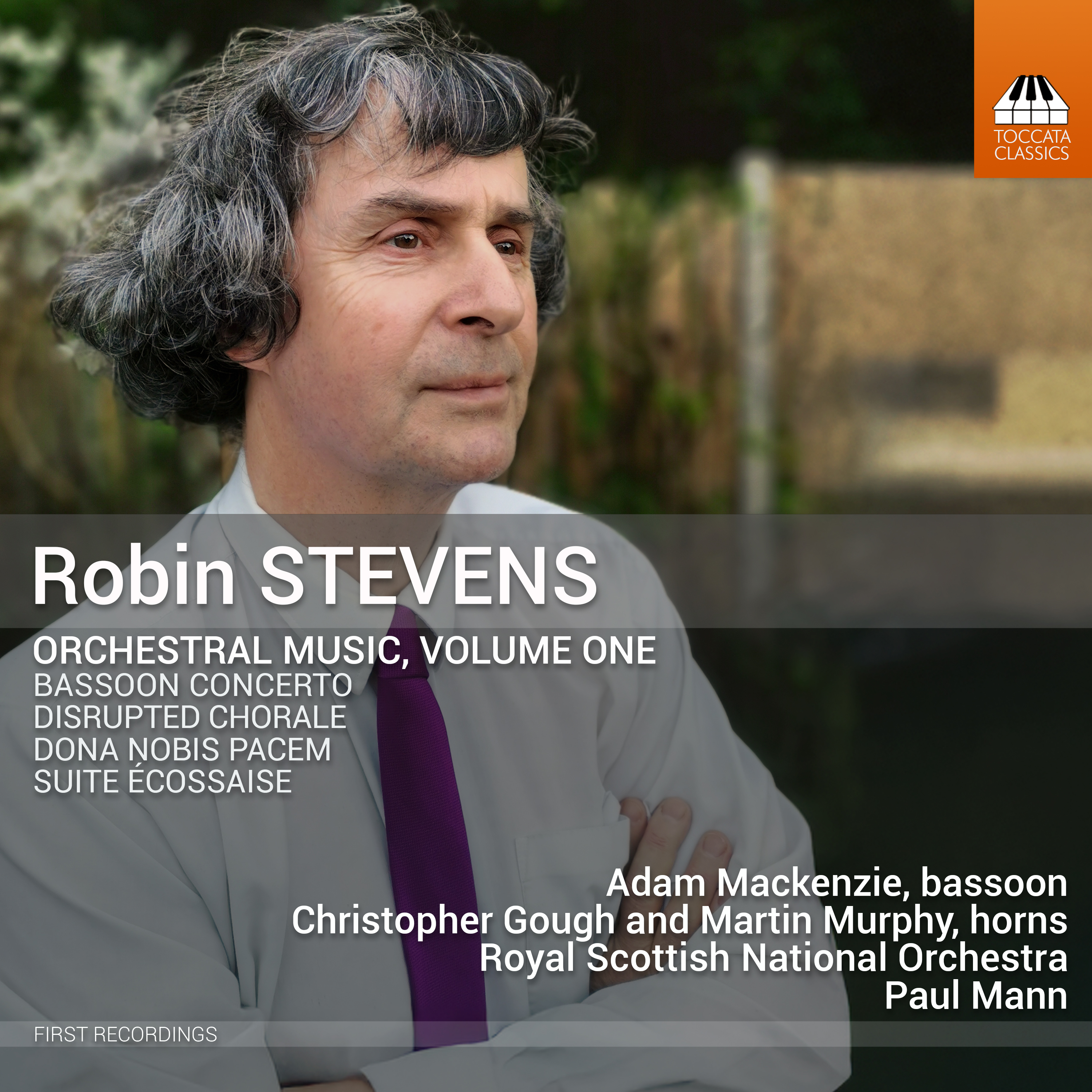
The compositional career of Robin Stevens, Welsh-born (in 1958) and Manchester-based, is divided into two periods, separated by a period of illness. The first mainly produced chamber music and works for the church that employed him; restored to health, he found an appetite for larger forms, writing three substantial concertos and a number of other orchestral works – all now recorded for Toccata Classics. This first album sets his expansive Bassoon Concerto amid three shorter works, each of them revealing how his command of orchestral colour and melodic line can suggest landscapes and narratives. In the slow movement of the Concerto in particular, there are passages of deep feeling and intensity, but Stevens also has a healthy sense of fun, which often emerges unexpectedly to energise his music.
Adam Mackenzie, bassoon
Christopher Gough & Martin Murphy, horns
Royal Scottish National Orchestra
Paul Mann, conductor
Listen To This Recording:
- Dona Nobis Pacem: A Prayer for Peace for Two Horns and Small Orchestra (1994, rev. 2024) (3:57)
- Disrupted Chorale for Wind Decet (2021) (3:46)
Concerto for Bassoon and Orchestra (2014-16) (41:15)
- I. Moderato con moto (14:47)
- II. Lament. Adagio non troppo – (14:17)
- III. Finale. Allegro amicable – (12:11)
Suite Écossaise (2010) (8:24)
- I. Mouvement à la Mode. Moderato, ben marcato (4:07)
- II. Berceuse. Adagio con moto (2:24)
- III. Gigue. Allegro vivo, alla danza (1:56)
First Recordings made in the Presence of the Composer
Gramophone :
‘Adam Mackenzie is at times astonishing in his ability to navigate this huge score (is there a larger bassoon concerto? It dwarfs even Skalkottas’s Sonata concertante), which Paul Mann and the Royal Scottish National Orchestra accompany impeccably. […]
The performances speak for themselves: committed, well-prepared, stunningly played to give these works the best possible start, in first-rate sound engineered by Phil Hardman (Vol 1) and Hedd Morfett-Jones (Vol 2) and producer Michael Ponder. Recommended.’
—Guy Rickards, Gramophone
MusicWeb Internatioanl :
‘[Dona Nobis Pacem: A Prayer for Peace] is very affecting work that uses the small forces to great effect. […]
The bassoon has long been associated with humorous music, and it is rather tricky to write lively music for it which does not sound amusing – but [in the bassoon concerto’s first movement] Stevens has succeeded and the different elements are expertly held together; the fourteen minutes are over before you know it. […]
[The bassoon concerto] is an engaging work that hangs together over its forty minutes by imaginative orchestration and the extraordinary demands placed on the soloist. The bassoon sounds quite different in its high and low registers, and the work regularly makes full use of the entire range. The use of the extreme upper register had me worried at times for the soloist’s lips. Adam Mackenzie principal bassoon of Opera North is, however, a fearless soloist and the first desk winds of the RSNO relish the solos the work allows them, particularly in the slow movement. […]
All three movements [of Suite Écossaise] are played with great aplomb.
The disc is superbly recorded and presented, and all the performers respond well to the music and the disciplined conducting of Paul Mann. I look forward to volumes two and three of Dr Stevens orchestral music which has already been recorded.
—Paul RW Jackson, MusicWeb International
Fanfare :
‘The Royal Scottish orchestra fares extremely well [in the bassoon concerto], with just the odd moment of strain in the upper strings. All credit to the extensive percussion section, too, who can function to awaken the bassoon from soliloquy-like reverie. Paul Mann reacts with laser-like speed to the score’s twists and turns, and his players are with him at every turn; Adam Mackenzie is the finest of bassoonists, tireless and possessed of a simply beautiful tone (one of the finest I have head). It is also worth noting that although the movements are long, there is not a single note wasted. […]
The finale is a sort of rondo with contrasting middle section and jazz-inspired coda. There is an overall lightness that masks the complexities here; this is a great movement, animated via the RSNO’s terrifically buoyant rhythms and Mackenzie’s unstoppable virtuosity. Again, there is the odd moment of scrabble in the strings, but what an experience this concerto offers, its lighthearted close absolutely in keeping with its ethos. […]
The recording is top-notch throughout (it is produced by Michael Ponder). A most worthwhile release, one absolutely worthy of investigation.’
—Colin Clarke, Fanfare, March 2026
Fanfare :
‘Next up, and definitely not short, is Steven’s Concerto for Bassoon and Orchestra (2014–16). Clocking in at over 41 minutes, this three-movement concerto is of a content, form, and style that immediately earns recognition as a significant addition to the bassoon concerto repertoire.
For the bassoonist, and no less the orchestra, this is a work demanding great technical virtuosity, but Stevens did not necessarily set out to write a concerto in the traditional manner of a virtuosic showpiece. He proves once again, if proof be needed, that the bassoon can be an instrument with a beautifully expressive and emotionally communicative voice. In that regard, the concerto’s second movement, Lament: Adagio non troppo, is deeply moving. […]
Bassoon soloist Adam Mackenzie certainly has his work cut out for him and rises to the occasion in stellar fashion. Indeed, all of the players who have solo roles in the other pieces in this program, and who I gather are members of the Royal Scottish National Orchestra, perform with technical assurance and a good deal of flair for Stevens’s music.
As an entrée into the world of Robin Stevens’s orchestral works, this new Toccata album can be strongly recommended. With repeated listening, the composer’s music soon progresses from merely interesting to thoroughly rewarding.’
—Jerry Dubins, Fanfare, March 2026
Fanfare :
As in all the works included on this disc, [in the bassoon concerto] Stevens demonstrates a marvelous ear for varied instrumental sonorities. He also possesses a keen and welcome sense of humor. The prospect of a 40-plus minute bassoon concerto might seem daunting. But Stevens’s imaginative score, brilliant playing by soloist Adam Mackenzie (Principal Bassoon of Opera North in Leeds), and marvelous support from the Royal Scottish National Orchestra and conductor Paul Mann provide a compelling experience. […]
Both Dona Nobis Pacem: A Prayer for Peace for Two Horns and Orchestra (1994, rev. 2024), and Disrupted Chorale for Wind Decet (2021) deliver an economy of expression and piquant sonorities that evoke Stravinsky. The Suite Éccosaise (2010), a trio of Scottish-influenced dance movements, have a melodic verve, irrepressible energy, and orchestral richness worthy of Malcolm Arnold, and every bit as entertaining. The performances of all three works are likewise outstanding. I look forward to hearing more of Robin Stevens’s music. Recommended.’
—Ken Meltzer, Fanfare, March 2026
Fanfare :
‘The major work here is an extremely expansive Bassoon Concerto. One characteristic of Stevens’s music, and one rarely found in music today, is wit. He can be cheeky, often switching between intense emotions and humor fairly quickly. Those changes, however, are made organically, and thus they flow well. Much of Stevens’s output is for wind instruments, so it is no surprise that his Bassoon Concerto is so successful. The middle movement, Lament: Adagio non troppo, is deeply moving, and it is then followed by a genial finale. […]
All of the performances are first-class, but special praise must go to bassoonist Adam Mackenzie for playing that is sensitive, athletic, incisive, and deeply felt throughout. Paul Mann and the Royal Scottish National Orchestra give committed readings as well. Toccata’s notes are up to their usual high standard.’
—Henry Fogel, Fanfare, March 2026
Fanfare :
‘The enterprising Toccata Classics label has introduced us to the orchestral music of several impressive contemporary composers, among them David Hackbridge Johnson and Steve Elcock. Here is another name to add to that pantheon, Welsh composer Robin Stevens (b. 1957). Stevens’s chamber music has already enjoyed several recordings, but this is the first volume devoted to his concertos and orchestral works, and an impressive program it is. […]
His skill as an orchestrator and the musical spontaneity that marks his ideas reflect long years of study and close musical analysis. […]
Contemporary bassoon concertos are scarce; Stevens’s is one of the best, maintaining real musical interest beside its virtuosity. […]
The performances are full of vim, as they must be. (Stevens oversaw the recordings.) Adam Mackenzie is irrepressible in the challenging solo part in the concerto, and conductor Paul Mann continues to be a major asset in unfamiliar music through his dedication and reliability. I truly enjoyed this release, and await the rest of the series.’
—Phillip Scott, Fanfare, March 2026
Fanfare :
‘On the basis of this well planned recital I’d say he’s a composer of considerable accomplishment. […]
After this thought-provoking start [Dona Nobis Pacem], Stevens gives a wind decet (pairs of horns, and woodwind instruments), Disrupted Chorale, which is memorable for the color and sonic effect achieved within its less than four-minute span. A model of how to write a meaningful miniature, and beautifully played here. […] In three movements and over 40 minutes long in total, [the bassoon concerto] a thrilling dialogue between soloist (the remarkable David Hubbard) and orchestra, with the demanding solo part based in a sort of recitative, interacting with the orchestra in a variously conversational, lyrical, and intensely dramatic manner. […] The final movement is a tour de force of contrasting styles with the bassoon having much to say for itself, sounding much more confident and upbeat in its exchanges with the orchestra than before, even being allowed a cadenza. […] A highly attractive and original composition, then, when played with the skill and commitment Hubbard and the excellent Royal Scottish National Orchestra under Paul Mann bring to it. […]
The RSNO receives an opportunity for an idiomatic celebration in the final work on the disc, the three-movement Suite Écossaise. This is a highly enjoyable pastiche of Scottish folk music powered very effectively and ingeniously by singable faux-folk melodies. […] It’s a roof-raising celebration and a great way to end the program, another triumph for the vision of Toccata and the indefatigable Mann, who now has another gifted composer holding him in his gratitude. As usual, Toccata provides detailed liner notes, where Stevens writes interestingly about his career as well as the pieces here. I was so glad to have made his acquaintance.’
—Dominic Hartley, Fanfare, March 2026