Myron Silberstein: Piano Music, 2016-2022
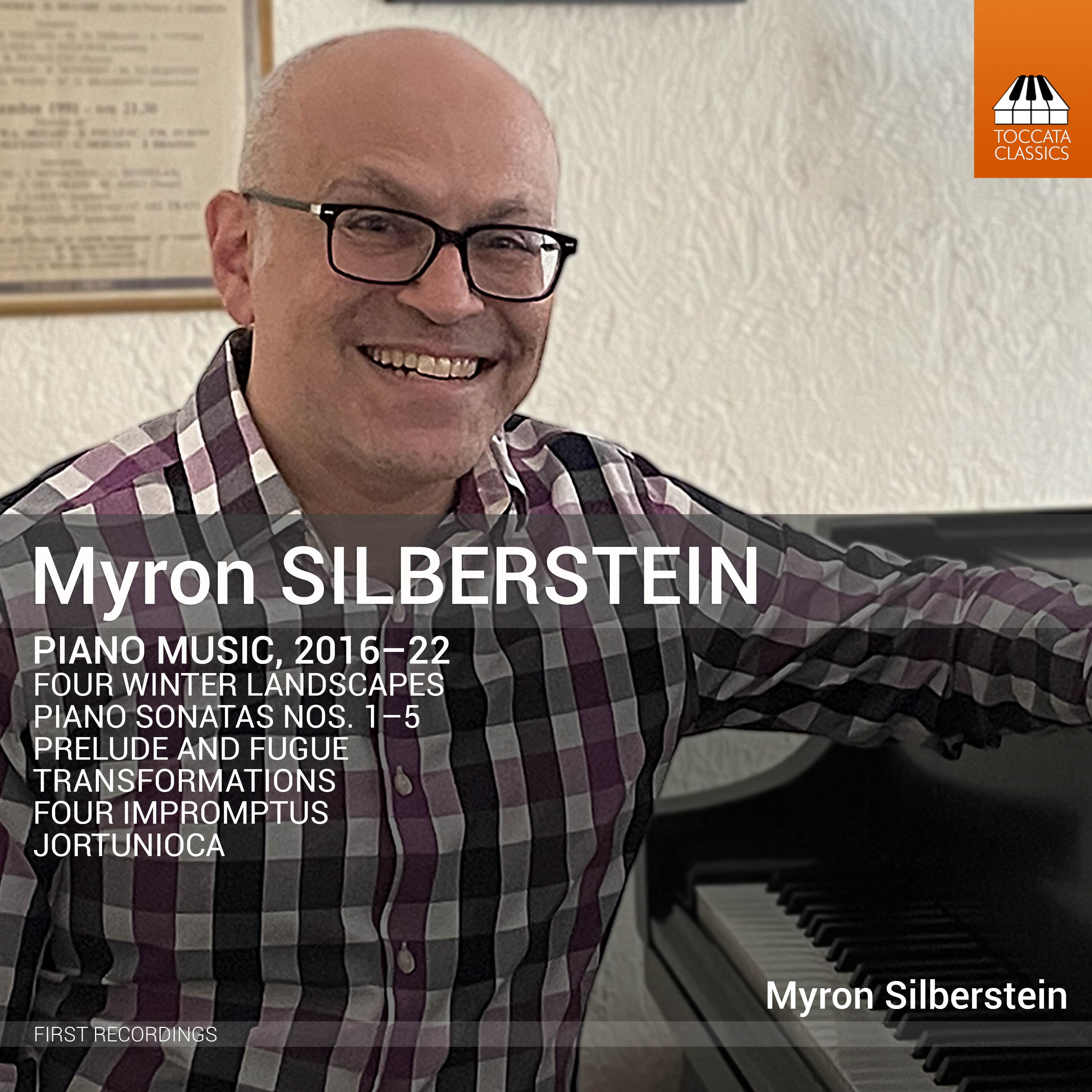
Myron Silberstein, Brooklyn-born (in 1974) and a long-term resident of Chicago, belongs to that centuries-old tradition of the composer-pianist. But here the distant roots are not so much in Mozart and Beethoven as in Copland and Barber. Silberstein’s language echoes the tradition of earlier American composers like Creston, Mennin and Persichetti, and his tonal harmony may remind some listeners of mid-twentieth-century jazz, especially in its sense of improvisatory freedom. Like much of American culture more generally, it is open, outgoing and often positive in spirit.
Myron Silberstein, piano
Listen To This Recording:
Four Impromptus (2022) (7:48)
- No. 1, Warm (1:53)
- No. 2, Lamenting (2:31)
- No. 3, Contemplative (1:42)
- No. 4, Vigorous (1:42)
Piano Sonata No. 1 (2016) (7:37)
- I. Light (2:34)
- II. Quiet (2:12)
- III. Bold (2:51)
Piano Sonata No. 2 (2018) (13:33)
- I. Declamatory (5:19)
- II. Reflective (4:42)
- III. Tumultuous (3:32)
Four Winter Landscapes (2022) (5:53)
- No. 1, Sunlight on Snow (1:19)
- No. 2, Bare Trees (1:45)
- No. 3, Afternoon Shadows (1:16)
- No. 4, The Frozen Lake (1:33)
Piano Sonata No. 3 (2019) (12:15)
- I. Lively (4:23)
- II. Gentle (4:21)
- III. Brilliant (3:31)
Prelude and Fugue (2018) (4:11)
- Prelude (2:58)
- Fugue (1:13)
Piano Sonata No. 4 (2019) (11:41)
- I. Graceful (4:52)
- II. Calm (3:06)
- III. Vigorous (3:43)
- Transformations (2021) (6:42)
- Piano Sonata No. 5 (2020) (7:31)
- Jortunioca (2020) (1:38)
First Recordings
Fanfare :
‘[In sonata no.3] Silberstein constantly veers into unexpected tonal regions to keep the listener on his toes, a device that I consider essential to any good composition, whether old or new. The concluding “Brilliant” of this Sonata gives evidence of the composer’s skill in counterpoint in its opening portion and his expert ability to vary texture and mood throughout the remainder of the piece. […]
Silberstein’s music is meant to connect emotionally to its listener, and does so successfully in every work. As a superb pianist, my colleague is able to present these very pianistic pieces most persuasively, thereby drawing the listener into his musical ethos. Given the delights afforded to listeners and performers alike, I strongly suspect that other pianists will want to investigate this music. […] Heartily recommended all around.’
—David DeBoor Canfield, Fanfare, April 2026
Fanfare :
‘This is music of continuous intellectual interest, but emotion—from the cheeky to the lamenting, from the joyful to the desolate, from the jazzy to the stern—is what truly gives it its power and memorability.
Needless to say, the performances are assured—but they never draw attention away from the music. The program notes, as I’ve said, are detailed: besides including a fascinating account of Silberstein’s development as an artist, there are eight pages of notes about the individual works. Lots of insight in these analyses—but I’d advise listening first and reading after. For all its ingenuity, this is music that works—indeed, works well—even without explanation. Warmly recommended.’
—Peter J. Rabinowitz, Fanfare, April 2026
Fanfare :
‘I quote Myron Silberstein’s comments at length because they resonate with my response to his engaging music and marvelous performances. Silberstein’s works offer abundant lyricism, couched in bright, transparent sonorities. Jazz impresses me as an important element. This is true both with Silberstein’s use of syncopation, but also in the impression that he is allowing a theme to embark on an improvisatory journey, “so it matures into the best version of itself.” These qualities are enhanced by Silberstein’s crystal-clear execution, masterful exploration of voices, textures, and colors, and vibrant phrasing. Silberstein proves himself equally adept in character pieces (Four Impromptus, Four Winter Landscapes, Jortunioca) and works focusing on thematic exploration/development (5 Piano Sonatas, Prelude and Fugue, Transformations). This is music that is accessible, creative, highly personal, and uplifting. And who better to perform it than the composer, a celebrated keyboard artist? Enthusiastically recommended.’
—Ken Meltzer, Fanfare, April 2026
Fanfare :
‘What we hear throughout is music of warmth, clarity, and communicative purpose—unpretentious in the best sense, yet never less than serious in its ambition. Silberstein writes as he plays: with directness, color, and an evident desire to reach the listener rather than to impress from a distance. […]
He works with triads—they remain the bedrock of his vocabulary, the common ground that gives the listener a way into even his most adventurous passages—but he colors, layers, and combines them with polychords and modal inflections to intensify and sharpen the emotional point. The result is music that sounds personal and distinctive without ever sounding willfully difficult. […]
The motivic economy [of the first sonata] is impressive—everything grows from that initial cell—and the writing is pianistically assured, with genuine virtuosic challenges woven into the texture rather than applied as decoration […]
The Third Sonata returns to motivic procedures, but with a new structural sophistication. Its most distinctive feature is a series of bold octave figures, and what begins as transitional material gradually assumes structural authority. In the slow movement, these octaves become the climactic gesture at the peak of each passionate episode. And in the finale, sped up, they are transformed into the motto that propels the entire movement. It is a beautifully organic solution to a compositional puzzle—Silberstein describes in the notes how the music essentially told him what it needed to become, and the result feels both inevitable and surprising. […] The motif proves astonishingly fertile across all three movements [of the 4th sonata], and the sonata has an improvisatory ease, a serendipitous quality, that makes it perhaps the most immediately lovable of the five. […]
Taken together, the sequence [of piano sonatas] amounts to a fascinating compositional journal. […]
[Four Winter Landscapes] are beautiful miniatures, each barely a minute or two long, and they demonstrate how much atmosphere Silberstein can conjure with the simplest of means—stacked intervals depicting bright sunlight on snow, a simple two-note chord beneath a melody evoking bare branches against a gray sky. If you need evidence that this composer can say a great deal in a very small space, here it is.
The Prelude and Fugue is a thoroughly satisfying demonstration of Silberstein’s command of established forms. […]
I am not sure when I last enjoyed a recital of new piano music this much. The program is varied and intelligently sequenced, the playing is warm and lucid throughout—Silberstein knows this music from the inside, naturally enough, and his performances have an authority and an unforced communicative ease that studio recordings of a composer’s own works do not always possess. There is no self-indulgence here, no sense of a composer pleading a case; just music that speaks for itself, played with conviction and evident affection. I’ll give the last word back to Silberstein, from the interview: “My hope is that I might be able to express something that listeners have felt in their lives but have not experienced in music in quite the way they have sought.” On the evidence of this disc, that hope is amply fulfilled.’
—Dominic Hartley, Fanfare, April 2026
Fanfare :
‘The recording of Silberstein’s Steinway is superb. At close on 80 minutes, this is something of a feast, a celebration of Silberstein’s music and its variety, in authoritative performances by the composer. Recommended.’
—Colin Clarke, Fanfare, April 2026