Search Results for "mac dee old picture" – Page 2
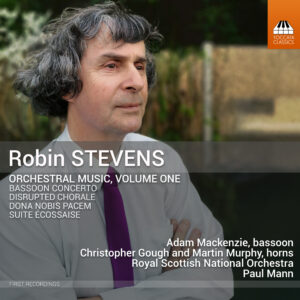
Robin Stevens: Orchestral Music, Volume One
The compositional career of Robin Stevens, Welsh-born (in 1958) and Manchester-based, is divided into two periods, separated by a period of illness. The first mainly produced chamber music and works for the church that employed him; restored to health, he found an appetite for larger forms, writing three substantial concertos and a number of other orchestral works – all now recorded for Toccata Classics. This first album sets his expansive Bassoon Concerto amid three shorter works, each of them revealing how his command of orchestral colour and melodic line can suggest landscapes and narratives. In the slow movement of the Concerto in particular, there are passages of deep feeling and intensity, but Stevens also has a healthy sense of fun, which often emerges unexpectedly to energise his music.
Adam Mackenzie, bassoon
Christopher Gough & Martin Murphy, horns
Royal Scottish National Orchestra
Paul Mann, conductor
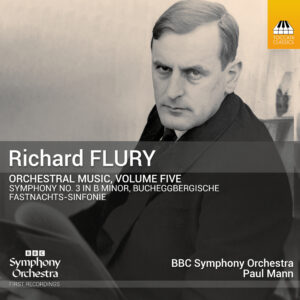
Richard Flury: Orchestral Music, Volume Five
This fifth volume of the orchestral works of the late-Romantic Swiss composer Richard Flury (1896–1967) brings two works deeply bound up with his native Solothurn, in the north-west of the country. His Fastnachts-Sinfonie, or ‘Carnival Symphony’, is an expansive symphonic poem predicated on local legend and folk tradition, embracing both frolic and feeling. The Third Symphony – in which one can hear traces of Bruckner and Richard Strauss – celebrates the rolling hills and endless skies of the Bucheggberg, where he loved to go walking and where, the freewheeling music would suggest, his heart found freedom.
BBC Symphony Orchestra
Paul Mann, conductor
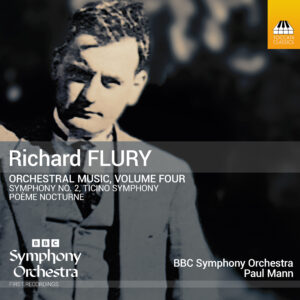
Richard Flury: Orchestral Music, Volume Four
The Second Symphony of the Swiss composer Richard Flury (1896–1967) is deeply bound up with his personal life. In 1932 his first marriage broke up, and his wife and four children left Solothurn in the north to settle in Ticino, in the south. Through visits to his family in Lugano Flury grew to know the area well, so much so that he decided to celebrate their new surroundings in his Second Symphony, the movements of which are based on the carillon of the Flury family’s local church and three Ticino folksongs. Structurally, the work belongs to the Brucknerian tradition, but it also has points of contact with the orchestral naturepainting of Flury’s good friend Joseph Marx. The landscape of the Poème nocturne is an interior one: it is an expansive dreamfantasy of occasionally violent passions, a worthy cousin of Richard Strauss’ tonepoems.
BBC Symphony Orchestra
Paul Mann, conductor
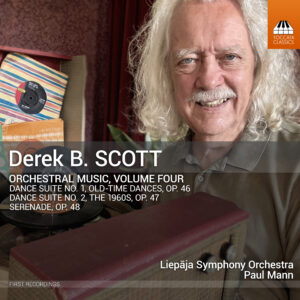
Derek B. Scott: Orchestral Music, Volume Four
Derek Scott, born in Birmingham in 1950, has a long history of engagement with the British music hall and other forms of light entertainment, as both historian and performer. Many of his own compositions attest to this interest in popular styles, with his craftsmanship and natural feeling for a good tune producing music of immediate appeal. One of his two recent Dance Suites takes its cue from ska, the twist and other enthusiasms from the early 1960s, and the other from older dance favourites. Time was when works like Arthur Benjamin’s Jamaican Rumba and Percy Faith’s arrangement of Alfvén’s Swedish RhapsodyNo. 1 could be heard on every domestic radio and record-player; these good-natured Dance Suites recapture some of that lost innocence and its relaxed energy – but his Serenade, another recent composition, touches gently on deeper feelings.
Liepāja Symphony Orchestra
Paul Mann, conductor
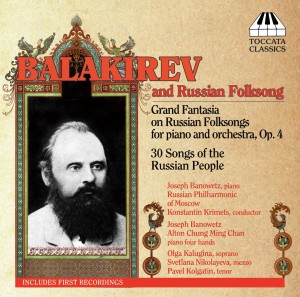
Balakirev and Russian Folksong
Mily Balakirev (1837–1910) – the leader of the group of Russian composers known as 'the Mighty Handful’ – was influenced by folksong from the very start of his career. His expansive Grand Fantasia on Russian Folksongs for piano and orchestra is one of his very first compositions, written when he was seventeen. And the 30 Folksongs of the Russian People for piano duet, folksong-arrangements from the other end of his career, show his deep understanding of the sources, which he endows with dignity and colour. Each of his arrangements is preceded on this CD by the original folksong, illuminating Balakirev’s perceptive approach to this fascinating material.
Joseph Banowetz, piano
Russian Philharmonic of Moscow, orchestra
Konstantin Krimets, conductor
Olga Kalugina, soprano
Svetlana Nikolaeva, mezzo soprano
Pavel Kolgatin, tenor
Joseph Banowetz and Alton Chung Ming Chan, piano duet
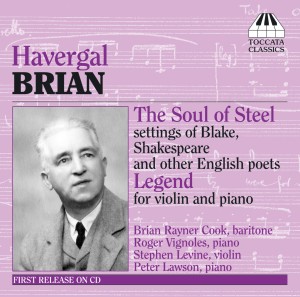
Havergal Brian: Songs for baritone and piano, Legend for violin and piano
Havergal Brian (1876–1972) is renowned as the composer of 32 powerful symphonies (then the largest symphonic cycle since Haydn), 21 of them composed after his 80th birthday; his First Symphony, The Gothic, is reputed to be the largest ever composed. But in the first part of his career Brian was also active on a smaller scale, his songs attracting the advocacy of singers as prominent as John McCormack and John Coates. The range of emotion in these songs is nonetheless vast, from folky innocence via Shakespearean irony to deep tragedy. Brian Rayner Cook’s performances can be taken as authoritative: he studied the songs with the composer. The CD is completed by the Legend for violin and piano, Brian’s only surviving piece of chamber music.
Brian Rayner Cook, baritone
Roger Vignoles, piano
Stephen Levine, violin
Peter Lawson, piano
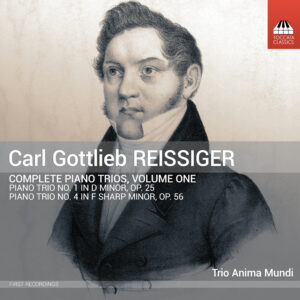
Carl Gottlieb Reissiger: Complete Piano Trios, Volume One
In his day the now-forgotten Carl Gottlieb Reissiger (1798–1859) was highly esteemed, both as conductor and composer; indeed, his presence in Dresden from 1826 made it one of the main operatic centres in Germany. He wrote nine operas himself, as well as a huge quantity of vocal music (including at least twelve Masses), and his large output of chamber music boasts no fewer than 27 piano trios. These two early exemplars in this first-ever complete recorded cycle of those trios have a Mendelssohnian elegance and clarity, deepened here and there by a touch of Beethovenian pathos. Schumann was an enthusiast: ‘When I think of Reissiger’s trios, the words lovely and jewel-like come to mind. These choice and lovely works remind one of a chain of flowers. […] His music never fatigues the ear, but holds our attention to the very end’.
Trio Anima Mundi
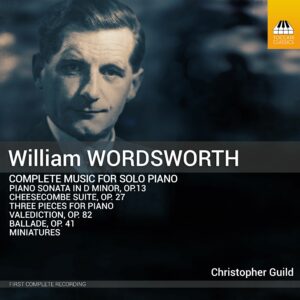
William Wordsworth: Complete Music for Solo Piano
The reputation of the Anglo-Scottish composer William Wordsworth (1908–88), great-great-grandnephew of the poet, has recently been restored by a series of Toccata Classics albums of his orchestral music. His piano music, too, was poorly known before now, none of it recorded since a handful of pieces appeared on LP 60 years ago – though his epic Piano Sonata is a work of major importance. This first ever complete recording reveals an honest, unfussy approach to the keyboard akin to that of two other major symphonists, Sibelius and Rubbra: like them, Wordsworth’s primary concern seems to have been the expression of deep feeling – which makes the gentle story-telling of his miniatures for children all the more surprising.
Christopher Guild, piano
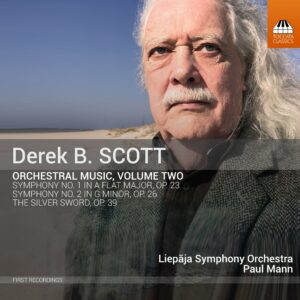
Derek B. Scott: Orchestral Music, Volume Two
Derek Scott, born in Birmingham in 1950, has an international reputation as an historian of the British music hall and other forms of light entertainment. But he is an outstanding composer in his own right, his music treading a fine line between a very English whimsy and a profoundly felt and natural response to his (often Celtic) subject matter. These works reveal a master craftsman and natural tunesmith, who manages to unite good humour, unerring technique and deep feeling in music of immediate appeal. His two symphonies – originally written for brass band – embody a return to the formal, Classical clarity of Haydn, though expressed with the satisfyingly beefy textures of the modern orchestra. He lists among his influences Shostakovich and Sibelius and, less predictably, The Beatles and The Kinks.
Liepāja Symphony Orchestra
Paul Mann, conductor
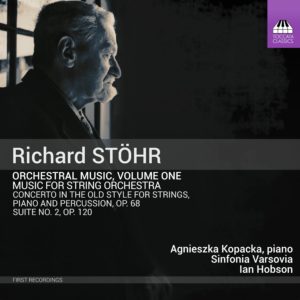
Richard Stöhr: Orchestral Music, Volume One: Music for String Orchestra
These two works for string orchestra were composed on either side of the flight of the Viennese composer Richard Stöhr (1874–1967) from occupied Austria to the USA, and from prominence and danger to liberty and obscurity, and they reflect the change in his circumstances: the Concerto in the Old Style is expansive, witty, energetic and endlessly good-natured, whereas the Second Suite is introspective, understated and deeply felt. These first recordings allow the discovery of two major additions to the repertoire for strings; the Second Suite is also one of the last grand statements of late Romanticism.
Agnieszka Kopacka, piano (Tracks 1–4)
Sinfonia Varsovia
Ian Hobson, conductor
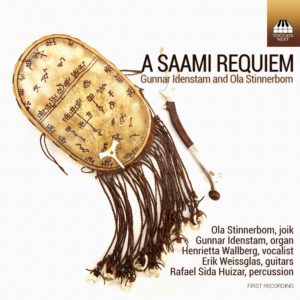
A Saami Requiem
A Saami Requiem is an extraordinary meeting-place of musical cultures – western classical, Sámi yoik, Nordic folk-dance, electric rock, blues, improv and more. It takes the form of a journey to Saajva, the Kingdom of Death in Sámi religious practice. With it the Swedish organist Gunnar Idenstam and Sámi artist Ola Stinnerbom provide a parallel to the Christian Requiem, with Ola Stinnerbom as Noite, the shaman who acts as guide to the Kingdom of Death – and back to this life, celebrated in the uplifting closing hymn. Some of the percussion sounds are sampled from traditional Sámi drums made by Ola Stinnerbom after ancient models; the electric guitars provide a link to rock groups like Deep Purple and King Crimson; and Gunnar Idenstam’s unmistakable style marries the French organ tradition with the alluring world of Swedish folk-music.
Ola Stinnerbom, yoik (Tracks 2–14)
Gunnar Idenstam, organ (Tracks 1–7, 9–14)
Henrietta Wallberg, vocalist (Tracks 7, 8, 10)
Erik Weissglas, guitars (Tracks 3–6, 9, 12–14)
Rafael Sida Huizar, percussion (Tracks 3–6, 8, 10–14)
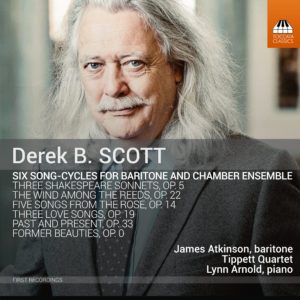
Derek B. Scott: Six Song-Cycles for Baritone and Chamber Ensemble
Derek Scott, born in Birmingham in 1950, has an international reputation as a leading historian of the British music hall and other forms of light entertainment. But he is an outstanding composer in his own right, his music treading a fine line between a very English whimsy and a profoundly felt and natural response to his subject matter. These six song-cycles – with influences ranging from Vaughan Williams to The Beatles – reveal a master craftsman and natural tunesmith, who manages to unite good humour, unerring technique and deep feeling in music of immediate appeal, setting texts by poets who include Burns, Hardy, Shakespeare, Swift, Wordsworth, Yeats and the composer himself.
James Atkinson, baritone
Lynn Arnold, piano (Tracks 1-8, 14-26)
Tippett Quartet
John Mills and Jeremy Isaac, violins
Lydia Lowndes-Northcott, viola
Božidar Vukotić, cello
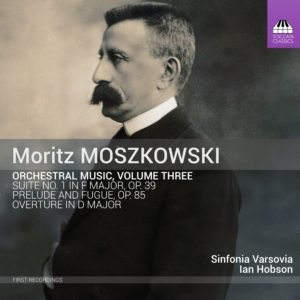
Moritz Moszkowski: Orchestral Music, Volume Three
The Polish composer Moritz Moszkowski (1854–1925) is best remembered for a handful of virtuoso piano pieces, but he also produced a substantial body of orchestral music, most of it unperformed for a century or more. This third volume presents his very first orchestral work, a strikingly assured Overture in D major, written when he was seventeen, and his last, a sombre, dignified and deeply felt Prelude and Fugue for strings, composed on the death of his mother in 1910. Between them comes Moszkowski’s First Orchestral Suite, from 1885, a joy from start to finish, with one delightful inspiration following another in a daisy-chain of dance-rhythms, memorable tunes and instrumental colour.
Sinfonia Varsovia
Ian Hobson, conductor
Andrzej Krzyżanowski, flute (Track 8)
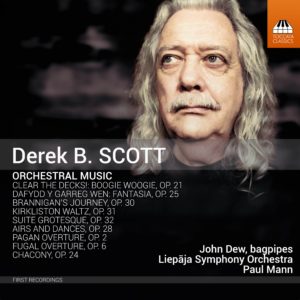
Derek B. Scott: Orchestral Music
Derek Scott, born 1950, Birmingham, has an international reputation as a leading historian of the British music hall and other forms of light entertainment but he is an outstanding composer in his own right, his music treading a fine line between a very English whimsy and a profoundly felt and natural response to his (often Celtic) subject matter. These works reveal a master, who finds deep feeling behind the levity
John Key, bagpipe
Liepāja Symphony Orchestra
Paul Mann, conductor
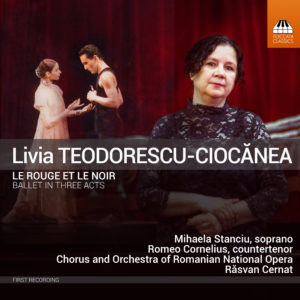
Livia Teodorescu-Ciocănea: Le rouge et le noir
Le rouge et le noir, the pioneering psychological novel by Stendhal published in 1830, has had a number of adaptations on film but surprisingly few treatments in music. This three-act ballet, premiered in 2000, by the Romanian composer Livia Teodorescu-Ciocănea (b. 1959), rectifies that omission in the grand manner. The atmosphere is dark and passionate, as the novel requires, and the musical language reflects the remarkable tradition of Romanian modernism that emerged in the second half of the twentieth century from the music of Enescu – a distinctive soundworld that blends rich timbral colour with deep roots in Romanian folk-music.
Mihaela Stanciu (soprano)
Romeo Cornelius (countertenor)
Chorus and Orchestra of Romanian National Opera
Răsvan Cernat (conductor)
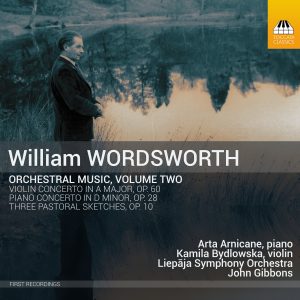
William WORDSWORTH: Orchestral Music, Volume Two
The music of William Wordsworth (1908–88) – a great-great-grandson of the poet’s brother Christopher – lies downstream from that of Vaughan Williams and Sibelius; like that of his contemporary Edmund Rubbra, Wordsworth’s music unfolds spontaneously, as a natural process. This second volume brings two concertos, both major works – though long forgotten, and contrasted in their approach: the gritty and muscular Piano Concerto is cast in a single, tightly argued span, whereas the lyrical Violin Concerto is expansive and unhurried – and deeply touching. They are complemented by the Three Pastoral Sketches, which grow gently from understated autumnal hues to a dignified and moving climax. All three scores show an extraordinary command of orchestral colour.
Arta Arnicane, piano (Tracks 1-5)
Kamila Bydlowska, violin (Tracks 9-11)
Liepāja Symphony Orchestra
John Gibbons