Search Results for "Modular aggregator for DEX-based margin" – Page 4
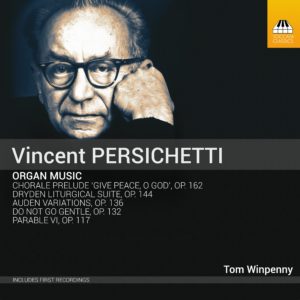
Vincent PERSICHETTI: Organ Music
The larger part of the organ music of the American composer Vincent Persichetti (1915–87) was composed towards the end of his life, with some of those pieces receiving their first recordings here. Several are based on hymn tunes, which can often be heard in the background – re-emerging in glorious affirmation in the Auden Variations. On occasion the language suggests a kaleidoscopic admixture of Hindemith and Messiaen, bristling with edgy flashes of colour; and Do not go gentle, an essay for pedals alone after the Dylan Thomas poem, is a statement of austere power. What these highly contrasted works have in common is complete textural clarity: Persichetti had been playing the organ since boyhood, and his writing for the instrument is that of a master.
Tom Winpenny, organ of St Alban’s Cathedral
ALL EXCEPT * FIRST RECORDINGS
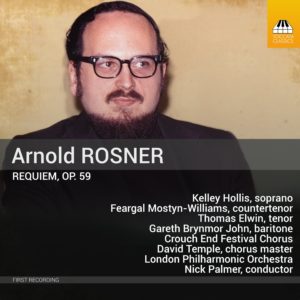
Arnold ROSNER: Requiem, Op. 59
Far from being a treatment of the usual Latin, the Requiem of the New York-based Arnold Rosner (1945–2013) sets spiritual and secular texts on death from a number of the world’s cultures, including Whitman, Villon, the Tibetan Book of the Dead, a sutra from Zen Buddhism and the Jewish Kaddish. The work of a young man (Rosner was 28 when he wrote it), this Requiem is both monumental and wildly energetic – but it also encompasses passages of transcendent beauty. His musical language clothes the modal harmony and rhythm of pre-Baroque polyphony in rich Romantic colours, producing a style that is instantly recognisable and immediately appealing. Some of the music was first written for an aborted operatic treatment of Ingmar Bergman’s film The Seventh Seal, where the main character plays chess with Death; in like spirit, Rosner’s Requiem is a major statement of human defiance in the face of mortality, even if its gentle closing pages bring uneasy acceptance
Kelley Hollis, soprano (Tracks 4,8)
Feargal Mostyn-Williams, counter-tenor (Tracks 1,7)
Thomas Elwin, tenor (Tracks 1,2,7)
Gareth Brynmor John, baritone (Tracks 1,5,7)
Crouch End Festival Chorus (Tracks 1,5,6,9)
David Temple, conductor (Track 6), chorus master (Track 1,5,9)
London Philharmonic Orchestra (Tracks 1-5, 7-10)
Nick Palmer, conductor (Tracks 1-5, 7-10)
First recording
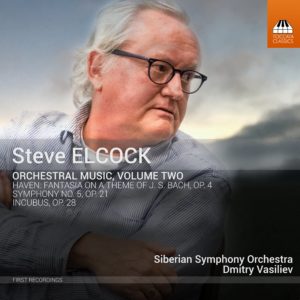
Steve ELCOCK: Orchestral Music, Volume Two
This second volume of orchestral music by the English composer Steve Elcock (b. 1957), long since resident in France, brings three powerful works all with their origins in earlier pieces. Incubus examines the terrors of nightmare-riven sleep in a vigorous symphonic essay based on a movement from Elcock’s string quartet Night after Night. The impulse behind Haven, an expansive and surprisingly muscular fantasy, is the Sarabanda theme from Bach’s First Partita for solo violin. And Elcock’s Fifth Symphony takes its cue from the most famous of all Fifth Symphonies, re-examining Beethoven’s structural logic in Elcock’s own musical language to produce a volcanic new Fifth, its charge of wild energy husbanded to maximum dramatic effect.
Siberian Symphony Orchestra
Andrey Lopatin, violin (Track 2)
Grigorii Vever, clarinet (Track 5)
Evgeny Plaksin, horn (Track 5)
Dmitry Vasiliev, conductor
FIRST RECORDINGS
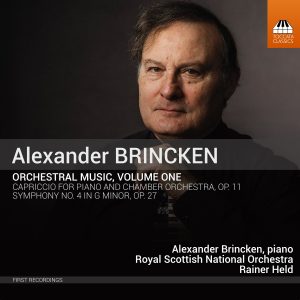
Alexander BRINCKEN: Orchestral Music, Volume One
Alexander Brincken, born in Leningrad in 1952 and Swiss-based since 1992, writes in an accessible and unashamedly late-Romantic language. His grandiose Fourth Symphony of 2014–15, written for a huge orchestra, has echoes of a number of earlier composers, among them Berlioz, Bruckner, Martinů, Wagner and, especially, Franz Schmidt and Richard Strauss, all assimilated into a big-hearted style that blends dignity, lyricism and power, with a strong sense of the Swiss landscapes in which he has made his home. The earlier Capriccio for piano and orchestra – a concerto in all but name – has, in turn, something of the sober strength and wiry energy of Frank Martin – curiously, since it was written seven years before Brincken moved to Switzerland.
Alexander Brincken, piano
Royal Scottish National Orchestra
Rainer Held, conductor
Maya Iwabuchi, leader
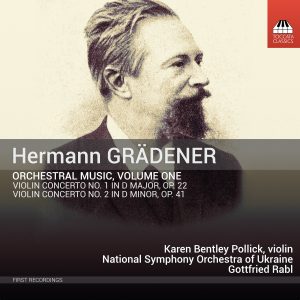
Hermann GRÄDENER: Orchestral Music, Volume One
The German-born, Vienna-based Hermann Grädener (1844–1929) is yet another composer whose music, esteemed in its own time, has since slipped between the floorboards of history. Yet this first recording of his two violin concertos – substantial works both, downstream from Brahms, and with a hint of Sibelius – prove him to have been one of the more important Romantics, with a strong sense of drama, a sure hand for musical architecture and a natural flair for extended melody.
Karen Bentley Pollick, violin
National Symphony Orchestra of Ukraine
Gottfried Rabl, conductor
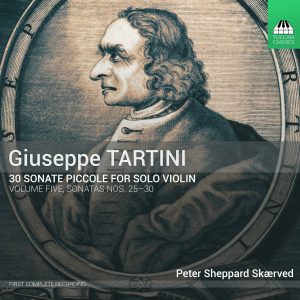
Giuseppe TARTINI: Sonate piccole, Volume Five: Nos. 25–30
In the last years of his life, the composer, violinist and swordsman Giuseppe Tartini (1692–1770) laboured at a vast cycle of sonatas for solo violin. The resulting manuscript offers the most important composition for solo violin after Bach and, at six hours in duration, the largest integrated work for the instrument. This first complete recording is based on a fresh study of the source and includes a number of works deciphered from Tartini’s shorthand and overlooked in earlier editions. These ‘Little Sonatas’ tread a delicate line between Baroque formality and proto-Romantic passion, occasionally illuminated with an echo of the folk-fiddling of his Slovenian homeland.
Peter Sheppard Skærved, violin
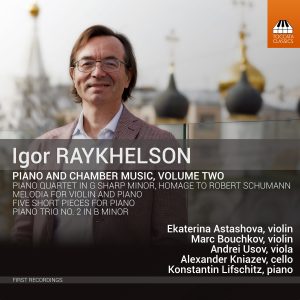
Igor Raykhelson: Piano & Chamber Music, Vol. 2
In his early days the composer-pianist Igor Raykhelson – born in Leningrad in 1961, once a New York resident and now based in Moscow – studied both classical and jazz piano. Both influences have combined to create a uniquely personal, Rachmaninov-plays-the-Blues Neo-Romantic style: not only is Raykelson unafraid to write a good tune- it’s clear right away whose tune it is. And in his chamber and instrumental works, the parlando manner that Raykhelson absorbed from jazz becomes particularly effective. Raykhelson’s chamber music is usually written for his friends, and here he is joined by some of Russia’s finest musicians, including the cellist Alexander Kniazev and the pianist Konstantin Lifschitz- and the violinist in Raykhelson’s lyrical ‘Melodia’ is his wife, Ekaterina Astashova.
Ekaterina Astashova, violin
Marc Bouchkov, violin
Andrei Usov, viola
Alexander Kniazev, cello
Konstantin Lifschitz, piano
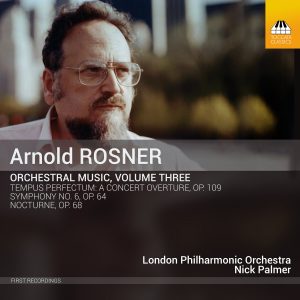
Arnold Rosner: Orchestral Music, Volume Three
The musical language of the New York-based Arnold Rosner (1945–2013) had its roots in the modal harmony and rhythm of pre-Baroque polyphony and evolved in an array of unusual directions, producing a style that is instantly recognisable and immediately appealing – as can be heard in the three works on this recording. Rosner’s Nocturne suggests the immensity – and the implacable violence – of outer space, whereas his overture Tempus Perfectum has its starting point in Renaissance dance. The monumental Sixth Symphony opens with music of volcanic ferocity and vehemence; the central Adagio then provides an island of troubled calm before the dignified opening of the finale presages a symphonic Allegro of wild, freewheeling energy; only when its immense force is spent does this powerful masterpiece sink to an uneasy close.
London Philharmonic Orchestra
Nick Palmer
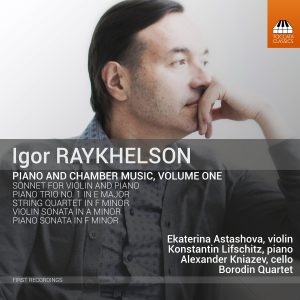
Igor Raykhelson: Piano and Chamber Music, Volume One
In his early days the composer-pianist Igor Raykhelson – born in Leningrad in 1961, once a New York resident and now based in Moscow – studied both classical and jazz piano. Those influences have combined to create a uniquely personal, Rachmaninov- plays-the-blues Neo-Romantic style: not only is Raykhelson unafraid to write a good tune – it’s clear right away whose tune it is. And in his chamber and instrumental works, the intimate, parlando manner that Raykhelson absorbed from jazz becomes particularly effective.
Borodin Quartet
Ekaterina Astashova, violin (Tracks 1 – 2)
Alexander Kniazev, cello (Track 1)
Konstantin Lifschitz, piano (Track 1 – 9)
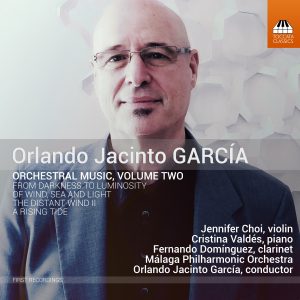
Orlando Jacinto García: Orchestral Music, Volume Two
Born in Havana in 1954, the Miami-based Orlando Jacinto García studied with Morton Feldman and has inherited some of Feldman’s concerns: his music likewise evolves gradually over slow-moving spans of time – here and there with an echo of West Coast minimalism. Like the still surface of the sea, the works on this album (three of them concertante pieces for virtuoso soloists) mirror the unhurried movement of natural phenomena, often in textures of considerable delicacy – and occasionally hinting at larger forces behind the apparent stasis.
Jennifer Choi, violin (track 1)
Cristina Valdés, piano (track 2)
Fernando Domínguez, clarinet (track 3)
Málaga Philharmonic Orchestra
Orlando Jacinto García, conductor
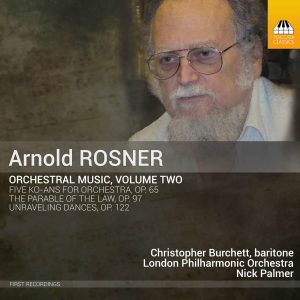
Arnold Rosner: Orchestral Music, Volume Two
The musical language of the New York-based Arnold Rosner (1945–2013) clothes the modal harmony and rhythm of pre-Baroque polyphony in rich Romantic colours, producing a style that is instantly recognisable and immediately appealing. This second Toccata Classics album of his orchestral music contrasts the high-spirited Unraveling Dances – a rhapsody with more than a nod to Ravel’s Bolero – with the powerful symphonic suite Five Ko-ans for Orchestra and Rosner’s dramatic, dark, hieratic setting of Kafka’s The Parable of the Law for baritone and orchestra.
London Philharmonic Orchestra
Nick Palmer, conductor
Christopher Burchett, baritone (Track 7)
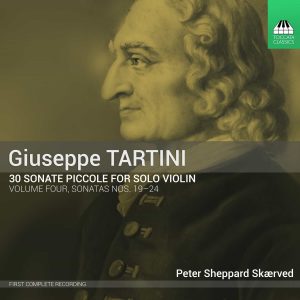
Giuseppe Tartini: 30 Sonate piccole, Volume Four – Sonatas Nos. 19-24
In the last years of his life, the great composer, violinist and swordsman Giuseppe Tartini (1692–1770) laboured at a cycle of sonatas for solo violin. The resulting manuscript offers the most important composition for solo violin after Bach and, at six hours in duration, the largest integrated work for the instrument. This first complete recording is based on a fresh study of the source and includes a number of works deciphered from Tartini’s shorthand and overlooked in earlier editions.
Peter Sheppard Skærved
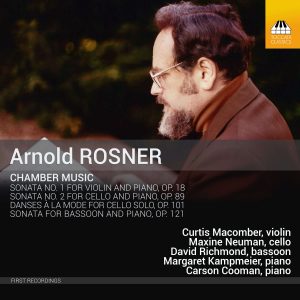
Arnold Rosner: Chamber Music
The musical language of the New York-based Arnold Rosner (1945–2013) clothes the modal harmony and rhythm of pre-Baroque polyphony in rich Romantic colours, producing a style that is instantly recognisable and immediately appealing. These four chamber works, all receiving their first recordings, embrace a wide range of emotions, from tragic nobility to buoyant good humour, with Rosner’s use of modality adding a hint of the Orient.
Curtis Macomber, violin Tracks 1–3
Maxine Neuman, cello Tracks 4–7, 11–13
David Richmond, bassoon Tracks 8–10
Margaret Kampmeier, piano Tracks 1-3
Carson Cooman, piano 8–10
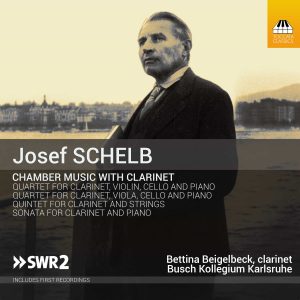
Josef Schelb: Chamber Music with Clarinet
The Karlsruhe-based Josef Schelb (1894–1977) is one of the better-kept secrets of twentieth-century German music. His output was substantial: he lost most of his early music in a bombing raid in 1942, but – as if to make up for lost time – wrote some 150 more works after that. These four, for clarinet in various chamber combinations, show his music emerging from the influence of Hindemith and Berg and developing a freewheeling energy, contrapuntal command and rhythmic charge of its own – often animated by a touch of devilish humour.
Busch Kollegium Karlsruhe
Bettina Beigelbeck, clarinet
Yasushi Ideue, violin (Tracks 5–7, 12–15)
Ayu Ideue, violin (Tracks 5–7)
Wolfgang Wahl, viola (Tracks 5–11)
Gabriela Bradley, cello (Tracks 8–11)
Bernhard Lörcher, cello (Tracks 1–7)
Manfred Kratzer, piano (Tracks 1–4)
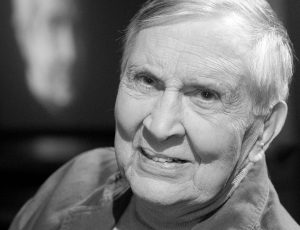
Einojuhani Rautavaara, Symphonist
THE FINNISH COMPOSER TALKS TO MARTIN ANDERSON In the light of the death of the Finnish composer Einojuhani Rautavaara, on 27 July 2016, in a…
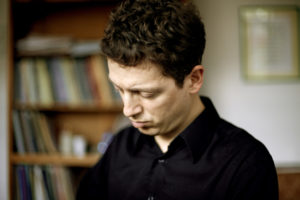
Some Thoughts on Marcel Mihalovici’s Left-Hand ‘Passacaille’
On 2 October Toccata Classics releases the first-ever album of the piano music of the Romanian-born, Paris-based Marcel Mihalovici (1898–1985), in performances by the Berlin-based…