Search Results for "fc 26 coins Buyfc26coins.com is EA Sports official for FC 26 coins The transfer time was very fast..ujWi" – Page 12
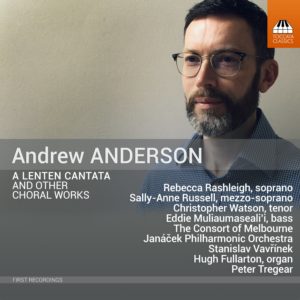
Andrew Anderson: A Lenten Cantata and Other Choral Works
In spite of the differences of time and distance, the choral works of the Australian composer Andrew Anderson (born in Melbourne in 1971) further the English cathedral tradition of such composers as Finzi and Howells, in music concerned particularly with lyricism and with clarity and directness of expression.
Rebecca Rashleigh, soprano (Track 5)
Sally-Anne Russell, mezzo-soprano (Tracks 3, 17)
Christopher Watson, tenor (Track 3)
Eddie Muliaumaseali’i, bass (Track 7)
The Consort of Melbourne (Tracks 2, 4, 6, 8, 9–16)
Janáček Philharmonic Orchestra (Tracks 1-3, 5-8, 17)
Pavel Doležal, violin (Track 4)
Stanislav Vavřínek, conductor (Tracks 1–3, 5–8, 17)
Hugh Fullarton, organ (Tracks 9, 15, 16)
Peter Tregear, choirmaster (Tracks 2, 4, 6, 8), conductor (Tracks 9–16)
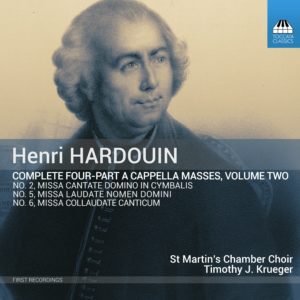
Henri Hardouin: Complete Four-Part Masses, Volume Two
Henri Hardouin (1727–1808) was a chorister in Rheims Cathedral, rising swiftly through the ranks to become maître de chapelle – until the French Revolution disbanded religious establishments. As a priest he was in potential danger and seems to have gone into hiding until, in 1794, the death of Robespierre allowed him to resume his duties. Hardouin’s six four-part masses, published in 1772, are unusual for their time in being a cappella, and they enjoyed wide circulation in pre-Revolutionary France. Since then they have been roundly neglected – an omission this first complete recording intends to rectify.
St Martin’s Chamber Choir
Timothy J. Krueger, director
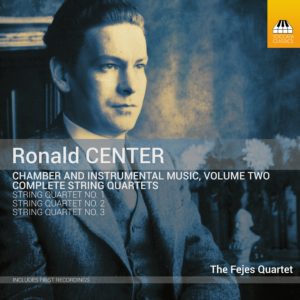
Ronald Center: Chamber and Instrumental Music, Volume Two
Ronald Center (1913–73) is sometimes described as ‘the Scottish Bartók’, and his music does indeed capture some of the stark, wild energy of the Scottish landscape in a style of Bartókian asperity. These three string quartets show him, in his northeast corner of Scotland, to have been fully conversant with the quartets being written around the same time by Barber, Britten and Shostakovich, but their direct manner, terse expression, wiry humour and roots in Scottish folk-music ensure that Center is his own man.
The Fejes Quartet
Tamás Fejes, violin
Yoan Hlebarov, violin
Theodore Chung Lei, viola
Balázs Renczés, cello
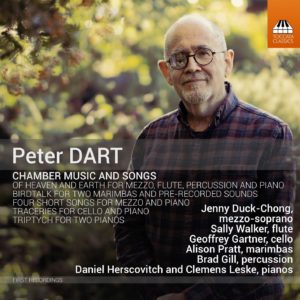
Peter Dart: Chamber Music and Songs
Painters sometimes talk about the intensity of the light they encounter in Australia. Peter Dart, born in Sydney in 1953, brings something of that brightness to his compositions, which are further animated by buoyant rhythms and a lively sense of humour, even mischief. They are, at the same time, anchored in a secure command of counterpoint, and given a timeless quality by his fondness for modal harmony. Most important of all, the technical mastery that gives these works their surefooted appeal is suffused with straightforward human warmth.
Daniel Herscovitch, piano (Tracks 1 – 12, 14 – 17)
Clemens Leske, piano (Tracks 1 – 3)
Jenny Duck-Chong, mezzo-soprano (Tracks 4 – 7, 14 – 17)
Sally Walker, flute (Tracks 15 – 16), piccolo (Tracks 14 – 17)
Geoffrey Gartner, cello (Tracks 8 – 12)
Brad Gill, percussion (Tracks 14 – 17)
Alison Pratt, marimbas (Track 13)
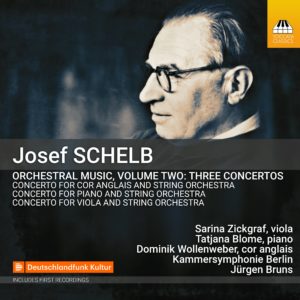
Josef Schelb: Orchestral Music, Volume Two: Three Concertos
Josef Schelb (1894–1977) is one of the better-kept secrets of German music. His output was substantial: he lost most of his early music in a bombing raid in 1942 but, as if to make up for lost time, wrote some 150 more works after that, in the tonally liberated, quasi-Expressionist contrapuntal tradition of Hindemith and Hartmann; Bartók was an important influence, too. These three concertos show him at his most engaging: the contrapuntal craftsmanship that drives the music forward is deployed with a light and nimble touch, and passages of touching delicacy contrast with others where a lively sense of humour comes bubbling up to the surface.
Tatjana Blome, piano (Tracks 1 – 3)
Sarina Zickgraf, viola (Tracks 4 – 6)
Dominik Wollenweber, cor anglais (Tracks 7 – 9)
Kammersymphonie Berlin
Jürgen Bruns, conductor
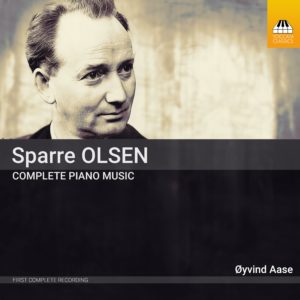
Carl Gustav Sparre Olsen: Complete Piano Music
Norwegian folksong and dance constitute the very DNA of the music of Carl Gustav Sparre Olsen (1903–84), on both a large and a small scale – from Draumkvedet, the 1936 oratorio that was his first major success, to the tiny miniatures that form most of his piano music, recorded here in its entirety for the first time. The apparent simplicity of much of this material belies the unassuming sophistication of its construction: many of these pieces, some barely a minute long, seem – to adapt William Blake – to contain the world in a grain of sand.
Øyvind Aase, piano
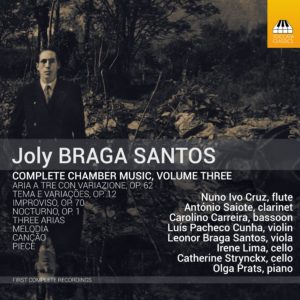
Joly Braga Santos: Complete Chamber Music, Volume Three
Joly Braga Santos (1924–88) was one of the most important composers in twentieth-century Portugal. In his early works his fondness for modal harmony, absorbed from the Portuguese masters of the Renaissance, and his busy counterpoint combine to make him sound surprisingly close to such particularly English composers as Vaughan Williams and Moeran. Although his harmonic language became more astringent with time, it retained a burly sense of humour and a powerful charge of energy, often infused with the spirit of Portuguese folk-dance.
António Saiote (clarinet)
Leonor Braga Santos (viola)
Carolino Carreira (bassoon)
Nuno Ivo Cruz (flute)
Catherine Strynckx (cello)
Irene Lima (cello)
Luís Pacheco Cunha (violin)
Olga Prats (piano)
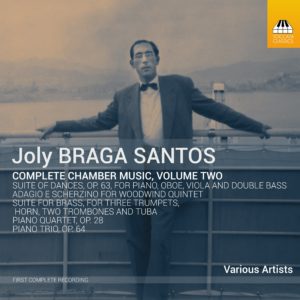
Joly Braga Santos: Complete Chamber Music, Volume Two
Joly Braga Santos (1924–88) was one of the most important composers in twentieth- century Portugal. In his early works his fondness for modal harmony, absorbed from the Portuguese masters of the Renaissance, and his busy counterpoint combine to make him sound surprisingly close to such particularly English composers as Vaughan Williams and Moeran. Although his harmonic language became more astringent with time, it retained a burly sense of humour and a powerful charge of energy, often infused with the spirit of Portuguese folk-dance. The five works on this second volume cover three decades of composition, from the mid-1950s to the mid-1980s, and offer a wide array of instrumental combinations.
Jill Lawson, piano (Tracks 1–7)
Eliot Lawson, violin (Tracks 1, 5–7)
Natalia Tchitch,viola (Tracks 1–4)
Catherine Strynckx, cello (Tracks 1 , 5–7)
Adriano Aguiar, double bass (Tracks 2–4)
Ricardo Lopes, oboe (Tracks 2–4, 8–9)
Nuno Ivo Cruz, flute (Tracks 8–9)
António Saiote, clarinet (Tracks 8–9)
Carolino Carreira, bassoon (Tracks 8–9)
Paulo Guerreiro, horn (Tracks 8–12)
Jorge Almeida, trumpet (Tracks 10–12)
António Quítalo, trumpet (Tracks 10–12)
Pedro Monteiro, trumpet (Tracks 10–12)
Jarrett Butler, trombone (Tracks 10–12)
Vítor Faria, trombone (Tracks 10–12)
Ilídio Massacote, tuba (Tracks 10–12)
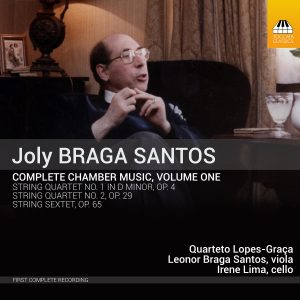
Joly Braga Santos: Complete Chamber Music, Volume One
Joly Braga Santos (1924–88) was one of the most important composers in twentieth- century Portugal. In his early works his fondness for modal harmony, absorbed from the Portuguese masters of the Renaissance, and his busy counterpoint combine to make him sound surprisingly close to such particularly English composers as Vaughan Williams and Moeran. Although his harmonic language became more astringent with time, it retained a burly sense of humour and a powerful charge of energy.
Quarteto Lopes-Graça
Luís Pacheco Cunha, violin
Maria José Laginha, violin
Isabel Pimentel, viola
Catherine Strynckx, cello
Leonor Braga Santos, viola (Tracks 8–10)
Irene Lima, cello (Tracks 8–10)
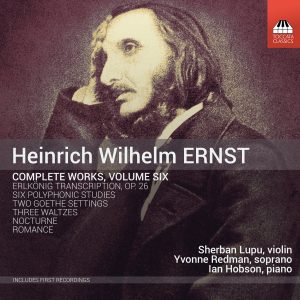
Heinrich Wilhelm Ernst: Complete Works, Volume Six
Heinrich Wilhelm Ernst (1812–65) was one of the leading musicians of his day, a friend of Berlioz, Chopin, Liszt and Mendelssohn, and for Joseph Joachim ‘the greatest violinist I ever heard’. This sixth album – in a series of seven presenting all his compositions for the first time – begins and ends with some of the most difficult music for solo violin ever composed: Ernst’s Six Polyphonic Studies and his transcription of Schubert’s song, Der Erlkönig. Between them comes less familiar fare: five Schubertian piano pieces, and two settings of Goethe.
Sherban Lupu, violin Tracks 1-12, 20
Yvonne Redman, soprano Tracks 18-19
Ian Hobson, piano Tracks 13-19
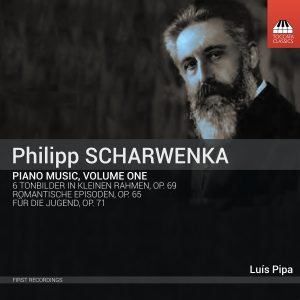
Philipp SCHARWENKA: Piano Music, Volume One
As composer, pianist and educationalist, the Prussian Philipp Scharwenka (1847–1917) was one of the most highly respected musicians of his day, although his star faded soon after his death. His music – more conservative and classical in orientation than that of his pianist-composer brother, Xaver – sits somewhere between Chopin and Brahms, with echoes of Schubert and Schumann. This first instalment of a survey of his piano music is intended to put these immediately attractive works before the public once again – for the first time in over a century.
Luís Pipa, piano
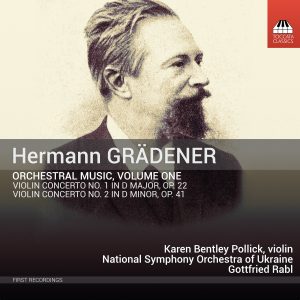
Hermann GRÄDENER: Orchestral Music, Volume One
The German-born, Vienna-based Hermann Grädener (1844–1929) is yet another composer whose music, esteemed in its own time, has since slipped between the floorboards of history. Yet this first recording of his two violin concertos – substantial works both, downstream from Brahms, and with a hint of Sibelius – prove him to have been one of the more important Romantics, with a strong sense of drama, a sure hand for musical architecture and a natural flair for extended melody.
Karen Bentley Pollick, violin
National Symphony Orchestra of Ukraine
Gottfried Rabl, conductor
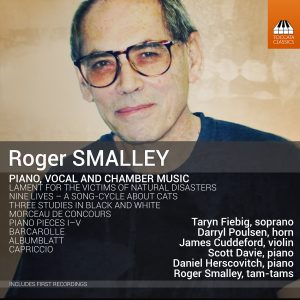
Roger SMALLEY: Piano, Vocal and Chamber Music
Roger Smalley (1943–2015) made his mark, first in his native Britain and then in Australia, as composer, pianist, conductor, writer, academic and teacher. Although as performer and commentator he was at the forefront of musical modernism, he was also very fond of nineteenth-century Romanticism, and much of his music bridges the gap between old and new, retaining its roots in the past while reflecting the concerns of his own time, as the works on this album demonstrate.
Taryn Fiebig, soprano (Tracks 2–10)
Darryl Poulsen, horn (Tracks 22)
James Cuddeford, violin (Tracks 11)
Daniel Herscovitch, piano (Track 1)
Scott Davie, piano (Tracks 2–10)
Roger Smalley, tam-tams (Track 22)
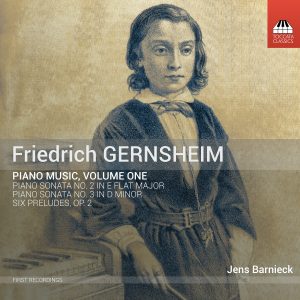
Friedrich Gernsheim: Piano Music, Volume One
Friedrich Gernsheim (1839–1916), born in Worms, on the Rhine, grew up to be one of the most formidable musicians of his age: composer, pianist, conductor and teacher. Even as a teenager, Gernsheim was attracting attention as a virtuoso-composer, earning comparisons with Mozart. These two early piano sonatas – restored by Jens Barnieck from Gernsheim’s manuscripts – combine youthful freshness with praeternatural assuredness, showing awareness of Schumann and anticipating Brahms. By the time of the Six Preludes, written a decade later, Chopin has become the dominant star in Gernsheim’s firmament.
Jens Barnieck
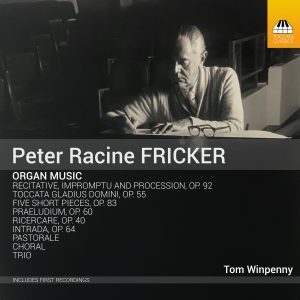
Peter Racine FRICKER: Organ Music
The London-born Peter Racine Fricker was once a prominent figure on the British musical landscape but slipped from view after he took up a teaching post in California in 1964. This first-ever survey of his organ music reveals a vigorously contrapuntal style, one which reconciles a taste for crunchy dissonance with a strong sense of melodic direction, its moods ranging from angular elegance to fierce climaxes swirling with energy and glittering with light. The organist here is Tom Winpenny, Assistant Master of the Music at St. Albans Cathedral and one of Britain’s brightest young stars in the organ firmament. He was formerly Sub-Organist at St. Paul’s Cathedral, and during this time he performed with the Cathedral Choir at the American Guild of Organists National Convention, performed in Mahler’s Symphony No. 8 with Valery Gergiev and the London Symphony Orchestra, and played for many major state occasions. He has also broadcast regularly on BBC Radio and been featured on American Public Media’s ‘Pipedreams.’
Tom Winpenny
Organ of Bridlington Priory
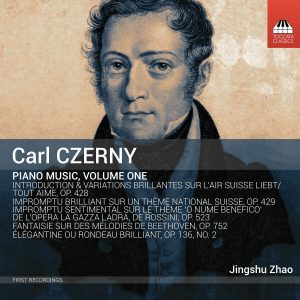
Carl CZERNY: Piano Music, Volume One
The Viennese-born Carl Czerny (1791–1857) is best remembered for his countless pedagogical studies, hundreds and hundreds of them. But Czerny’s astonishing fecundity – his opus numbers go up to 861, but there is much more music than that – has served to obscure the fact that he was an important composer in his own right, his works forming a link between Beethoven (his teacher) and Liszt (his student), between the Classical and Romantic eras. The pieces recorded here, all for the first time, reflect the brilliance of his own playing and were intended to impress the salons of Biedermeyer Vienna.
Jingshu Zhao, piano