Search Results for "choral"

Robert Fürstenthal: Complete Choral Music, Volume One
Like many Austrian Jews, Robert Fürstenthal (1920–2016) fled to the USA after the German invasion of his country in 1938. Music then became a link to his homeland: ‘When I compose, I am back in Vienna’. As an amateur composer, Fürstenthal preferred to work on a small scale, and his output of songs and chamber music is considerable. But he also wrote two sizable works for chamber choir, the first of which, in this series of two albums, is bookended by piano sonatas – all three works revealing that the tradition of Schubert and Brahms was alive in the California sun.
Ian Buckle, piano (Tracks 1–4, 16)
Richard Casey, piano (Tracks 5–10, 12–16)
Philippa Hyde, soprano (Tracks 6, 8, 12, 14)
Emma Roberts, contralto (Tracks 6, 7. 9, 12–15)
Rory Carver, tenor (Tracks 5–7, 10, 12, 14, 15)
Felix Kemp, bass (Tracks 5–7, 14)
Borealis (Tracks 5, 6, 8, 10, 13–15)
Skipton Camerata (Tracks 5–8, 10–15)
Stephen Muir, conductor (Tracks 5–15)
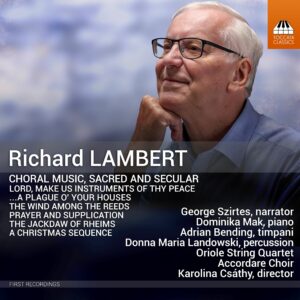
Richard Lambert: Choral Music, Sacred and Secular
The choral music of Richard Lambert, born in Bath in the English West Country in 1951, covers a wide range of expression, ranging on this album from straightforward SATB settings for church performance to a sardonic parody of the excesses of established religion. It also encompasses the timeless and the timely, with a number of contributions to the age-old tradition of Christmas music to a cantata inspired by the Covid pandemic.
This is the first recording of the Accordare Choir, founded and conducted by Karolina Csáthy, initially using former choral scholars of The Choir of Trinity College Cambridge; since then it has expanded in size, scope and accomplishment.
George Szirtes, narrator
Dominika Mak, piano
Adrian Bending, timpani
Donna Maria Landowski, percussion
Accordare Choir
Karolina Csáthy, director
In Handel’s Shadow: Vocal Music by his Rivals in 18th-Century London
The figure of George Frideric Handel cast a long shadow over musical London in the first half of the eighteenth century, condemning many of his contemporaries – fine composers themselves – to long years of obscurity. This recording throws light into forgotten corners and discovers some glittering gems, some of them demanding dazzling vocal fireworks from their performers. Several of these composers set scenes from Classical mythology or Old Testament narratives – but they also explore the underside of the Baroque psyche in one of David’s darkest psalms and in a representation of Arcadian madness.
Lux et Umbrae
Robert Crowe, soprano and artistic director
Annette Fischer, soprano
Julia Nilsen-Savage, cello
Sigrun Richter, archlute
Michael Eberth, harpsichord
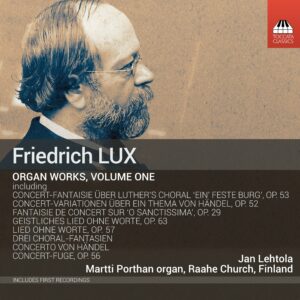
Friedrich Lux: Complete Works for Organ, Volume One
Friedrich Lux (1820–95) was one of the breed of musicians who bound together musical life in nineteenth-century Germany: though he worked away from the major cities, as conductor, teacher, organist, organiser and composer, he was an indispensable element of the communities in which he worked. His large body of organ music, as good as unknown before now, brings together elements of the musical language of Bach, Mendelssohn and Schumann, in works that range from the intimate to the grandiose
Jan Lehtola, Martti Porthan organ, Raahe Church, Finland
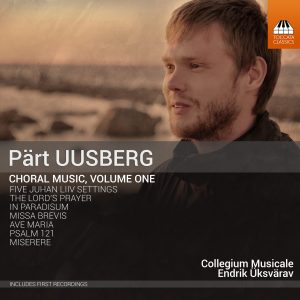
Pärt Uusberg: Choral Music, Volume One
This album introduces both a new voice and a new choir to western audiences: the Estonian Pärt Uusberg (b. 1986) is well known at home as a film actor as well as a composer; and in 2017 Collegium Musicale carried the coveted Silver Rose Bowl of the EBU competition ‘Let the Peoples Sing’ home to Tallinn. Uusberg’s works use many of the devices that have made recent Baltic choral music so popular in the wider world: melodies that unfold calmly over long bass lines, sustained by suspensions and piqued by mild dissonance – reflecting an awareness of the immensity of nature in music that is both exquisitely beautiful and infinitely touching.
Collegium Musicale
Endrik Üksvärav
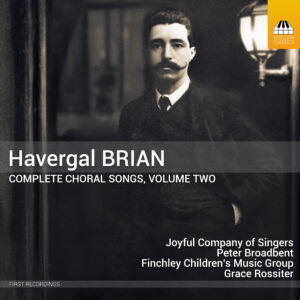
Havergal Brian: Complete Choral Songs, Volume Two
The reputation of Havergal Brian (1876–1972) as a late-blooming symphonist obscures the fact that he was an early-blooming composer of choral music for the huge market of amateur choirs thriving in Edwardian England. His choral songs range from simple unison settings for children’s or women’s voices to harmonically complex essays intended to tax the ability of groups taking part in the choral competitions once popular in regional Britain. This second selection includes four canons that Brian wrote in the early 1920s as contrapuntal studies for his mighty Gothic Symphony.
Joyful Company of Singers
Peter Broadbent, conductor
Finchley Children’s Music Group
Grace Rossiter, conductor
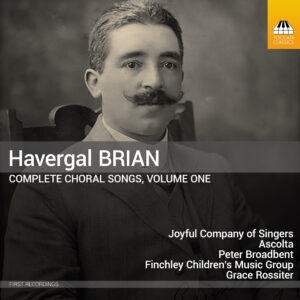
Havergal Brian: Complete Choral Songs, Volume One
The reputation of Havergal Brian (1876–1972) as a late-blossoming symphonist obscures the fact that he was an early-blossoming composer of choral music for the huge market of amateur choirs thriving in Edwardian England. His choral songs range from simple unison settings for children’s or women’s voices to harmonically complex essays intended to tax the ability of groups taking part in the choral competitions once popular in many parts of Britain.
Joyful Company of Singers
Peter Broadbent, conductor
Finchley Children’s Music Group
Grace Rossiter, conductor
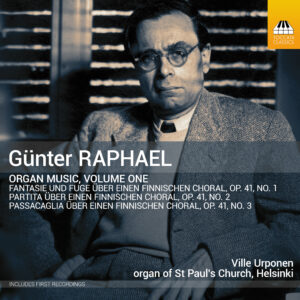
Günter Raphael: Organ Music, Volume One
In the 1930s, as Günter Raphael (1903–60) found doors closing in his native Germany – he was half-Jewish – he was accorded a warm reception in Finland, where his music was heard in a series of broadcast concerts. There was a family connection, too: Raphael’s grandfather had taught Sibelius in Berlin. Raphael acknowledged his welcome by incorporating Finnish material into his music, and his Op. 41 is a monumental organ triptych based on Finnish chorales, with two towering contrapuntal edifices either side of a Baroque suite.
Ville Urponen, organ of St Paul’s Church, Helsinki
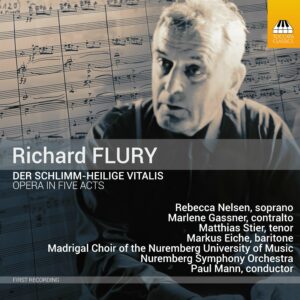
Richard Flury: Der schlimm-heilige Vitalis, Opera in Five Acts
Der schlimm-heilige Vitalis (which can be translated roughly as ‘Lustful Brother Vitalis‘) was the last of the four operas by the Swiss composer Richard Flury (1896–1967). It was premiered in 1963, the year after its completion, and then remained unheard until this recording. The plot, based on a novella by Flury’s fellow Swiss, Gottfried Keller, sets jolly village life against religious intolerance and sexual politics in an unsettling blend of the sentimental and the cynical – although love, of course, triumphs in the end. Flury’s late-Romantic music redeems the libretto with a steady flow of memorable melodies, engaging solo and choral numbers, and colourful orchestration – and with a sense of fun never far from the surface.
Rebecca Nelsen, soprano
Marlene Gassner, contralto
Matthias Stier, tenor
Markus Eiche, baritone
Madrigal Choir of the Nuremberg University of Music
Alfons Brandl, chorus-master
Nuremberg Symphony Orchestra
Paul Mann, conductor
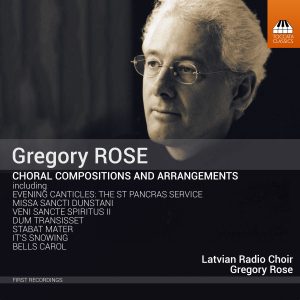
Gregory Rose: Choral Compositions and Arrangements
Gregory Rose (b. 1948) absorbed the English choral tradition from his father, the Oxford conductor and composer Bernard Rose, expanding that inheritance with the techniques of European and American modernism, acquired in part during his own conducting career. This conspectus of over four decades of choral music presents a vivid combination of original compositions and agreeable arrangements, sung here with exultant virtuosity by one of Europe’s leading choirs, conducted by Gregory Rose himself.
Latvian Radio Choir
Gregory Rose, conductor
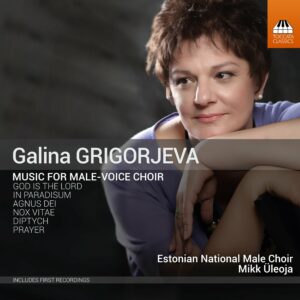
Galina Grigorjeva: Music for Male-Voice Choir
The choral music of Galina Grigorjeva – born in Simferopol in Ukraine in 1962 and based in Tallinn, in Estonia, since 1994 – is deeply rooted in the traditions of the Orthodox Church and in ancient Russian and Slavonic folklore. Although clearly by a contemporary composer, her works have a timeless, even hypnotic, quality that seems to reach back through the ages. She has been working with the Estonian National Male Choir – one of the finest in a country full of choirs – for some years now, and some of the works here were composed or arranged specifically for this recording.
Theodor Sink, cello (8, 9)
Aleksandr Mihhailov, bass (3)
Aleksander Arder, tenor (7)
Margus Vellmann, tenor (7, 9)
Grigori Rutškin, tenor (9)
Estonian National Male Choir
Mikk Üleoja, conductor
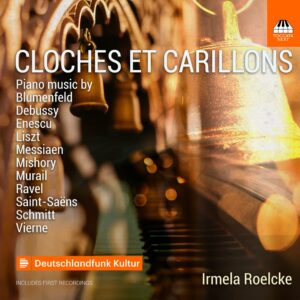
Cloches et Carillons
The piano is perhaps better suited than any other instrument to evoke the sound of bells – evening bells, bells of farewell and of joy, funereal bells, bells with spiritual overtones – and late-Romantic and twentieth-century French and Russian composers in particular have responded to the challenge of capturing those sonorities at the keyboard. This recital explores three centuries of pianistic tintinnabulation, and its ability to capture atmosphere and emotion.
Irmela Roelcke, piano
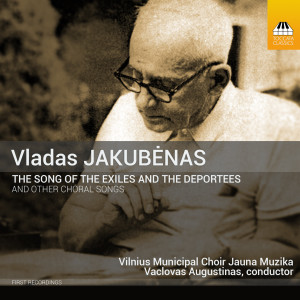
Vladas Jakubėnas: The Song of the Exiles and The Deportees and Other Choral Songs
The Lithuanian Vladas Jakubėnas (1904–78) is one of a lost generation of Baltic composers. A student of Schreker in Berlin, he returned home to help build the musical culture of his country. But the Nazi invasion and Soviet occupation drove him into exile and, after five years in refugee camps in Germany, he settled in Chicago, playing an important role in the Lithuanian diaspora in North America. These choral songs show the deep identification of his late-Romantic style with the folk-music of the land he was forced to leave behind.
Vilnius Municipal Choir Jauna Muzika
Jurgita Mintautiene, soprano
Gintautas Skliutas, tenor
Dainius Jozenas, piano
Vaclovas Augustinas, conductor
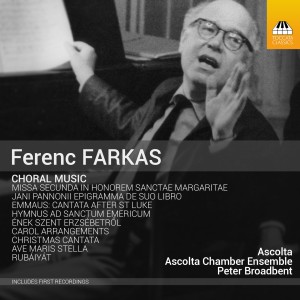
Ferenc Farkas: Choral Music
Toccata Classics continues its exploration of the music of the Hungarian composer Ferenc Farkas (1905–2000) with this selection from his huge output of choral music, ranging in mood from the folklike simplicity of the Missa Secunda in honorem Sanctae Margaritae and his bright carol settings via the asperity of some late a cappella pieces to the fresh and buoyant Christmas Cantata. This recording is also the first by the new London-based chamber choir Ascolta.
Ascolta; Ascolta Chamber Ensemble; Peter Broadbent, conductor;
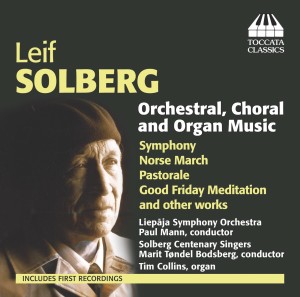
Leif Solberg: Orchestral, Choral and Organ Music
This CD commemorates the 100th birthday of the Norwegian composer and organist Leif Solberg (b. 1914). Solberg's only symphony (1950-51) confirms the contrapuntal mastery evident in his magisterial organ works, investing it with a touch of sardonic humour and the dancing rhythms of Norwegian folk-music; the choral Good Friday Meditation, by contrast, points to the lyrical side of his muse.
Tim Collins, organ; Anna Sundstrom Otervik, mezzo soprano; Magnus Ingemund Kjelstad, baritone; Solberg Centenary Singers; Marit Tondel Bodsberg, conductor; Liepaja Symphony Orchestra; Paul Mann, conductor
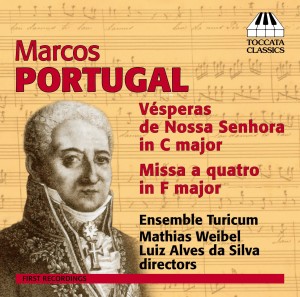
Marcos António Portugal: Choral Music
The Portuguese-Brazilian composer Marcos António Portugal (1762-1830) was best known in his day for his fifty or so operas, but he also composed a huge body of more than 160 religious choral works. The two here — in their first performances in modern times — illustrate his conservative Classical style as well as the operatic influences on his sacred music, but the absence of female voices from the chorus and violins from the orchestra bring an unexpectedly dark colour.
Ensemble Turicum, ensemble
Mathias Weibel, director
Luiz Alves da Silva, director