Search Results for "vokal gwsm" – Page 2
Showing results for vocal gun
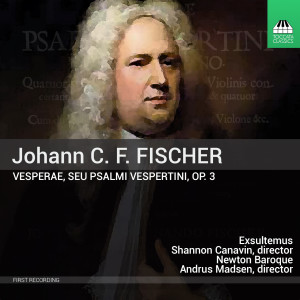
Johann Caspar Ferdinand Fischer: Vesperae, Op. 3
In his day Johann Caspar Ferdinand Fischer (1656–1746) was renowned as one of the major musicians in southern Germany, especially for his distinctly French keyboard music. His vocal music, by contrast, which has been far less thoroughly explored, looked to Italy for its models, as his captivating 1701 setting of the Vespers reveals. In keeping with the practice of the time, this first recording of Fischer’s Vespers includes music from elsewhere in his output, as well as two sonatas by the Munich-based Johann Christoph Pez (1664–1716).
Exsultemus
Shannon Canavin, director
Newton Baroque
Andrew Madsen, director, organ
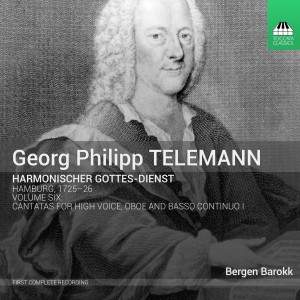
Georg Philipp Telemann: Harmonischer Gottes-Dienst, Volume 6: Seven Cantatas
This is the sixth CD in the first complete recording of the 72 cantatas in Georg Philipp Telemann’s collection Harmonischer Gottes-Dienst, published in Hamburg in 1726 – the first complete set of cantatas for the liturgical year to appear in print. The cantatas are designated for voice, an obbligato instrument (recorder, violin, transverse flute or oboe) and basso continuo, and generally take the form of two da capo arias with an intervening recitative. Although intended for worship, both public and private, Telemann’s cantatas are a masterly blend of tunefulness with skilled counterpoint and vocal and instrumental virtuosity.
Bergen Barokk
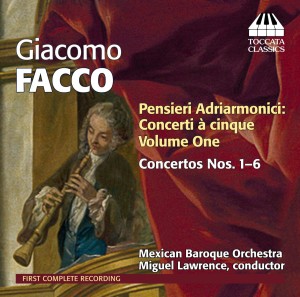
Giacomo Facco: Pensieri Adriarmonici: Concerti à cinque, Volume One
Giacomo Facco (1676-1753), born near Venice, was active in southern Italy as violinist, choirmaster and teacher before his appointment to the Spanish royal court around 1720. Although highly esteemed in his own time, particularly as a composer of vocal music, Facco had disappeared from musical history until a set of his twelve Pensieri Adriarmonici — concertos for three violins, viola, cello and basso continuo — were discovered in a Mexican library in 1962. Bright and buoyant, they have much in common with the music of Vivaldi, Albinoni, Marcello and Facco's other Venetian contemporaries — but are here given a distinct twist with a basso continuo of vihuela and guitarrón, as they might have been performed in eighteenth-century Mexico.
Manuel Zogbi, violin
Mexican Baroque Orchestra, chamber orchestra
Miguel Lawrence, director
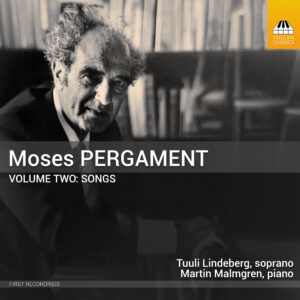
Moses Pergament, Volume Two: Songs
The Swedish composer Moses Pergament (1893-1977) — Finnish-born of Lithuanian-Jewish stock — chose the poems he set to music from a wide range of sources: those heard in this first-ever recording of his songs are mostly in Swedish but also in a variety of other languages. They likewise cover the gamut of human emotion, from buoyant folksongs and children’s verses via lyrical expressions of love and loss to stark meditations on suffering and death. Many of Pergament’s poets evoke the natural world in their expression of emotion, but his music never yields to sentimentality: he treats each song as a microcosm, expressed with drama and dignity. Time was when Pergament’s vocal music was performed by singers of the calibre of Birgit Nilsson, Elisabeth Söderström and Nicolai Gedda; it is high time it was rediscovered.
Tuuli Lindeberg, soprano
Martin Malmgren, piano
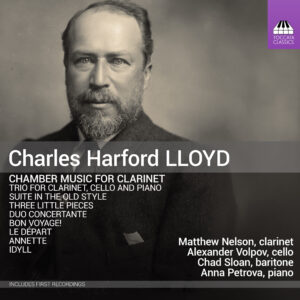
Charles Harford Lloyd: Chamber Music for Clarinet
Charles Harford Lloyd (1849–1919) – organist of Gloucester Cathedral and the Chapel Royal, Oxford theologian and concert-organiser, music master at Eton and much more – was one of the most distinguished musicians of Victorian England. The largest part of his output is vocal music, mostly for the church; he composed only a handful of chamber works, often involving the clarinet. He wrote in a light Romantic idiom, where the influence of Brahms is often audible, as with his close friend, Hubert Parry. Lloyd knew how to make the clarinet sing, with one lovely, long-limbed melody after another. This first-ever album of his chamber music rescues a long-forgotten figure from the shadows.
Matthew Nelson, clarinet
Alexander Volpov, cello
Chad Sloan, baritone
Anna Petrova, piano
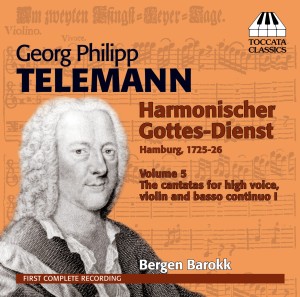
Georg Philipp Telemann: Harmonischer Gottes-Dienst, Volume Five
This is the fifth CD in the first complete recording of the 72 cantatas from Georg Philipp Telemann's collection Harmonischer Gottes-Dienst, published in Hamburg in 1726 — the first complete set of cantatas for the liturgical year to be appear in print. The cantatas are designated for voice, an obbligato instrument (recorder, violin, transverse flute or oboe) and basso continuo, and generally take the form of two da capo arias with an intervening recitative. Although intended for worship, both public and private, Telemann's cantatas are a masterly blend of tunefulness with skilled counterpoint and vocal and instrumental virtuosity.
Bergen Barokk
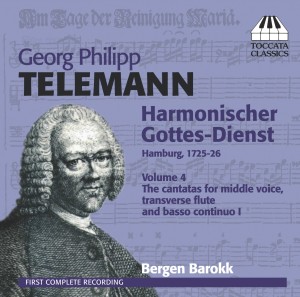
Georg Philipp Telemann: Harmonischer Gottes-Dienst, Volume Four
This is the fourth CD in the first complete recording of the 72 cantatas from Georg Philipp Telemann's collection Harmonischer Gottes-Dienst, published in Hamburg in 1726 — the first complete set of cantatas for the liturgical year to appear in print. The cantatas are designated for voice, an obbligato instrument (recorder, violin, transverse flute or oboe) and basso continuo, and generally take the form of two da capo arias with an intervening recitative. Although intended for worship, both public and private, Telemann's cantatas are a masterly blend of tunefulness with skilled counterpoint and vocal and instrumental virtuosity.
Bergen Barokk
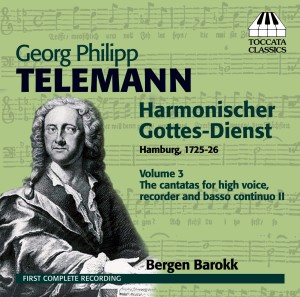
Georg Philipp Telemann: Harmonischer Gottes-Dienst, Volume Three
This is the third CD in the first complete recording of the 72 cantatas from Georg Philipp Telemann’s collection Harmonischer Gottes-Dienst, published in Hamburg in 1726 – the first complete set of cantatas for the liturgical year to be published. The cantatas are designated for voice, an obbligato instrument – recorder (as on this disc), violin, transverse flute or oboe – and basso continuo, and take the form of two da capo arias with an intervening recitative. Although intended for worship, both public and private, Telemann’s cantatas are a masterly blend of tunefulness with skilled counterpoint and vocal and instrumental virtuosity.
Bergen Barokk
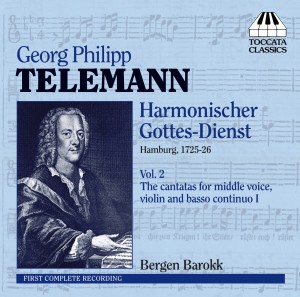
Georg Philipp Telemann: Harmonischer Gottes-Dienst, Volume Two
This is the second CD in the first complete recording of the 72 cantatas from Georg Philipp Telemann’s collection Harmonischer Gottes-Dienst, published in Hamburg in 1726 – the first complete set of cantatas for the liturgical year to be published. The cantatas are designated for voice, an obbligato instrument (violin on this disc) and basso continuo, and take the form of two da capo arias with an intervening recitative. Although intended for worship, both public and private, Telemann’s cantatas are a masterly blend of tunefulness with skilled counterpoint and vocal and instrumental virtuosity.
Bergen Barokk
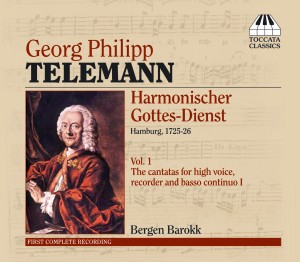
Georg Philipp Telemann: Harmonischer Gottes-Dienst, Volume One
This is the first CD in the first complete recording of the 72 cantatas from Georg Philipp Telemann’s collection Harmonischer Gottes-Dienst, published in Hamburg in 1726 – the first complete set of cantatas for the liturgical year to be published. The cantatas are designated for voice, an obbligato instrument (recorder, violin, transverse flute or oboe) and basso continuo, and take the form of two da capo arias with an intervening recitative. Although intended for worship, both public and private, Telemann’s cantatas are a masterly blend of tunefulness with skilled counterpoint and vocal and instrumental virtuosity.
Bergen Barokk
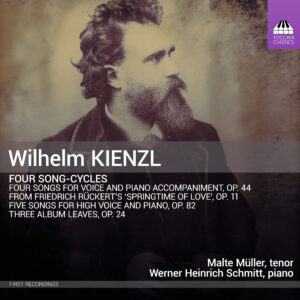
Wilhelm Kienzl: Four Song-Cycles
The Austrian composer Wilhelm Kienzl (1857–1941) – also a pianist, conductor, musicologist and writer on music – enjoyed the esteem of his contemporaries particularly for his vocal music. But his star has waned over the past century, and only a handful of his 238 songs have had recent recordings. In style they range from the simple and folk-like to the dramatic and quasi-operatic; their harmonic world likewise embraces both the diatonic and chromatic, with hints of the influence of Schubert, Schumann, Brahms, Wagner and a foretaste of later composers. The four song-cycles recorded here treat the grand themes of life: love, loss, death and man’s interaction with nature.
Malte Müller, tenor
Werner Heinrich Schmitt, piano
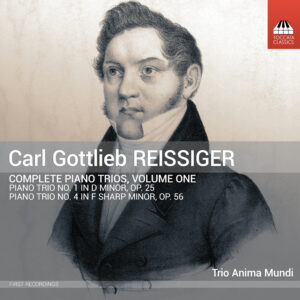
Carl Gottlieb Reissiger: Complete Piano Trios, Volume One
In his day the now-forgotten Carl Gottlieb Reissiger (1798–1859) was highly esteemed, both as conductor and composer; indeed, his presence in Dresden from 1826 made it one of the main operatic centres in Germany. He wrote nine operas himself, as well as a huge quantity of vocal music (including at least twelve Masses), and his large output of chamber music boasts no fewer than 27 piano trios. These two early exemplars in this first-ever complete recorded cycle of those trios have a Mendelssohnian elegance and clarity, deepened here and there by a touch of Beethovenian pathos. Schumann was an enthusiast: ‘When I think of Reissiger’s trios, the words lovely and jewel-like come to mind. These choice and lovely works remind one of a chain of flowers. […] His music never fatigues the ear, but holds our attention to the very end’.
Trio Anima Mundi
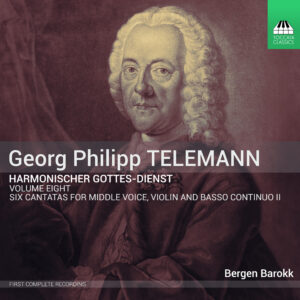
Telemann: Harmonischer Gottes-Dienst, Volume 8
This is the eighth album in the first complete recording of the 72 cantatas in Georg Philipp Telemann’s collection Harmonischer Gottes-Dienst, published in Hamburg in 1726 – the first complete set of cantatas for the liturgical year to appear in print. The cantatas are designated for voice, an obbligato instrument (recorder, transverse flute, oboe or violin) and basso continuo, and generally take the form of two da capo arias with an intervening recitative. Although intended for worship, both public and private, Telemann’s cantatas are a masterly blend of tunefulness with skilled counterpoint and vocal and instrumental virtuosity.
Bergen Barokk