Search Results for "marya waad"
Showing results for mary wood
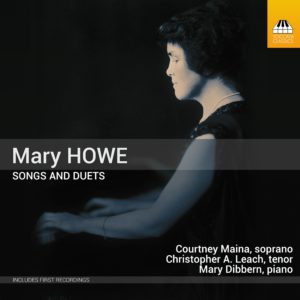
Mary Howe: Songs and Duets
The name of Mary Howe (1882–1964) seems to have vanished from the history books. But she was an important voice in American music in the first half of the twentieth century, as an activist and organiser, as a concert pianist and, especially, as a composer. This pioneering album of her songs shows her late-Romantic style open to influences from Debussy, Mahler, Richard Strauss and other contemporaries: she was, she said, ‘alert for new sensations, like a Puritan on a holiday’.
Courtney Maina, soprano (tracks 1,2, 4, 10-13, 15, 16, 19, 20, 22)
Christopher A. Leach, tenor (tracks 1, 3, 5-10, 13, 17, 18, 21, 22)
Mary Dibbern, piano
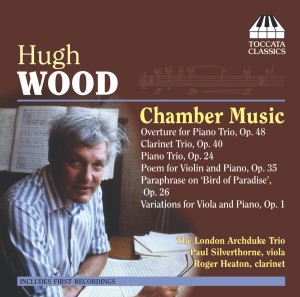
Hugh Wood: Chamber Music
Hugh Wood, born in Lancashire in 1932, is one of Britain's most distinguished composers, his music marrying expressionist power and lyrical elegance. Although Wood has a number of large-scale pieces to his credit, he prefers the intimacy of chamber music and these six works ranging from his Op. 1, written in 1958, to Overture for Piano Trio of 2005 — expertly balance formal clarity, rigorous craftsmanship and a high charge of energy.
Paul Silverthorne, viola
Roger Heaton, clarinet
London Archduke Trio, piano trio
Nathaniel Vallois, violin
Gabriella Swallow, cello
Charles Wiffen, piano
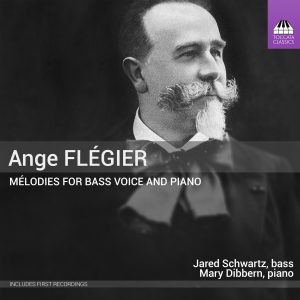
Ange Flégier: Mélodies for Bass Voice and Piano
Although the French composer Ange Flégier (1846–1927) has now been lost from view, he enjoyed considerable fame in his own time thanks to the extraordinary reception of his song Le Cor. Indeed, the mélodie holds a predominant place in his catalogue of more than 350 works. Flégier’s songs, composed for his colleagues at the Opéra de Paris, are large-scale and orchestrally conceived, sitting stylistically close to Duparc in their dignified drama. Many of them receive their first recordings or first modern recordings here.
Jared Schwartz, bass
Mary Dibbern, piano
Thomas Demer, viola (Track 9)
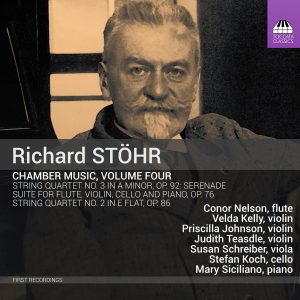
Richard STÖHR: Chamber Music, Volume Four
Like Korngold, Toch, Schoenberg, Zeisl and Zemlinsky, Richard Stöhr (1874–1967) was another Austrian composer driven into American exile by the Nazis. His generous output of music, being rediscovered at last in these Toccata Classics recordings, includes seven symphonies, much chamber music, songs, and choral and piano pieces. These chamber works, from his first years in the United States, show him in surprisingly relaxed mood, the Viennese lyricism of his native city maintained in his US refuge.
Stefan Koch, cello
Conor Nelson, (Tracks flute 1 – 4)
Velda Kelly, (Tracks violin 1 – 4)
Priscilla Johnson, (Tracks violin 5 – 9)
Judith Teasdle, (Tracks violin 5 – 9)
Susan Schreiber, (Tracks viola 5 – 9)
Mary Siciliano (Tracks 1 – 4)
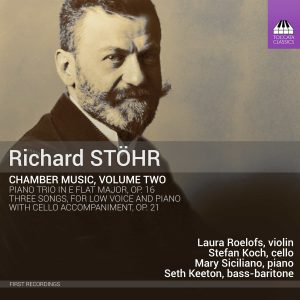
Richard Stöhr: Chamber Music, Volume Two
Like Korngold, Toch, Schoenberg, Zeisl and Zemlinsky, Richard Stöhr (1874–1967) was another Austrian composer driven into American exile by the Nazis. His generous output of music – ripe for rediscovery – includes seven symphonies, fifteen violin sonatas among much other chamber music, songs, and choral and piano pieces. His expansive E flat Piano Trio of 1905 sits firmly in the Viennese Romantic tradition downstream from Schubert and Brahms, with one lovely tune following another, whereas the Three Songs, written only four years later, look forward to the lyrical intensity of Korngold.
Laura Roelofs, violin (Tracks 1-4)
Stefan Koch, cello
Mary Siciliano, piano
Seth Keeton, bass-baritone (Tracks 5-7)
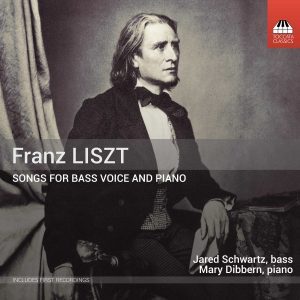
Franz Liszt: Songs for Bass Voice and Piano
Throughout Liszt’s long career, his songs – perhaps the most neglected part of his enormous output – took a radical approach to form, eschewing convention in search of a sincere musical response to each text. His free-spirited creativity meant that a single song would often call on a range of stylistic devices, among them bel canto vocal lines, unaccompanied recitative, orchestrally conceived piano textures and audacious harmonic procedures. This first recording of Liszt songs by a bass voice brings out both the power and poetry of his remarkable imagination.
Jared Schwartz, bass
Mary Dibbern, piano
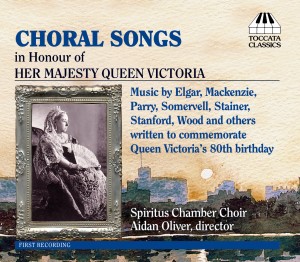
Choral Songs in honour of Her Majesty Queen Victoria
In celebration of Queen Victoria’s 80th birthday in 1899, thirteen of the leading composers and poets of the day collaborated on a collection of partsongs to rival their Elizabethan model, The Triumphs of Oriana. Published in a limited edition of only 100 copies, this superb sequence, studded with musical gems, provides a fascinating snapshot of the British musical renaissance on the eve of the twentieth century.
Spiritus Chamber Choir, choir
Aidan Oliver, director
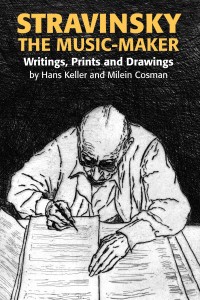
Stravinsky the Music-Maker: Writings, Prints and Drawings
Foreword by Hugh Wood
Edited by Martin Anderson
Extent: 242 pages
Composition: Royal octavo; profusely illustrated
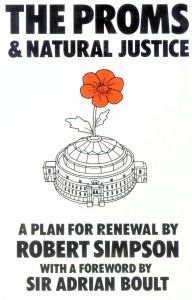
The Proms and Natural Justice: A Plan for Renewal
With a Forward by Sir Adrian Boult
Extent: 72 pages
Composition: Crown octavo; no illus or exx. vi+66 pages
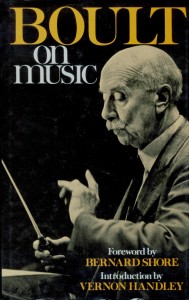
Boult on Music: Words from a Lifetime’s Communication
Foreward by Bernard Shore
Introduction by Vernon Handley
Edited by Martin Anderson
Extent: 197 pages
Composition: Demy octavo ~ Index
Illustrations: 6 music exx.
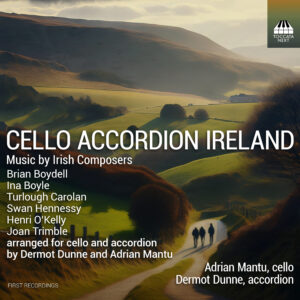
Cello Accordion Ireland
The sound of the accordion is an underexploited resource in classical music; it is heard even less frequently in combination with other instruments. This recital of music by Irish composers for cello and accordion – from the nimble folk idiom of Turlough Carolan to the passionate Romanticism of more recent men and women – demonstrates just how effectively these colours blend together. And it is not just the medium which is unusual: much of this music is as good as unknown.
Adrian Mantu, cello
Dermot Dunne, accordion
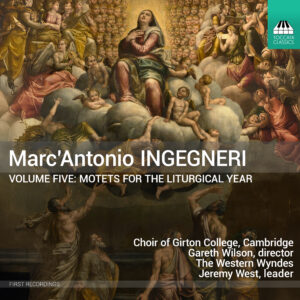
Marc’Antonio Ingegneri, Volume Five: Motets for the Liturgical Year
The Choir of Girton College, Cambridge, continues its pioneering exploration of the music of the Italian Renaissance master Marc’Antonio Ingegneri (c. 1535/36–92) with a journey through the liturgical year, as mirrored in Ingegneri’s motets. A ‘concept album’ of Renaissance polyphony may be an unusual undertaking, but this one illustrates how Ingegneri took his lead from the emotions implicit in each major celebration of the church – from sorrow and awe to joy and jubilation – expressed in music of extraordinary beauty, belying the internal complexity that gives it its emotional power.
Choir of Girton College, Cambridge
Gareth Wilson, director
The Western Wyndes
Jeremy West, leader
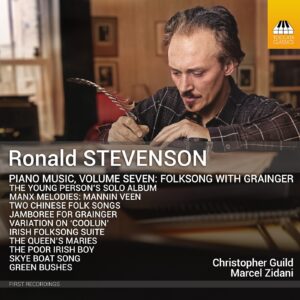
Ronald Stevenson: Piano Music, Volume Seven – Folksongs with Grainger
Percy Grainger (1882–1961) and Ronald Stevenson (1928–2015), both composer-pianists of the Golden Age of keyboard virtuosity, shared a passion for folksong, especially the modal Celtic melodies from the fringes of the British Isles. Though the two never met, they corresponded for many years, with Stevenson arranging many of Grainger’s transcriptions in a deliberate act of homage to the older man, whose quirky originality brought Stevenson illumination on his own idiosyncratic path. This seventh instalment in Christopher Guild’s Toccata Classics survey of Stevenson’s piano music uncorks the exultant good humour that he and Grainger found on that common Celtic ground.
Christopher Guild, piano
Marcel Zidani, piano
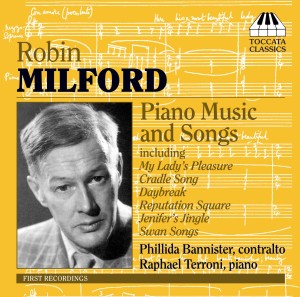
Robin Milford: Piano Music and Songs
The music of Robin Milford (1903-59) taps into that distinctly English vein of pastoral melancholy. Lying on a continuum between the work of his friends Gerald Finzi and Ralph Vaughan Williams, Milford’s voice is nonetheless unique: lyrical, gentle, unemphatic – quietly individual. The dark lyricism of the songs on this CD, reflecting the composer’s troubled life, offers a striking contrast with the buoyant, folksong-inspired dances for solo piano – Milford at his happiest.
Phillida Bannister, contralto
Raphael Terroni, piano
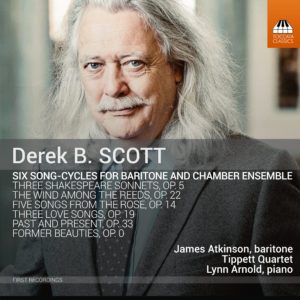
Derek B. Scott: Six Song-Cycles for Baritone and Chamber Ensemble
Derek Scott, born in Birmingham in 1950, has an international reputation as a leading historian of the British music hall and other forms of light entertainment. But he is an outstanding composer in his own right, his music treading a fine line between a very English whimsy and a profoundly felt and natural response to his subject matter. These six song-cycles – with influences ranging from Vaughan Williams to The Beatles – reveal a master craftsman and natural tunesmith, who manages to unite good humour, unerring technique and deep feeling in music of immediate appeal, setting texts by poets who include Burns, Hardy, Shakespeare, Swift, Wordsworth, Yeats and the composer himself.
James Atkinson, baritone
Lynn Arnold, piano (Tracks 1-8, 14-26)
Tippett Quartet
John Mills and Jeremy Isaac, violins
Lydia Lowndes-Northcott, viola
Božidar Vukotić, cello