Search Results for "kupi lover nangis original" – Page 7
Showing results for kbp lover nazis original
Recording “An Outstretched Hand” and Other Chamber Works
At half past four on a Friday morning in May 2018 I set out from my home in south-eastern France to go to England. The…

An Infinity of Traces: Influence Without Anxiety
I often play a kind of party game with friends: each participant will offer a recording of a piece of music by a less-well-known composer,…

All the Keys in Kent
One of the Toccata Classics releases later this summer will be a recording of a sequence of piano preludes commissioned from me in 2014 by…
Steven Elcock, symphonist
UPDATE – STEVE ELCOCK: ORCHESTRAL MUSIC, VOLUME ONE IS OUT NOW! You can imagine that, running a recording label, I get approaches from all sorts…

Recording my Tone Poems in Liepāja
The first thing I noticed was the trees. Once we were out of Riga airport, they soon crowded up to the edge of the road;…
John Gardner, Symphonist
This interview was published in Fanfare, Vol. 24, No. 1 (September/October 2000) to mark the release of an ASV CD of John Gardner’s orchestral music.…
‘We Should Know Who We Are’: Veljo Tormis in Conversation
Learn More I am much saddened by the news of the death of Veljo Tormis on Saturday, 21 January. Tormis was as significant a figure…

Unlocking the Secrets of Sacred Music in Late-Eighteenth-Century Rome: Detective Work among Dusty Manuscripts
For better or worse, I have always been highly (some would say provocatively) inquisitive, and not always content to accept, without question, received narratives of…
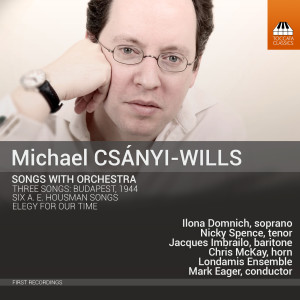
Michael Csányi-Wills: Songs With Orchestra
These orchestral songs by the English composer Michael Csányi-Wills (b. 1975) all deal with the subject of loss. In Three Songs – Budapest, 1944 Csányi-Wills uses documentation from his own family history to shadow the fate of Hungary’s Jews under the Nazis. Mortality is an omnipresent theme in A. E. Housman’s Shropshire Lad poems. And Elegy for Our Time sets an anguished lament by Jessica d’Este, sparked by the death of her granddaughter in a car crash. Csányi-Wills responds to the stimulus of these dark texts with music that is hauntingly lyrical and elegiac.
Ilona Domnich, soprano
Nicky Spence, tenor
Jacques Imbrailo, baritone
Chris McKay, horn
Londamis Ensemble
Mark Eager, conductor
First recordings
‘And do you also play the violin?’
Foreword by Sir Yehudi Menuhin
Extant: 382
Composition: Demy octavo ~ Profusely illustrated with facsimiles and photographs ~ Index
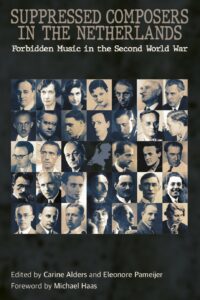
Suppressed Composers in the Netherlands
Forbidden Music in the Second World War
Edited by Carine Alders and Eleonore Pameijer
Foreword by Michael Haas
356 Pages
23.4 x 15.6 cm
Hardcover
11 colour and 61 b/w illustrations
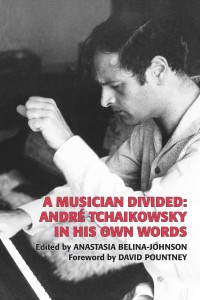
A Musician Divided: André Tchaikowsky in his Own Words
Edited by Anastasia Belina-Johnson
Foreword by David Pountney
Extant: 434
Composition: Royal octavo ~ Recordings of André Tchaikowsky's Music ~ André Tchaikowsky's Recordings ~ Index of Tchaikowsky's Music ~ General Index ~ CD of André Tchaikowsky in recital
Illustrations: 72
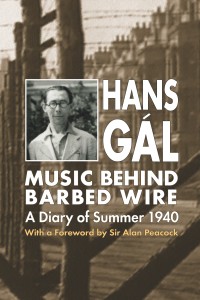
Hans Gál: Music behind Barbed Wire: A Diary of Summer 1940
Translated by Eva Fox-Gál and Anthony Fox
English edition edited by Martin Anderson
Foreword by Sir Alan Peacock
Extant: 243
Composition: Royal octavo ~ Editorial Introduction ~ Eva Fox-Gál: ‘Hans Gál: A Biographical Introduction’ ~ Richard Dove: ‘”Most Regrettable and Deplorable Things have Happened”: Britain’s Internment of Enemy Aliens in 1940’ ~ Hans Gál: Music behind Barbed Wire ~ Eva Fox-Gál: ‘Gál in Britain’ ~ Appendices – One: Personalia; Two: CD Programme; Three: Martin Anderson: Hans Gál in Conversation; Four: The Hans Gál Society; Five: The Contributors ~ Bibliography ~ Index of Gál’s Works ~ General Index
Illustrations: c. 50
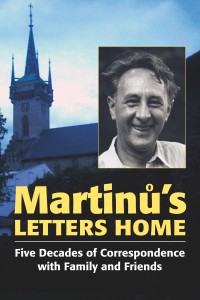
Martinů’s Letters Home: Five Decades of Correspondence with Family and Friends
Edited by Iša Popelka
Translated by Ralph Slayton
ISBN: 978-0-907689-77-5
Extent: 245 pages
Size: 16.4 x 24.1 cm
Published: March 2013
Composition: Royal octavo
Illustrations: 52
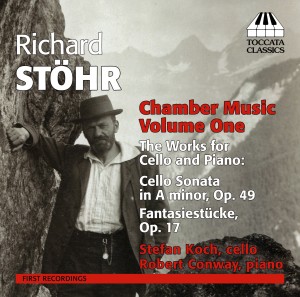
Richard Stöhr: Chamber Music, Volume One
Like Korngold, Schoenberg, Zeisl and Zemlinsky, Richard Stöhr (1874-1967) was another Austrian composer driven into American exile by the Nazis. His generous output of music — ripe for rediscovery — includes seven symphonies, fifteen violin sonatas among much other chamber music, songs, and choral and piano pieces. His two works for cello and piano — the four Fantasiestücke of 1907 and a Sonata from 1915, recorded here in the first of a series devoted to Stöhr's music — reveal a composer with a lyrical and expressive language downstream from Brahms and Schumann.
Stefan Koch, cello
Robert Conway, piano
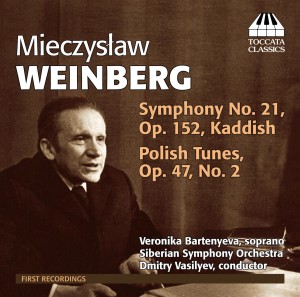
Mieczysław Weinberg: Music for Orchestra
Mieczysław Weinberg, born in Warsaw in 1919, became a close friend of Shostakovich in Moscow, after fleeing eastwards before the invading Nazis in 1939. His style has much in common with Shostakovich's: fluent contrapuntal skill, a keen feeling for melody, often inflected with Jewish cantilena, and an acute sense of drama which combines a natural narrative manner with an extraordinary ability to create atmosphere. Since his death in 1996, his vast output — which includes 26 symphonies, seven operas and seventeen string quartets — has enjoyed increasing recognition as some of the most individual and compelling music to have been composed in the twentieth century. This recording pairs an early orchestral work, the suite Polish Tunes of 1950, with the last full orchestral symphony he was to complete, dedicated to the memory of those who died in the Warsaw Ghetto.
Veronika Bartenyeva, soprano
Siberian Symphony Orchestra, orchestra
Dmitry Vasilyev, conductor