Search Results for "kupi lover nangis original" – Page 4
Showing results for kbp lover nazis original
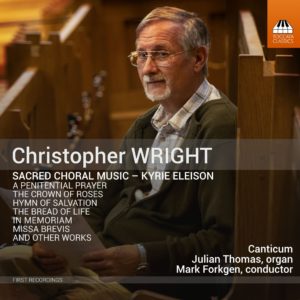
Christopher Wright: Sacred Choral Music
The English composer Christopher Wright, born in Suffolk in 1954, declares that he is ‘not fettered by fashion, style, ideology or gimmickry or some insatiable desire to be original’; instead, he writes music that aims to communicate directly with the listener – although it can also be thorny and challenging. This first-ever album of his sacred choral music reveals it to be in the British-cathedral tradition of composers like Benjamin Britten, William Mathias, Bernard Rose and Malcolm Williamson: the melodic lines may on occasion be angular and the harmonies sometimes tart, but Wright’s concern with immediacy of expression ensures that the ‘personal prayers’ embodied in these pieces can be readily understood and appreciated.
Canticum
Julian Thomas, organ
Mark Forkgen, director
First recordings
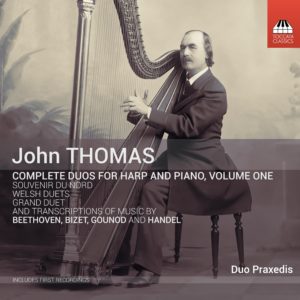
John THOMAS: Complete Duos for Harp and Piano, Volume One
Harpist to Queen Victoria, the Welsh composer John Thomas (1826–1913) was also a prolific composer for his own instrument, writing works both for solo harp and for duos of two harps or harp and piano – a combination where the different sounds of the two instruments enhances the clarity of the texture. Thomas’ original works use the elegant Romantic style of his own day, but he often drew on Welsh folksong for his inspiration and also left a generous legacy of transcriptions, especially of operatic favourites
Duo Praxedis: Praxedis Hug-Rütti (harp); Praxedis Geneviève Hug (piano)
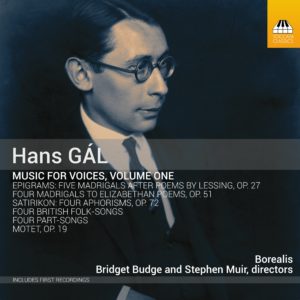
Hans GÁL: Music for Voices, Volume One
Whether in his original home of Vienna, as a conservatoire director in Germany, or as an émigré in Edinburgh, where he became one of the mainstays of musical life, Hans Gál (1890–1987) championed choral singing as a way of directly involving people in making music: he founded and conducted a number of choirs and provided an extensive output of choral compositions. This first volume in a long-term project to record his choral music presents a rich variety of works for a cappella voices, ranging from demanding eight-part choruses to charming folksong settings.
Borealis
Bridget Budge (1 –14, 19–22)
and Stephen Muir (15–18), directors
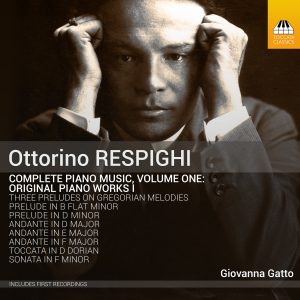
Ottorino RESPIGHI: Complete Piano Music, Volume One
Respighi’s orchestral works are some of the most popular in the mainstream repertoire. His output of piano music, by contrast, is as good as unknown, and this new Toccata Classics series will be the first ever to present it all: original works and transcriptions alike, for solo piano, piano four hands and two pianos. This first instalment crowns his earliest keyboard compositions with the magisterial Three Preludes on Gregorian Melodies, miniature Lisztian tone-poems presented with Busonian grandeur.
Giovanna Gatto, piano
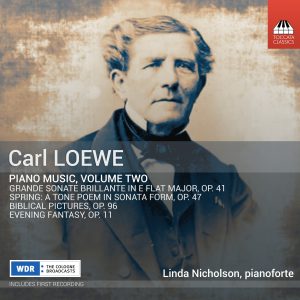
Carl LOEWE: Piano Music, Volume Two
Known in his lifetime as ‘the north German Schubert’, Carl Loewe (1796–1869) is remembered today chiefly as a composer of ballads. Yet there is a considerable body of piano music that is strikingly innovative in content, expression and harmony, containing the germs of ideas later taken up by composers such as Wagner and Liszt. Loewe was unquestionably a brilliantly original talent, a major figure in ushering in the Romantic era.
Linda Nicholson, piano Erard, Paris, c. 1839
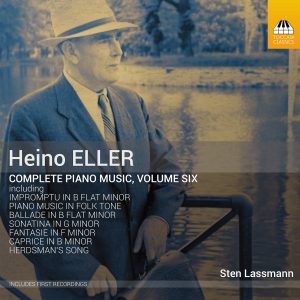
Heino Eller: Complete Piano Music, Volume Six
The piano music of the Estonian composer Heino Eller (1887–1970), a total of 206 works, is not only the largest part of his output: it is also the largest body of works in Estonian classical music. But most of these pieces are unknown, even though the best of them are original contributions to the piano repertoire of the twentieth century, with Eller’s sensitive lyricism underpinned by gentle humour and an occasional epic tone. Volume Six in this series of nine recordings brings over a half-century of music, from 1910 to 1965, including the melodious Sonatina in G minor, the spirited Piano Music in Folk Tone and the exquisite La fille du nord.
Sten Lassmann, piano
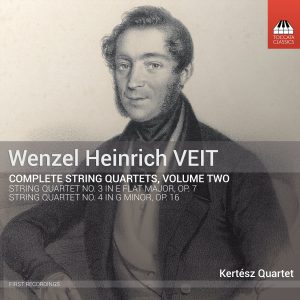
Wenzel Heinrich Veit: Complete String Quartets, Volume Two
The German-Bohemian composer Wenzel Heinrich Veit (1806–64) – Václav Jindřich Veit in Czech – is one of music’s most unjustly forgotten figures. As these first recordings of his four string quartets will show, he is not only the link between the Bohemian composers of the end of the Classical period and the wave of Czech Romanticism that began with Smetana but also an outstanding composer in his own right. His quartets trace the stylistic evolution of his time: they emerge from a debt to Haydn and Beethoven and embrace Mendelssohn and Schumann on their way to pre-echoes of Dvořák.
Kertész Quartet, playing on original instruments
Katalin Kertész and Jean Paterson, violins
Nichola Blakey, viola
Cressida Nash, cello
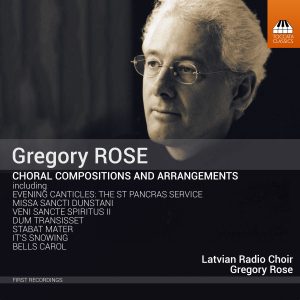
Gregory Rose: Choral Compositions and Arrangements
Gregory Rose (b. 1948) absorbed the English choral tradition from his father, the Oxford conductor and composer Bernard Rose, expanding that inheritance with the techniques of European and American modernism, acquired in part during his own conducting career. This conspectus of over four decades of choral music presents a vivid combination of original compositions and agreeable arrangements, sung here with exultant virtuosity by one of Europe’s leading choirs, conducted by Gregory Rose himself.
Latvian Radio Choir
Gregory Rose, conductor
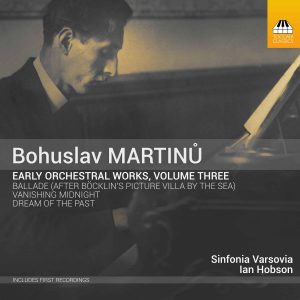
Bohuslav Martinů: Early Orchestral Works, Volume Three
This series of recordings of Martinů’s early orchestral works has already brought more than its fair share of surprises. The two shorter works here are colourful and atmospheric tone-poems, pieces of real substance and major discoveries in their own right. But it is the 1922 symphonic triptych Vanishing Midnight (Míjející půlnoc in the original Czech) – here receiving its first recording – which will prove the real revelation. A big-hearted work of breathtaking opulence and striking confidence, Vanishing Midnight is as exquisitely lovely as it is powerful and dramatic – Martinů’s first true masterpiece.
Sinfonia Varsovia
Agnieszka Kopacka, piano (Track 5)
Ian Hobson, conductor
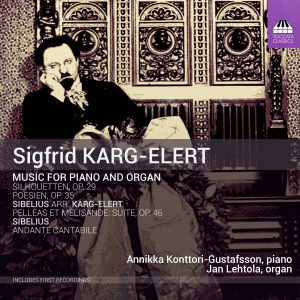
Sigfrid Karg-Elert: Music for Piano and Organ
As the popularity of domestic music-making grew through the nineteenth century, it brought first the piano and, then, often the harmonium into well-off living-rooms across the western world. Composers naturally responded, with original works and arrangements: Sibelius’ Andante cantabile was written after a visit to relatives who had both instruments in their salon; Karg-Elert, by contrast, was one of the world’s outstanding virtuosi on both harmonium and organ and composed with his concert public in mind. This recording thus revives long-forgotten sonorities that once would have been very familiar.
Annikka Konttori-Gustafsson, piano
Jan Lehtola, organ
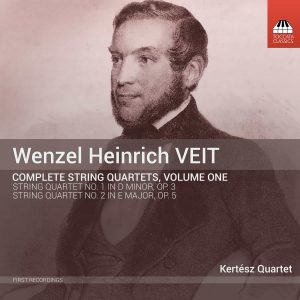
Wenzel Heinrich Veit: Complete String Quartets, Volume One
The German-Bohemian composer Wenzel Heinrich Veit (1806–64) – Václav Jindřich Veit in Czech – is one of music’s most unjustly forgotten figures. As these first recordings of his four string quartets will show, he is not only the link between the Bohemian composers of the end of the Classical period and the wave of Czech Romanticism that began with Smetana but also an outstanding composer in his own right. His quartets trace the stylistic evolution of his time: they emerge from a debt to Haydn and Beethoven and embrace Mendelssohn and Schumann on their way to pre-echoes of Dvořák.
Kertész Quartet, playing on original instruments
Katalin Kertész and Jean Paterson, violins
Nichola Blakey, viola
Cressida Nash, cello
Too Many Symphonies? — Part two: Fridrich Bruk
Having traversed the symphonies of Robert Keeley in Part One of this brief survey (Too Many Symphonies – Part One – posted on 9 March…
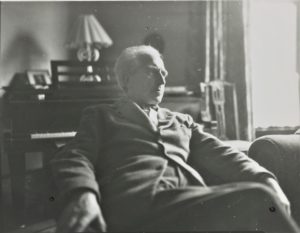
Recording Francis George Scott’s Piano Music
Two years after I began to record it, the first-ever album of Francis George Scott’s piano music is now available. The programme as it appears…

Noah Max in Conversation with Martin Anderson
In March 2022 Toccata Classics released an album of music by Noah Max (b. 1998) – painter, poet and conductor as well as composer. Since…

Arranging Wagner and the Ensuing Obsession
The release of Wagner by Arrangement, Volume Three (TOCC 0673), is the first part in a personal masterplan of Wagnerianism that has been going on for the…
‘A Gigantic Bear Hug’ From Scotland
The third volume of Ronald Stevenson’s piano music (TOCC 0403, released on 1 February) has been probably the most interesting album of his music I’ve…