Search Results for "Modular aggregator for DEX-based margin" – Page 2
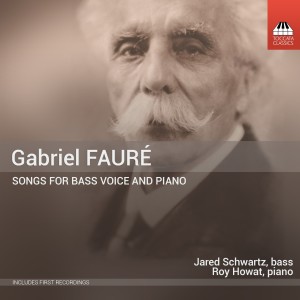
Gabriel Fauré: Songs for Bass Voice and Piano
This collection of Fauré’s mélodies – the first recording to be conceived for a bass voice – juxtaposes some of the composer’s best-loved songs with some of his lesser-known works. Going beyond the often arbitrary ordering of early editions, this programme draws out connections of poets and poetic themes, some of which restore the composer’s own original groupings. This is the first recording to be based on the new Peters Edition, which eliminates countless errors in older publications.
Jared Schwartz, bass; Roy Howat, piano;
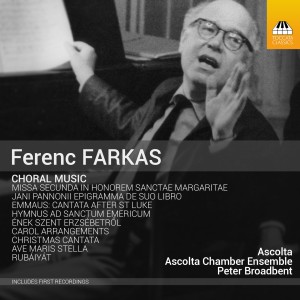
Ferenc Farkas: Choral Music
Toccata Classics continues its exploration of the music of the Hungarian composer Ferenc Farkas (1905–2000) with this selection from his huge output of choral music, ranging in mood from the folklike simplicity of the Missa Secunda in honorem Sanctae Margaritae and his bright carol settings via the asperity of some late a cappella pieces to the fresh and buoyant Christmas Cantata. This recording is also the first by the new London-based chamber choir Ascolta.
Ascolta; Ascolta Chamber Ensemble; Peter Broadbent, conductor;
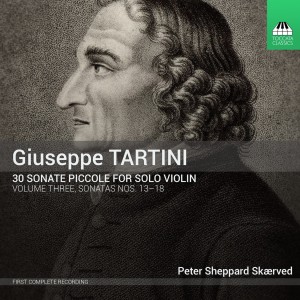
Giuseppe Tartini: 30 Sonate Piccole for Solo Violin, Volume Three: Sonatas Nos. 13-18
In the last years of his life, the great composer, violinist and swordsman Giuseppe Tartini (1692–1770) laboured at a cycle of sonatas for solo violin. The resulting manuscript offers the most important composition for solo violin after Bach and, at six hours in duration, the largest integrated work for the instrument. This first complete recording is based on a fresh study of the source and includes a number of works in Tartini’s shorthand, overlooked in earlier editions.
Peter Sheppard Skærved
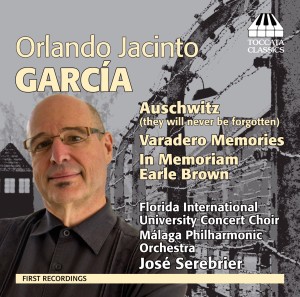
Orlando Jacinto García: Music for Chorus and Orchestra
Born in Havana in 1954, the Miami-based Orlando Jacinto García studied with Morton Feldman and has inherited some of Feldman's concerns: his music likewise evolves gradually over slow-moving spans of time, unfolding like the leaves of a plant, generating colours as with the gentle turning of a kaleidoscope. The elegiac Auschwitz (they will never be forgotten), a meditation for chorus and orchestra, captures something of the infinite sorrow evoked by the memory of such institutionalised cruelty. Varadero Memories is an abstract recollection of a Cuban beach where as a child he spent time with his grandparents. And the hypnotic In Memoriam Earle Brown pays elegant, understated tribute to a seminal figure in American modernism.
Florida International University Concert Choir, choir
Mark Aliapoulios, conductor
Málaga Philharmonic Orchestra, orchestra
José Serebrier, conductor
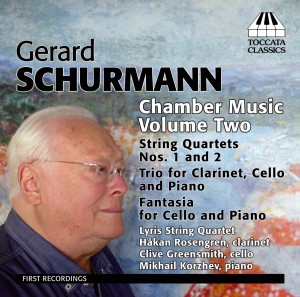
Gerard Schurmann: Chamber Music Volume Two
The Anglo-Dutch composer Gerard Schurmann, born in the East Indies in 1924 and based in the USA since 1981, first made his mark in Britain in the 1940s and '50s, as a pianist and composer, particularly of chamber music and, later, of film scores. His concert output is intense, passionate, tightly argued and charged with energy, but also infused with lyricism, as these four works demonstrate.
Lyris Quartet, string quartet
Håkan Rosengren, clarinet
Clive Greensmith, cello
Mikhail Korzhev, piano
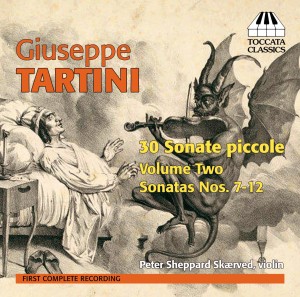
Giuseppe Tartini: 30 Sonate piccole, Volume Two
In the last years of his life, the great composer, violinist and swordsman Giuseppe Tartini (1692-1770) laboured at a cycle of sonatas for solo violin. The resulting manuscript offers the most important composition for solo violin after Bach and, at six hours in duration, the largest integrated work for the instrument. This first complete recording is based on a fresh study of the source and includes a number of works in Tartini's shorthand, overlooked in earlier editions.
Peter Sheppard Skærved, violin
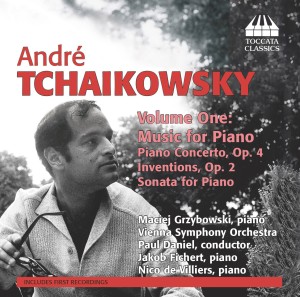
André Tchaikowsky: Music for Piano, Volume One
Although André Tchaikowsky (1935-82), Polish-born but based in Britain, was one of the finest pianists of his era, his true calling was as a composer, and this first conspectus of his piano music features the first recording of his powerful, craggy Piano Concerto (1973-75), the epigrammatic Inventions he dedicated to a series of friends and his only mature Piano Sonata — evidence of the magnitude of the loss from his early death from cancer, aged only 46.
Maciej Grzybowski, piano
Vienna Symphony Orchestra, orchestra
Paul Daniel, conductor
Jakob Fichert, piano
Nico de Villiers, piano
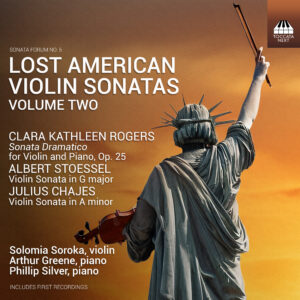
Lost American Violin Sonatas, Volume Two
In their second volume exploring lost American violin sonatas, Solomia Soroka, Phillip Silver and Arthur Greene survey a half-century of music-making, from the buoyant High Romanticism of the Bostonian Clara Rogers via the impassioned early Impressionism of the New York-based Albert Stoessel, to the explicitly Jewish sounds of Julius Chajes, who settled in Detroit, one of the many refugees from Nazism who added a new flavour to American music. All three works testify to the rich heritage of forgotten American music awaiting rediscovery by alert and curious musicians and listeners.
Solomia Soroka, violin
Phillip Silver, piano
Arthur Greene, piano
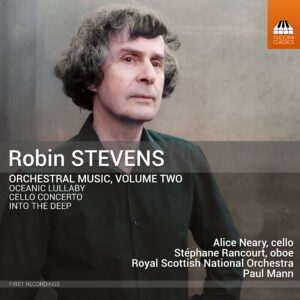
Robin Stevens: Orchestral Music, Volume Two
The compositional career of Robin Stevens, Welsh-born (in 1958) and Manchester-based, is divided into two periods, separated by a period of illness. The first produced mainly chamber music and works for the church that employed him; restored to health, he found an appetite for larger forms, writing three substantial concertos and a number of other orchestral works. Stevens’ big-boned, four-movement Cello Concerto is something of a younger cousin of Britten’s Cello Symphony, casting the orchestra in kaleidoscopic discussion with the soloist, in moods that range from the humorous to the heroic. Here it sits between a charming orchestral miniature and a searching symphonic poem. In all three works Stevens’ mastery of orchestral colour allows the musical discourse to unfold almost as wordless drama.
Alice Neary, cello
Stéphane Rancourt, oboe
Royal Scottish National Orchestra
Paul Mann, conductor
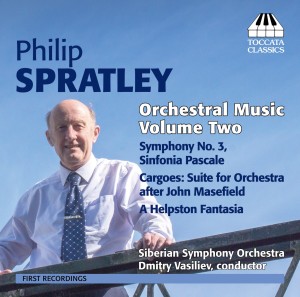
Philip Spratley: Orchestral Music, Volume Two
This second Toccata Classics recording of music by Philip Spratley, born in Nottinghamshire in 1942, opens with the atmospheric orchestral suite Cargoes, inspired by John Masefield's famous poem, and continues with a sparkling folksong medley based on fiddle tunes by another poet, John Clare. The main work here, Spratley's Third Symphony, which had its initial impulses in visits to North Wales and Jerusalem, traces a path from tension to triumph.
Siberian Symphony Orchestra, orchestra
Dmitry Vasilyev, conductor
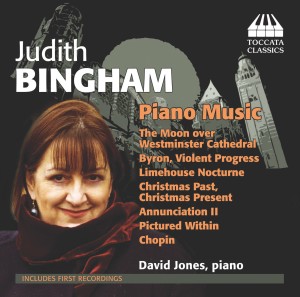
Judith Bingham: Piano Music
Judith Bingham (born in Nottingham in 1952 and London-based since 1970) spent several years as a member of the BBC Singers, which may help explain the lyricism of her music. But the works on this CD also reveals her strong response to poetry and to place, a keen instinct for drama, an ear for keyboard colour and a Busonian sense of space and atmosphere.
David Jones, piano
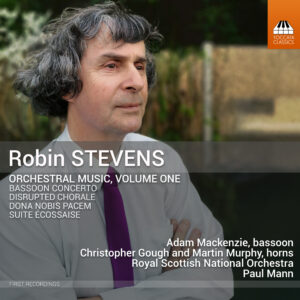
Robin Stevens: Orchestral Music, Volume One
The compositional career of Robin Stevens, Welsh-born (in 1958) and Manchester-based, is divided into two periods, separated by a period of illness. The first mainly produced chamber music and works for the church that employed him; restored to health, he found an appetite for larger forms, writing three substantial concertos and a number of other orchestral works – all now recorded for Toccata Classics. This first album sets his expansive Bassoon Concerto amid three shorter works, each of them revealing how his command of orchestral colour and melodic line can suggest landscapes and narratives. In the slow movement of the Concerto in particular, there are passages of deep feeling and intensity, but Stevens also has a healthy sense of fun, which often emerges unexpectedly to energise his music.
Adam Mackenzie, bassoon
Christopher Gough & Martin Murphy, horns
Royal Scottish National Orchestra
Paul Mann, conductor
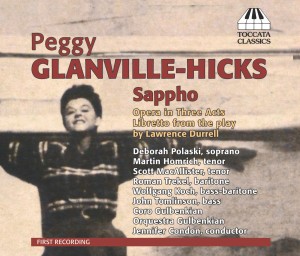
Peggy Glanville-Hicks: Sappho
Sappho, the last grand opera of Australian composer Peggy Glanville-Hicks (1912-90), was written in her stone cottage on Mykonos in 1963. Never heard before this recording, Sappho reflects Glanville-Hicks' fascination with the orient and folk music, encapturing the colours of ancient Greece, with a heroic brass fanfare and epic writing for chorus, haunting woodwind solos and shimmering percussion evoking the stillness of crystal island waters. Deborah Polaski, who creates the role of the disenchanted Sappho, describes it as 'the kind of music that singers want to sing'. The libretto, based on Lawrence Durrell's verse-play, incorporates fragments of Sappho's own verse.
Deborah Polaski, soprano: Sappho
Martin Homrich, tenor: Phaon
Scott MacAllister, tenor: Pittakos
Roman Trekel, baritone: Diomedes
Wolfgang Koch, bass-baritone: Minos
Sir John Tomlinson, bass: Kreon
Jacquelyn Wagner, soprano: Chloe/Priestess
Bettina Jensen, soprano: Joy
Maria Markina, mezzo soprano: Doris
Laurence Meikle, baritone Alexandrian
Coro Gulbenkian, choir
Orquestra Gulbenkian, orchestra
Jennifer Condon, conductor
Double Disc!
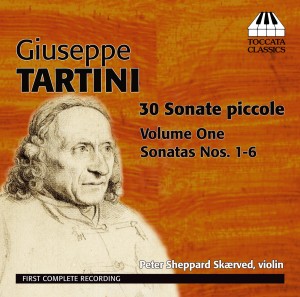
Giuseppe Tartini: 30 Sonate piccole, Volume One
In the last years of his life, the great composer, violinist and swordsman Giuseppe Tartini (1692-1770) laboured at a cycle of sonatas for solo violin. The resulting manuscript offers the most important composition for solo violin after Bach and, at six hours in duration, the largest integrated work for the instrument. This first complete recording is based on a fresh study of the source and includes a number of works in Tartini's shorthand, overlooked in earlier editions.
Peter Sheppard Skærved, violin
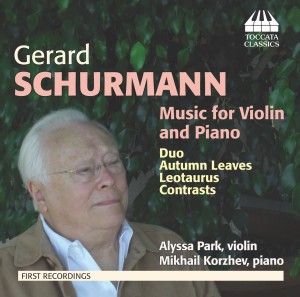
Gerard Schurmann: Music for Violin and Piano
The Anglo-Dutch composer Gerard Schurmann, born in the East Indies in 1924 and based in the USA since 1981, first made his mark in Britain in the 1940s and '50s, as a pianist and composer, particularly of chamber music and, later, of film scores. His concert output is intense, passionate, tightly argued and charged with energy, but also infused with lyricism, as these four pieces demonstrate.
Alyssa Park, violin
Mikhail Korzhev, piano
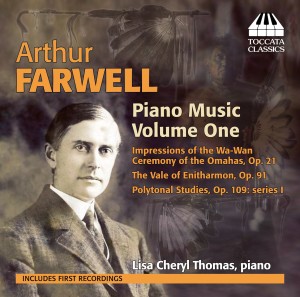
Arthur Farwell: Piano Music, Volume One
The American composer Arthur Farwell (1872-1952) is remembered as the leading member of a group of 'Indianists' who used Native American tribal melodies. But Farwell's stylistic range was much wider than is realised today. This CD, the first of two to be recorded by Lisa Cheryl Thomas, herself of Cherokee, Blackfoot and Sioux ancestry, presents first The Vale of Enitharmon, based on the mythology of William Blake, which mixes Romanticism and Impressionism. Impressions of the Wa-Wan Ceremony of the Omahas represents an American Indian ritual so revered that warring tribes would lay down their arms to let the procession pass. And the experimental Polytonal Studies pit two different keys against each other, exploiting the attraction of opposites to generate unusual harmonies and melodies.
Lisa Cheryl Thomas, piano