Search Results for "nastexad kadhigataa nawar ani garee hees" – Page 2
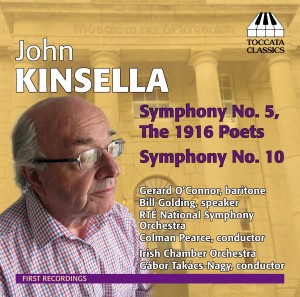
John Kinsella: Symphonies
John Kinsella (b. 1932) is the most important Irish symphonist since Stanford, with no fewer than ten to his credit. This CD couples Kinsella's Fifth Symphony, written in 1992, an impassioned setting of humanist poetry by three Irish poets killed in the 1916 Uprising, with his most recent, No. 10, composed in 2010 for an orchestra of Mozartean dimensions, its clear textures animated by driving power and energy.
Gerard O’Connor, baritone
Bill Golding, speaker
RTÉ National Symphony Orchestra, orchestra
Colman Pearce, conductor
Irish Chamber Orchestra, chamber orchestra
Gábor Takács-Nagy, conductor
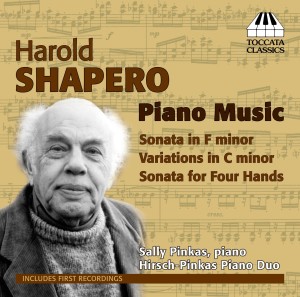
Harold Shapero: Piano Music
Harold Shapero (1920-2013) reacted against the dominance of modernism in American musical life in the mid-twentieth-century by using a Neoclassical language with its roots in Beethoven and Schubert, initially animated by Stravinsky. These three early piano works — two of them receiving their first-ever recordings — reveal Shapero's superb craftsmanship and his ready wit, in music which embraces the past instead of rejecting it.
Sally Pinkas, piano
Evan Hirsch and Sally Pinkas, piano duo
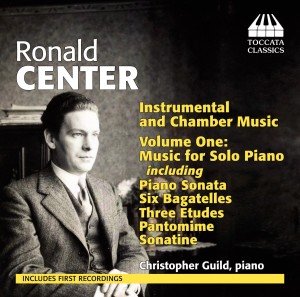
Ronald Center: Instrumental and Chamber Music, Volume One
Ronald Center (1913-73) is sometimes described as 'the Scottish Bartók', and his music does indeed capture some of the wild energy of the Scottish landscape in a style of Bartókian asperity. It also shows affinities with the music of Busoni, Debussy, Prokofiev, Shostakovich and Vaughan Williams, absorbed into an individual style that is audibly Scots. Center wrote with striking concision and meticulous craftsmanship, his works encompassing a wide range of emotions — heart-felt sorrow, grim humour, relaxed lyricism, dark despair — in a crisp and succinct manner, animated by sharp wit and irony.
Christopher Guild, piano
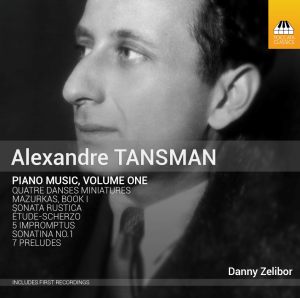
Alexandre Tansman: Piano Music, Volume One
Alexandre Tansman (1897–1986) was one of the most prolific composers of the twentieth century. His fundamental style is a Stravinskyan Neo-Classicism, animated by the dance-rhythms of his native Poland and energised by a masterly command of counterpoint. The substantial body of music he produced for his own instrument, the piano, has never been systematically examined in recordings; this first installment presents works he wrote soon after his arrival in Paris in 1919, the city that was to remain his home.
Danny Zelibor, piano
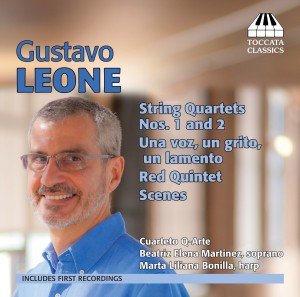
Gustavo Leone: String Quartets
The music of Gustavo Leone — born in Buenos Aires in 1956 and now a professor of music at Loyola University in Chicago — combines a strong sense of atmosphere with a feeling for drama, its basic lyricism coloured with echoes of folk-music and the Baroque and animated by outbreaks of dancing energy.
Cuarteto Q-Arte, string quartet
Beatriz Elena Martínez, soprano
Marta Liliana Bonilla, harp
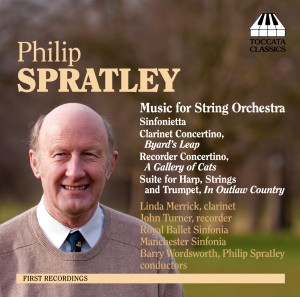
Philip Spratley: Music for String Orchestra
This CD reveals a fresh, original and immediately attractive voice in British music. Philip Spratley, born in Nottinghamshire in 1942, has his roots in English folksong and his compositions are strongly evocative of the countryside — though animated by a rhythmic vivacity and drive that recalls Shostakovich, Britten and Tippett. Spratley's music also abounds in memorable melodies, and his ability to write tunes with the ring of folksong about them reveals him as a true heir of Holst and Vaughan Williams.
Philip Spratley, conductor
Linda Merrick, clarinet
John Turner, recorder
Tracey Redfern, trumpet
Eira Lynn Jones, harp
Royal Ballet Sinfonia, orchestra
Barry Wordsworth, conductor
Manchester Sinfonia, orchestra
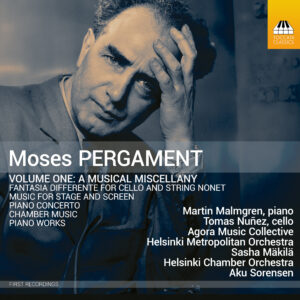
Moses Pergament Volume One: A Musical Miscellany
The neglect of Moses Pergament (1893–1977) can be ascribed in part to the complexities of his life: he was born in Finland of Lithuanian-Jewish stock, a student in Russia and a Swedish citizen by 1919. As a result, no national culture stepped forward to claim him, with his outsider status initially worsened by blatant anti-Semitism – and the gradual realisation that he was one of the most interesting Swedish composers of the mid-twentieth century then fell away again after his death. This series of recordings aim to return his music to the public ear, beginning with an album tracing the growth of his style, from early Romanticism to a spicy Bartókian vivacity, occasionally animated by Jewish melos and dance-rhythms.
Martin Malmgren, piano
Tomas Nuñez, cello
Helsinki Metropolitan Orchestra
Sasha Mäkilä, conductor
Helsinki Chamber Orchestra
Aku Sorensen, conductor
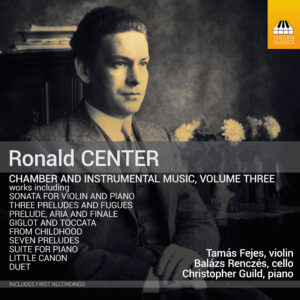
Ronald Center: Instrumental and Chamber Music, Volume Three
Ronald Center (1913–73) is sometimes described as ‘the Scottish Bartók’, and his music does indeed capture some of the wild energy of the Scottish landscape in a style of Bartókian asperity. It also shows affinities with the music of Busoni, Debussy, Prokofiev, Shostakovich and Vaughan Williams, absorbed into an individual style that is audibly Scots. Center was essentially a miniaturist, his meticulous craftsmanship allowing him to encompass a range of emotions – heart-felt sorrow, grim humour, relaxed lyricism, dark despair – in a crisp and succinct manner, animated by sharp wit and irony. Many of the works recorded here also show off his skill as a contrapuntist and one, surprisingly, is a rumba.
Tamás Fejes, violin
Balázs Renczés, cello
Christopher Guild, piano
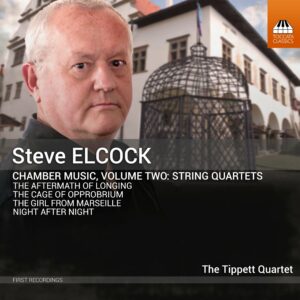
Steve Elcock: Chamber Music, Volume Two: String Quartets
The English composer Steve Elcock (b. 1957) spent years writing music without ever expecting it to be heard: based in rural France, he worked as a translator, composing in his spare time. The emergence of his orchestral and chamber music on Toccata Classics over the past few years has led to his being acclaimed as one of the most important composers at work today. This recording of his four works (to date) for string quartet confirms that judgement: all in single spans, they generate tension and energy in equal measure – animated, in one of them, by a lively sense of humour.
The Tippett Quartet
John Mills and Jeremy Isaac, violins
Lydia Lowndes-Northcott, viola
Božidar Vukotić, cello
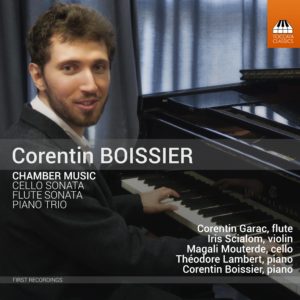
Corentin Boissier: Chamber Music
Corentin Boissier was born in the suburbs of Paris in 1995. For a composer still only in his twenties, he writes music that is unusually direct in its emotional expression and robust and confident in its musical language. His Cello Sonata, in the grand Romantic tradition of Brahms and Rachmaninov, is animated by a wild and resolute energy; and his buoyant Flute Sonata continues the line of the French flute classics of the first half of the twentieth century. The darker Piano Trio sits downstream from those of Debussy, Ravel and, especially, Fauré. All three works bid fair to become major contributions to their genre.
Trio Aralia
Iris Scialom, violin (Tracks 7–9)
Magali Mouterde, cello (Tracks 1-3, 7-9)
Théodore Lambert, piano (Tracks 1-3, 7-9)
Corentin Garac, flute (Tracks 4-6)
Corentin Boissier, piano (Tracks 4-6)
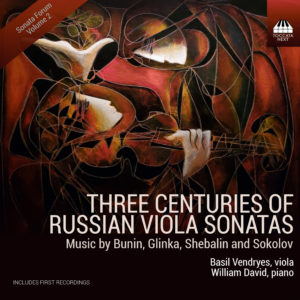
Three Centuries of Russian Viola Sonatas
The Russian viola sonata is a rare bird, not least because the instrument itself was frowned upon by the Soviet authorities; as a result Russian music for the viola has a rather patchy history. It begins in earnest in 1931, when the 1825 Sonata by Mikhail Glinka, ‘the father of Russian music’, was reconstructed from his sketches by Vadim Borisovsky, ‘the father of the Russian viola’. Thereafter, musicians and composers worked together to expand the repertoire. The relationship between the composer Revol Bunin and the violist Rudolf Barshai resulted in a sonata of 1955 which deserves wider currency. Although half a century apart, the Shebalin and Sokolov sonatas have something unusual in common: both were created as part of a triptych, alongside sonatas for violin and cello. All four composers knew how to make the viola sing – though this lyricism is often animated by moments of drama and excitement.
Basil Vendryes, viola
William David, piano
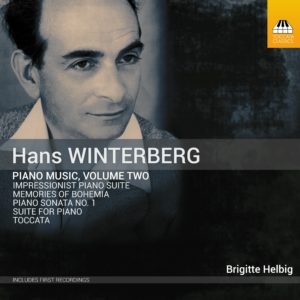
Hans Winterberg: Piano Music, Volume Two
The tale of Hans Winterberg (1901–91) is a strange one. A survivor of the Terezín concentration camp, where he had been interned as a Czech Jew, he settled in Munich after the War as a German citizen, and his music enjoyed a number of broadcasts – but with his death his estate disappeared into a legal limbo, emerging only in 2015. This second album of his piano music reveals an unusual and individual voice, an idiosyncratic blend of Janáček, Ravel, Schoenberg and other mid-twentieth-century masters, animated by a hard-edged, freewheeling energy and grim humour reminiscent of his close contemporary, Nikos Skalkottas.
Brigitte Helbig, piano
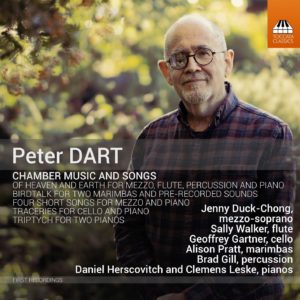
Peter Dart: Chamber Music and Songs
Painters sometimes talk about the intensity of the light they encounter in Australia. Peter Dart, born in Sydney in 1953, brings something of that brightness to his compositions, which are further animated by buoyant rhythms and a lively sense of humour, even mischief. They are, at the same time, anchored in a secure command of counterpoint, and given a timeless quality by his fondness for modal harmony. Most important of all, the technical mastery that gives these works their surefooted appeal is suffused with straightforward human warmth.
Daniel Herscovitch, piano (Tracks 1 – 12, 14 – 17)
Clemens Leske, piano (Tracks 1 – 3)
Jenny Duck-Chong, mezzo-soprano (Tracks 4 – 7, 14 – 17)
Sally Walker, flute (Tracks 15 – 16), piccolo (Tracks 14 – 17)
Geoffrey Gartner, cello (Tracks 8 – 12)
Brad Gill, percussion (Tracks 14 – 17)
Alison Pratt, marimbas (Track 13)
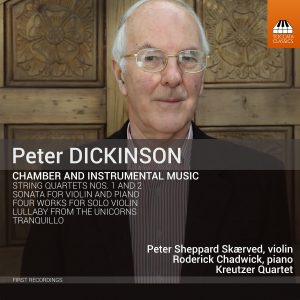
Peter DICKINSON: Chamber and Solo Works
As pianist, writer and academic, Peter Dickinson – Lancashire-born in 1934 – has been one of the mainstays of British musical life for decades. Alongside these activities he is also a highly regarded composer, whose music, reconciling modernism and tradition, speaks directly to its listeners. This album presents works from the earlier part of his career, with an expressive range between delicate lyricism and wild, freewheeling energy, animated by a keen sense of instrumental drama.
Peter Sheppard Skærved, violin (Tracks 1-5, 9, 10, 13, 14)
Roderick Chadwick, piano (Tracks 1-3, 10, 14)
Kreutzer Quartet (6-9, 11-12)
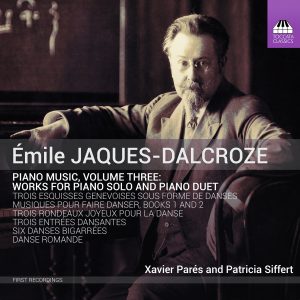
Émile JAQUES-DALCROZE: Piano Music, Volume Three
The Swiss composer Émile Jaques-Dalcroze (1865–1950) is best remembered for his development of Eurhythmics, which teaches the appreciation of music through movement. The buoyant miniatures recorded here document his fascination with dance, including a flirtation with jazz and ragtime, although the apparent innocence of the music conceals a striking degree of metrical and rhythmic complexity, cast in a style not so far from Debussy and Fauré – and animated by the blithe spirit of Chabrier.
Notes en Français
Xavier Parés, piano (Tracks 1 – 6, 10 – 12), piano duet (Track 22)
Patricia Siffert, piano (Tracks 7 – 9, 13 – 21), piano duet (Track 22)
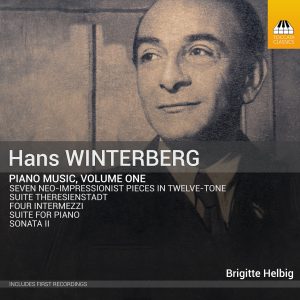
Hans WINTERBERG: Piano Music, Volume One
The tale of Hans Winterberg (1901–91) is a strange one. A survivor of the Terezín concentration camp, where he had been interned as a Czech Jew, he settled in Munich after the Second World War as a German citizen, and his music enjoyed a number of broadcasts – but with his death his estate disappeared into a legal limbo, emerging only in 2015. This first album of his piano music reveals an unusual and individual voice, an idiosyncratic blend of Janáček, Ravel, Schoenberg and other mid-twentieth-century masters, animated by a hard-edged, freewheeling energy and grim humour reminiscent of his close contemporary, Nikos Skalkottas.
Brigitte Helbig, piano