Search Results for "nastexad kadhigataa nawar ani garee hees"
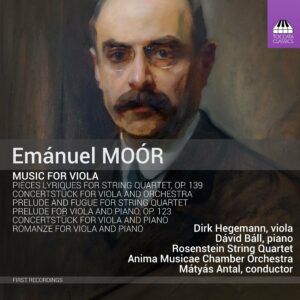
Emánuel Moór: Music for Viola
The works of Emánuel Moór (1863–1931) ought to be celebrated as among the major achievements of Romantic music, but because of Moór’s peripatetic life – he was born in Hungary, studied in Vienna (with Bruckner), performed in the US and across Europe, became a UK citizen and settled and died in Switzerland – no country has claimed and promoted him to the degree he deserves. Moór’s musical language offers a deeply satisfying blend of contrapuntal mastery and ardent lyricism, as the works on this album – written for or involving the viola – demonstrate. In time he will be recognised as one of the masters of his age.
Dirk Hegemann, viola
Dávid Báll, piano (Tracks 3, 8, 9)
Rosenstein String Quartet (Tracks 1–2, 4–7):
Michael Hsu and SooEun Lee, violins
Dirk Hegemann, viola
Markus Tillier, cello
Anima Musicae Chamber Orchestra (Track 10)
Mátyás Antal, conductor (Track 10)
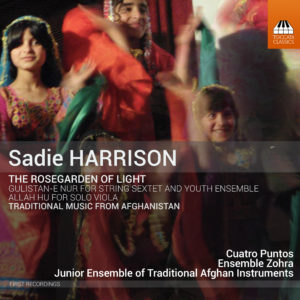
Sadie Harrison: The Rosegarden of Light
Since its foundation in 2010, the Afghanistan National Institute of Music in Kabul has been working small miracles. Its students – among them orphans, street vendors and other disadvantaged children – play both western and traditional Afghan instruments in groups which include a ground-breaking girls’ ensemble. On this album, the fruit of a remarkable collaborative project, they meet the US string sextet Cuatro Puntos. In Sadie Harrison’s Gulistan-e Nur: The Rosegarden of Light, they perform Afghan songs and dances which Harrison’s music then explores and develops. Kevin Bishop’s arrangements of Afghan tunes likewise link east and west in a visionary venture celebrating the power of music to transform lives as it also revives and rebuilds Afghan musical traditions.
ANIM Junior Ensemble of Traditional Instruments
Kevin Bishop, viola
Ensemble Zohra
Cuatro Puntos
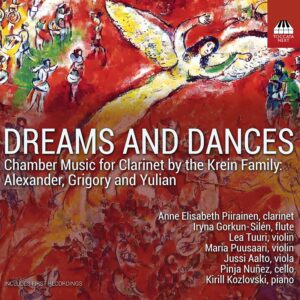
Dreams and Dances: Chamber Music for the Clarinet by the Krein Family
The Krein family, with its origins in Lithuania, became a musical dynasty of considerable importance in Imperial and then Soviet Russia. The seven sons of its patriarch, Abram Krein, were all musicians, with Alexander and Grigory becoming respected composers, and Grigori’s son, Yulian, adding another generation of Krein compositions. The dances and cantillation of their Jewish background was an important part of their musical make-up, combining at various stages with Russian folk-music, Skryabinesque harmony and French Impressionism. All three shared a predilection for the clarinet, developing a repertoire for the instrument that is only now beginning to be discovered – in what one might call a Krein scene investigation.
Anne Elisabeth Piirainen, clarinet
Iryna Gorkun-Silén, flute (tracks 4–6)
Lea Tuuri, violin (Tracks 1, 2, 9–11, 14–16)
Maria Puusaari, violin (Tracks 1, 2, 9–11)
Jussi Aalto, viola (Tracks 1, 2, 9–11)
Pinja Nuñez, cello (Tracks 1, 2, 9–11, 14–16)
Kirill Kozlovski, piano (Tracks 3–8, 12–16)
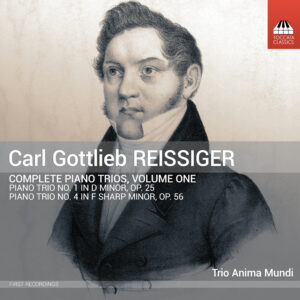
Carl Gottlieb Reissiger: Complete Piano Trios, Volume One
In his day the now-forgotten Carl Gottlieb Reissiger (1798–1859) was highly esteemed, both as conductor and composer; indeed, his presence in Dresden from 1826 made it one of the main operatic centres in Germany. He wrote nine operas himself, as well as a huge quantity of vocal music (including at least twelve Masses), and his large output of chamber music boasts no fewer than 27 piano trios. These two early exemplars in this first-ever complete recorded cycle of those trios have a Mendelssohnian elegance and clarity, deepened here and there by a touch of Beethovenian pathos. Schumann was an enthusiast: ‘When I think of Reissiger’s trios, the words lovely and jewel-like come to mind. These choice and lovely works remind one of a chain of flowers. […] His music never fatigues the ear, but holds our attention to the very end’.
Trio Anima Mundi
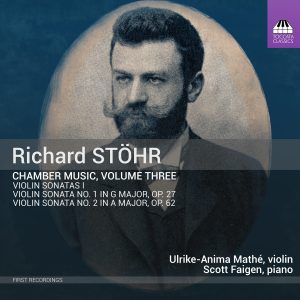
Richard Stöhr: Chamber Music, Volume Three: Violin Sonatas I
Like Korngold, Schoenberg, Toch, Zeisl and Zemlinsky, Richard Stöhr (1874–1967) was another Austrian composer driven into American exile by the Nazis. His generous output of music, being rediscovered at last in these Toccata Classics recordings, includes seven symphonies, much chamber music, songs, and choral and piano pieces. The first two of his fifteen violin sonatas offer a seamless outpouring of fin de siècle Viennese lyricism, with one good tune following another, in a style somewhere between Brahms and Korngold.
Ulrike-Anima Mathé, violin
Scott Faigen, piano
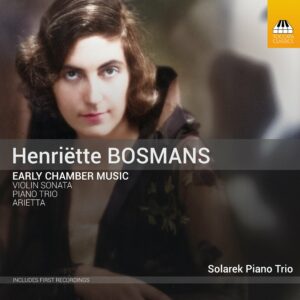
Henriëtte Bosmans: Early Chamber Music
The three works by the Amsterdam-born Henriëtte Bosmans (1895–1952) in this album all date from her early to mid-twenties. The Violin Sonata and Piano Trio are substantial pieces, both animated by the passion of youth – and, given their quality, it is astounding that they should be receiving their first recordings here. At this stage in her life Bosmans was still writing in an expansive, Romantic style, although echoes of French Impressionism, Spain and the Middle East can often be heard – and from time to time the Violin Sonata nods to Bach and Reger.
Solarek Piano Trio
Marina Solarek, violin
Miriam Lowbury, cello
Andrew Bottrill, piano
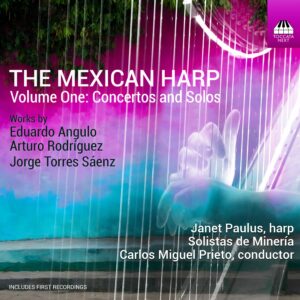
The Mexican Harp Volume One: Concertos and Solos
With this first Toccata Next album of Mexican music for harp, the American harpist Janet Paulus pays tribute to her adoptive country and to three composer friends, each with a concertante work and music for solo harp – several of them recently written for her. The predominant style is gently Neo-Romantic, occasionally animated with echoes of Mexican folk-music.
Janet Paulus, harp
Solistas de Minería (Tracks 2–5, 10-12)
Carlos Miguel Prieto, conductor (Tracks 2-5, 10-12)
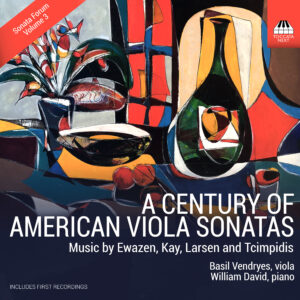
A Century of American Viola Sonatas
These five works – four sonatas and a sonatina – chronicle a century of American writing for the viola and are linked by a concern for directness of musical language. But they also reflect diversity in their origins and inspirations, the Ulysses Kay pieces being written by a pioneering African American, Libby Larsen’s by a successful female freelance composer, Eric Ewazen’s animated by a particularly American lyricism and energy, and the sonata by David Tcimpidis commemorating the ‘9/11’ terrorist attack on the World Trade Center, which Tcimpidis heard unfolding.
Basil Vendryes, viola
William David, piano
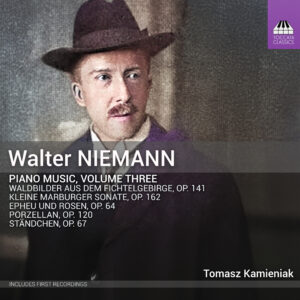
Walter Niemann: Piano Music, Volume Three
The largest part of the output of the Hamburg-born composer and writer Walter Niemann (1876–1953), a student of both Humperdinck and Reinecke, is piano music: an astonishing 1,000 or so pieces, divided into 189 opus numbers. Most of them are lyrical miniatures in a warm and approachable late-Romantic style, some evoking the music of the past – often with a touching degree of dignity and restraint, but also with an occasional flash of good humour. The range of moods here is surprisingly wide, from pieces recalling late Brahms and a barcarolle evoking Offenbach, via light-hearted character-sketches and evocative picture-postcards, to a warm-hearted and tender piano sonata.
Tomasz Kamieniak, piano
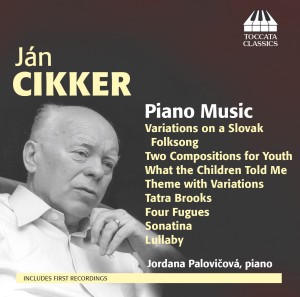
Ján Cikker: Piano Music
Ján Cikker (1911-89) was one of the leading Slovak composers of the twentieth century, with no fewer than nine operas to his credit. Cikker was also a fluent pianist and his piano music — little known even in his native Slovakia (this disc features several first recordings) — sits downstream from Szymanowski and Janáček, similarly blending folk influences with an echo of French impressionism.
Jordana Palovičová, piano
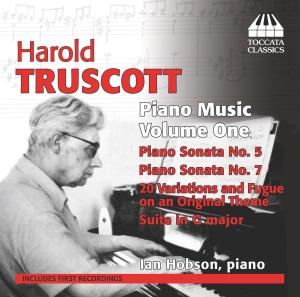
Harold Truscott: Piano Music, Volume One
Harold Truscott (1914-92) enjoyed a reputation as one of Britain's most perceptive writers on music, a doughty champion of many neglected composers who have now become familiar figures. But Truscott himself was a composer of some stature, writing in an individual style that is rooted in Beethoven and Schubert but also absorbs the influences of Nielsen, Medtner and Hindemith. This is the first CD in a series which will present his substantial corpus of piano music.
Ian Hobson, piano
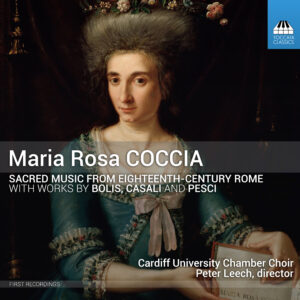
Maria Rosa Coccia: Sacred Music from 18th Century Rome
The Roman Maria Rosa Coccia (1759–1833) was a musical phenomenon of almost Mozartian precocity, becoming the first female composer to be awarded the professional distinction of maestra di cappella – at the age of fifteen. But the church could not contemplate the idea of a woman in charge of the music-making in a religious establishment, and so she hit a stained-glass ceiling; she seems to have given up composition in the mid-1780s, not yet 30. The freshness and buoyancy of her writing up to that point give an indication of what might have been.
Cardiff University Chamber Choir
Peter Leech, director
Robert Court, chamber organ
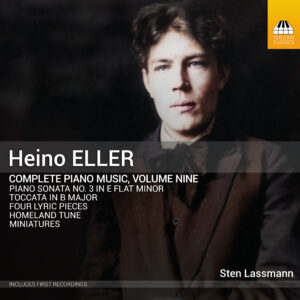
Heino Eller: Complete Piano Music, Volume Nine
The piano music of Heino Eller (1887–1970), a total of 206 works, is not only the largest part of his output: it is also the largest body of works in Estonian classical music. But most of these pieces are unknown, even though the best of them are original contributions to the twentieth-century piano repertoire, with Eller’s sensitive lyricism underpinned by gentle humour and an occasional epic tone. This ninth and final volume in its first-ever complete recording prefaces his expansive Piano Sonata No. 3 with a series of charming miniatures and ends with the emblematic anthem Homeland Tune, a musical embodiment of Estonian national feeling.
Sten Lassmann, piano
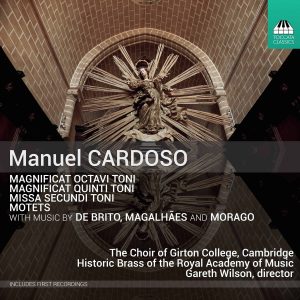
Manuel Cardoso: Missa Secundi Toni and Other Works
Manuel Cardoso (1566–1650) was one of the most important composers of the golden age of Portuguese polyphony around the turn of the seventeenth century. But modern choirs have been surprisingly slow to explore the rich legacy of his compositions: this is the first recording of his Missa Secundi Toni, and the first of any of his works with brass consort, its dark colours providing an effective contrast with the young voices of the Girton College Choir.
The Choir of Girton College, Cambridge (Tracks 1–2, 4–7)
Historic Brass of the Royal Academy of Music (Jeremy West, leader) (Tracks 1–5, 7 10–14, 16–17)
Lucy Morrell, organ (Tracks 1–5, 7–8, 10–13, 15–17)
Gareth Wilson, director (Tracks 1–7, 9–14, 16–17)
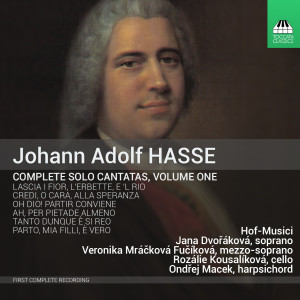
Johann Adolf HASSE: Complete Solo Cantatas, Volume One
In his own day Johann Adolf Hasse (1699–1783) was enormously popular as a writer of operas – Burney described him as ‘superior to all other lyric composers’. His chamber cantatas were written for private performance in the palaces of the powerful, where Hasse enjoyed the patronage of the very highest ranks of society: some of his cantatas may even have been sung by the empress Maria Theresa herself. But with the eclipse of his fame after his death, these works were scattered across Europe, and this first complete recording was made possible only by many years of detective work. They reveal, even on this smaller scale, the keen sense of drama that animated his operas.
Featuring:
Hof-Musici
Jana Dvořáková, soprano
Veronika Mráčková Fučíková, mezzo-soprano
Rozálie Kousalíková, Baroque cello
Ondřej Macek, harpsichord
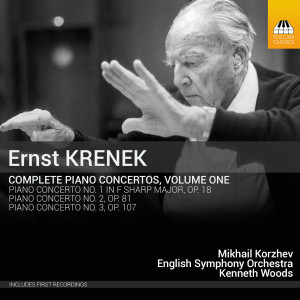
Ernst KRENEK: Complete Piano Concertos, Volume One
The piano concertos of Ernst Krenek (1900–91) are major contributions to the twentieth-century repertoire, comparable to those of Bartók, Prokofiev, Schoenberg and Shostakovich, but astonishingly two of them have never had commercial recordings – an omission this series seeks to redress. Piano Concertos Nos. 1–3, written between 1923 and 1946, show Krenek throwing off the constraints of tonality in favour of a freewheeling, individual use of twelve-tone technique, brimming with colour and often animated with a keen sense of wit.
Mikhail Korzhev
English Symphony Orchestra
Kenneth Woods