Search Results for "kupi lover nangis original"
Showing results for kbp lover nazis original
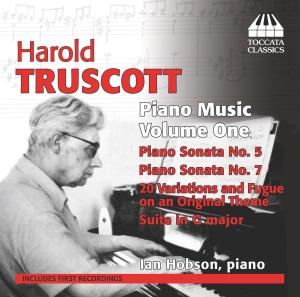
Harold Truscott: Piano Music, Volume One
Harold Truscott (1914-92) enjoyed a reputation as one of Britain's most perceptive writers on music, a doughty champion of many neglected composers who have now become familiar figures. But Truscott himself was a composer of some stature, writing in an individual style that is rooted in Beethoven and Schubert but also absorbs the influences of Nielsen, Medtner and Hindemith. This is the first CD in a series which will present his substantial corpus of piano music.
Ian Hobson, piano
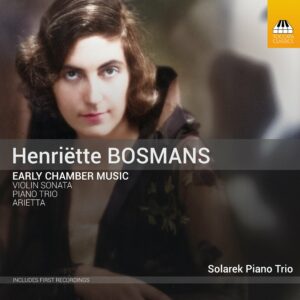
Henriëtte Bosmans: Early Chamber Music
The three works by the Amsterdam-born Henriëtte Bosmans (1895–1952) in this album all date from her early to mid-twenties. The Violin Sonata and Piano Trio are substantial pieces, both animated by the passion of youth – and, given their quality, it is astounding that they should be receiving their first recordings here. At this stage in her life Bosmans was still writing in an expansive, Romantic style, although echoes of French Impressionism, Spain and the Middle East can often be heard – and from time to time the Violin Sonata nods to Bach and Reger.
Solarek Piano Trio
Marina Solarek, violin
Miriam Lowbury, cello
Andrew Bottrill, piano
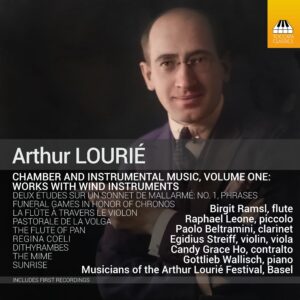
Arthur Lourié: Chamber and Instrumental music, Volume One: Works with Wind Instruments
The turbulent life of Arthur Lourié (1891–1966) – student of Glazunov, friend of Blok, lover of Akhmatova, commissar of the Soviet regime, an exile in Germany, France and the USA, ghost-writer for Koussevitzky – is reflected in the wide range of references in his music, from echoes of the ceremonies of ancient Greece to Neo-Baroque and Neo-Classical procedures perhaps inspired by his collaboration with Stravinsky in Paris. Some of the works in this first of two albums surveying his chamber and instrumental music have an almost ritual formality; in others a mischievous grin is not far from the surface.
Birgit Ramsl (flute)
Raphael Leone (piccolo)
Paolo Beltramini (clarinet)
Candy Grace Ho (contralto)
Gottlieb Wallisch (piano)
Egidius Streiff (viola, violin);
Musicians of the Arthur Lourié Festival, Basel:
Lucie Brotbek Prochásková (alto flute)
Hansjürgen Wäldele (oboe)
Nicolas Rihs (bassoon)
Simon Lilly (trumpet)
Nicolas Suter (percussion)
Agnès Mauri (viola)
Mateusz Paweł Kamiński (cello)
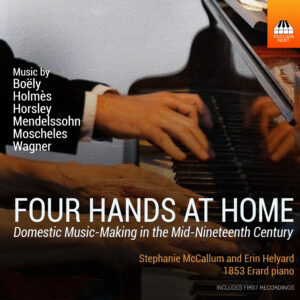
Four Hands at Home: Domestic Music-Making in the Mid-Nineteenth Century
Playing piano four-hands was both vital in the dissemination of music in the nineteenth century and also a popular domestic activity. The original 1853 Parisian Erard piano on which this recording was made demonstrates the clarity, warmth and differentiated timbres characteristic of the ‘straight stringing’ that was later replaced by the ‘cross-stringing’ of the modern concert grand. The repertoire from the period covers the many genres of four-hand piano works in their varied roles as domestic ‘info-entertainment’: orchestral works large and small, serious sonatas and variations, showpieces for emerging virtuosi and even a string quartet are all equally engaging in this once-familiar medium.
Stephanie McCallum (primo) and Erin Helyard (secondo), 1853 Érard Piano
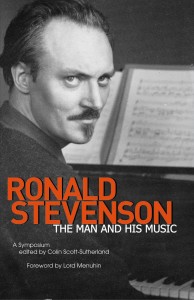
Ronald Stevenson: The Man and His Music
A Symposium
Edited by Colin Scott-Sutherland
Foreword by Lord Menuhin
Extent: 507 pages
Composition: Royal octavo ~ 509p ~ Copiously illustrated ~ List of Works ~ Bibliography ~ Discography ~ Index of Stevenson's Music ~ General Index
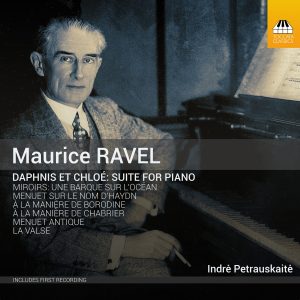
Maurice Ravel: Piano Music
Almost every pianist, it seems, wants to record Ravel, but virtually all of them have overlooked a treasure trove of his solo-piano music: the composer’s short score for Daphnis et Chloé. Some parts of it are unplayable by a single pair of hands, but with judicious arrangement this working draft can be mined for diamonds. Only a handful of musicians have made their own suites for solo piano; here the Lithuanian pianist Indrė Petrauskaitė, carefully observing Ravel’s original textures, has produced something new: a 40-minute concert suite of unsuspected Ravel for solo piano that also respects the dramatic outline of the original ballet. The other, more familiar works here extend the ideas of antiquity and transcription.
Indrė Petrauskaitė, piano
The Proms and Natural Justice: A Plan for Renewal
With a Forward by Sir Adrian Boult
Extent: 72 pages
Composition: Crown octavo; no illus or exx. vi+66 pages
Beethoven: The Sonatas for Piano and Violin: Thoughts on their Interpretation
With a Preface by The Amadeus Quartet, a Postscript by Günter Ludwig, and an Appendix by Paul Rolland Translated by Horace and Anna Rosenberg
Extent: 219 pages
Composition: Demy octavo ~ Illustrated ~ Bibliography ~ Index

Amy Woodforde-Finden: The Oriental Song-Cycles
Amy Woodforde-Finden (1860-1919) wrote a number of 'oriental' song-cycles, one of which, the Four Indian Love Lyrics of 1902, contained the 'Kashmiri Song' — beginning 'Pale hands I loved beside the Shalimar' — that became a runaway success in its own day. These ballads have long since fallen from favour, but they contain plenty of honest sentiment, good tunes and splashes of local colour — and their hints of inter-racial love and lesbian romance must have given a real frisson to their contemporary audiences.
Michael Halliwell, baritone
David Miller, piano
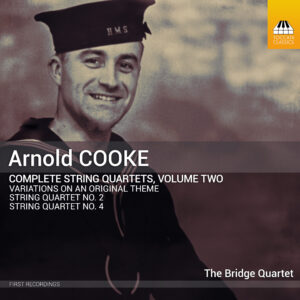
Arnold Cooke: Complete String Quartets, Volume Two
The music of the Yorkshire-born Arnold Cooke (1906–2005) – inventively contrapuntal, lyrical and energetic in turns – does not deserve the neglect it suffered even in its composer’s lifetime. This second album of two presenting all five of Cooke’s string quartets underlines his reputation for resourceful craftsmanship, presented in a style which sits downstream from Hindemith, with whom he studied in Berlin, and from Bartók. There is also a surprisingly strong dance element in all three works heard here, though tempered, even in their lighter moments, by something of the emotional reticence of Britten’s quartets.
The Bridge Quartet
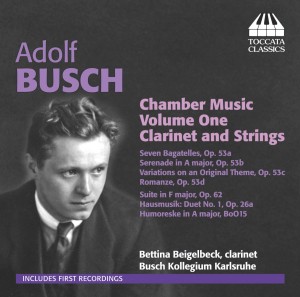
Adolf Busch: Chamber Music, Volume One
Adolf Busch (1891-1952) enjoys a reputation as one of the greatest of all violinists: his recordings of Beethoven with the Busch Quartet have never been surpassed. But Busch was also one of the major composers of his day, equally natural as contrapuntist and melodist, with a style that owed much to his boyhood idol, Max Reger. Yet, always a man of principle, he sacrificed his career as both violinist and composer with his dignified refusal to perform or be performed in Nazi Germany. This CD of his lyrical writing for clarinet, the first in a series of recordings of Busch's light-filled chamber music, is part of the rediscovery of one of the leading musicians of his day.
Bettina Beigelbeck, clarinet
Busch Kollegium Karlsruhe
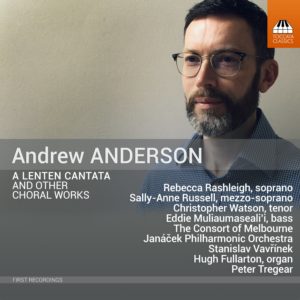
Andrew Anderson: A Lenten Cantata and Other Choral Works
In spite of the differences of time and distance, the choral works of the Australian composer Andrew Anderson (born in Melbourne in 1971) further the English cathedral tradition of such composers as Finzi and Howells, in music concerned particularly with lyricism and with clarity and directness of expression.
Rebecca Rashleigh, soprano (Track 5)
Sally-Anne Russell, mezzo-soprano (Tracks 3, 17)
Christopher Watson, tenor (Track 3)
Eddie Muliaumaseali’i, bass (Track 7)
The Consort of Melbourne (Tracks 2, 4, 6, 8, 9–16)
Janáček Philharmonic Orchestra (Tracks 1-3, 5-8, 17)
Pavel Doležal, violin (Track 4)
Stanislav Vavřínek, conductor (Tracks 1–3, 5–8, 17)
Hugh Fullarton, organ (Tracks 9, 15, 16)
Peter Tregear, choirmaster (Tracks 2, 4, 6, 8), conductor (Tracks 9–16)
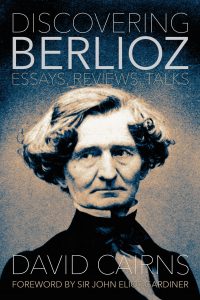
Discovering Berlioz: Essays, Reviews, Talks
by David Cairns
Foreward by Sir John Eliot Gardiner
Extent: 400 pages
Size: royal octavo
Published: December 2019
ISSN 0264-6889
Musicians on Music, No. 12
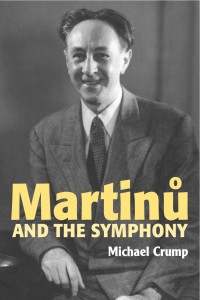
Martinů and the Symphony
Extent: 550 pages
Composition: Royal octavo
Illustrations: 9 half-tones; 199 music exx.
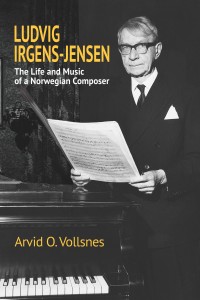
Ludvig Irgens-Jensen: The Life and Music of a Norwegian Composer
Extent: 368 pages
Composition: Royal octavo ~ Illustrations ~ LoW ~ Irgens-Jensen as Poet ~ Bibliography ~ Discography ~ Index of Irgens-Jensen's Music ~ General Index ~ Sampler CD of Irgens-Jensen’s Music
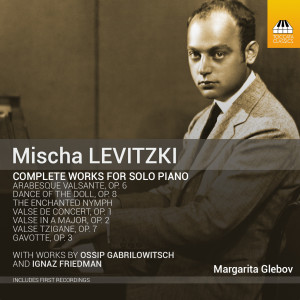
Mischa Levitzki: Complete Works for Solo Piano
With works by OSSIP GABRILOWITSCH and IGNAZ FRIEDMAN
What was called ‘the Golden Age of Pianism’ – the last decades of the nineteenth century and the first of the twentieth – also saw the final flourish of the composer-pianist, a tradition that had begun with Mozart and Beethoven. This recording presents music by three of these last lions. The handful of works left by Mischa Levitzki (1898–1941) are charming miniatures; those by Ossip Gabrilowitsch (1878–1936) are slightly more ambitious; and the compositions of Ignaz Friedman (1882–1948) – both original pieces and transcriptions – point to a substantial body of music that has yet to be fully explored.
Margarita Glebov, pianist