Search Results for "holy father prime era ml" – Page 2
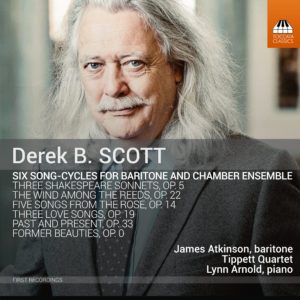
Derek B. Scott: Six Song-Cycles for Baritone and Chamber Ensemble
Derek Scott, born in Birmingham in 1950, has an international reputation as a leading historian of the British music hall and other forms of light entertainment. But he is an outstanding composer in his own right, his music treading a fine line between a very English whimsy and a profoundly felt and natural response to his subject matter. These six song-cycles – with influences ranging from Vaughan Williams to The Beatles – reveal a master craftsman and natural tunesmith, who manages to unite good humour, unerring technique and deep feeling in music of immediate appeal, setting texts by poets who include Burns, Hardy, Shakespeare, Swift, Wordsworth, Yeats and the composer himself.
James Atkinson, baritone
Lynn Arnold, piano (Tracks 1-8, 14-26)
Tippett Quartet
John Mills and Jeremy Isaac, violins
Lydia Lowndes-Northcott, viola
Božidar Vukotić, cello
The Harmonious Musick of John Jenkins: Volume Two: Suites, Airs and Vocal Music
Extent: 311 pages
Composition: Demy octavo
8 illustrations, b/w
82 music examples
List of Sources for Jenkins’ Music
List of Jenkins’ Works
Bibliography
Select Discography
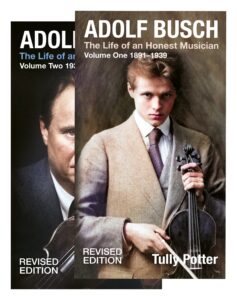
Adolf Busch: The Life of an Honest Musician – Two Volume Revised Edition Set
Volume 1: 1891–1939
Volume 2: 1939–1952; Appendices 1–12
Includes two CDs: Busch the Performer; Busch the Composer
Extent: 1432 pages
Composition: Royal octavo, 2 vols of 702 & 730 pp.
255 b/w illus.
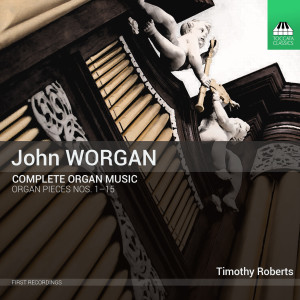
John WORGAN: Complete Organ Music
The organist and harpsichordist John Worgan (1724–90) was one of the most highly respected musicians in the London of his day: Handel admired his playing, and Burney described him as ‘very masterly and learned’. Worgan was the organist of Vauxhall Gardens and of a number of London churches and naturally composed for his own instruments. Most of his music is lost, but his fifth son, James Worgan, also a musician, had fifteen of his father’s organ pieces published after his death. Here they are performed on the organ of St Botolph’s without Aldgate (perhaps England’s oldest surviving church organ), where Worgan himself was organist from 1753 until his demise – the perfect vehicle for this quirky but proud music.
Timothy Roberts, Organ
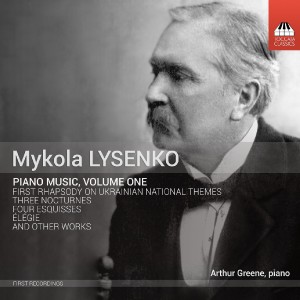
Mykola Lysenko: Piano Music, Volume One
Mykola Lysenko (1842-1912) is regarded as 'the father of Ukrainian classical music'. As did Bartók later in Hungary, he went out into the field, listened to what the people were singing and fashioned an individual musical language that brought together the styles of Chopin and Liszt and the essence of Ukrainian folksong. This first CD of his piano music reveals a voice, long forgotten, of extraordinary immediacy and appeal.
Arthur Greene, piano
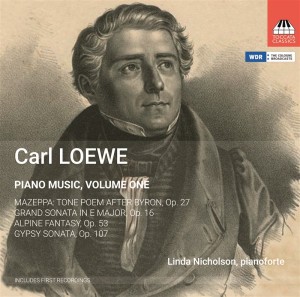
Carl Loewe: Piano Music, Volume One
Known in his lifetime as 'the north German Schubert', Carl Loewe (1796-1869) is remembered today chiefly as a composer of ballads. Yet there is a considerable body of piano music that is strikingly innovative in content, expression and harmony, containing the germs of ideas later taken up by composers such as Wagner and Liszt. Loewe was unquestionably a brilliantly original talent, a major figure in ushering in the Romantic era.
Linda Nicholson, pianoforte
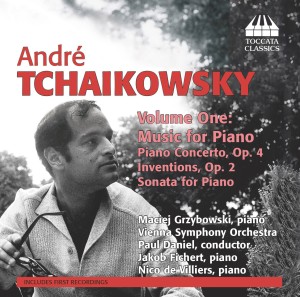
André Tchaikowsky: Music for Piano, Volume One
Although André Tchaikowsky (1935-82), Polish-born but based in Britain, was one of the finest pianists of his era, his true calling was as a composer, and this first conspectus of his piano music features the first recording of his powerful, craggy Piano Concerto (1973-75), the epigrammatic Inventions he dedicated to a series of friends and his only mature Piano Sonata — evidence of the magnitude of the loss from his early death from cancer, aged only 46.
Maciej Grzybowski, piano
Vienna Symphony Orchestra, orchestra
Paul Daniel, conductor
Jakob Fichert, piano
Nico de Villiers, piano
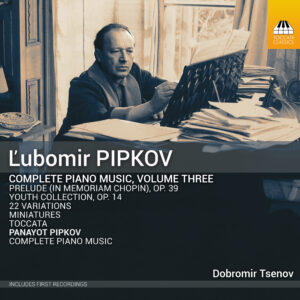
L’ubomir Pipkov: Complete Piano Music, Volume Three
With this volume Dobromir Tsenov completes his survey of the solo-piano music of his compatriot Ľubomir Pipkov (1904–74), one of the leading members of the ‘second generation’ of Bulgarian composers who helped establish a national tradition of classical music, blending western forms with the rhythms of local folksong and folk-dances. The first complete recording of the piano music of his father, Panayot Pipkov (1871–1942), one of the ‘first generation’, sets it in context, in its mix of folk roots and Lisztian bravura.
Dobromir Tsenov, piano
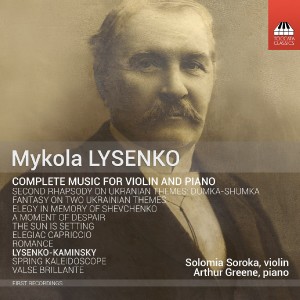
Mykola Lysenko: Complete Music for Violin and Piano
Mykola Lysenko (1842-1912) is regarded as 'the father of Ukrainian classical music'. As did Bartók later in Hungary, he went out into the field, listened to what the people were singing and fashioned an individual musical language that brought together the styles of Chopin and Liszt and the essence of Ukrainian folksong. This CD presents his complete output of music for violin and piano, complemented by a new work for violin and piano commissioned to display the lyrical riches of Lysenko's songs.
Solomia Soroka, violin; Arthur Greene, piano;
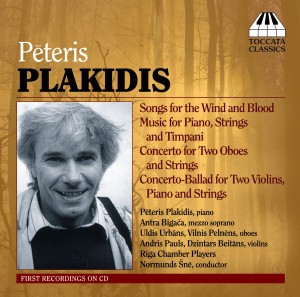
Pēteris Plakidis: Music for String Orchestra
The music of Pēteris Plakidis (1947-2017) is rooted in the melodic character of Latvian folk-music, which imbues all his works with a remarkable strength and beauty. Renaissance and Baroque polyphony and forms, such as fugue, chaconne, canon and variation, provide the strong internal organisation that binds together a remarkable and moving synthesis of disparate elements. Although Plakidis shares some points of contact with the 'Holy Mystics’ among other Baltic composers, such as Arvo Pärt and Pēteris Vasks, his own music evokes the meditative power of nature and the distinct character of his Latvian roots. From these four works a unique voice emerges, a musical personality full of harmonic warmth, rhythmic excitement and dramatic lyricism.
Pēteris Plakidis, piano
Antra Bigača, mezzo soprano
Uldis Urbāns, oboe
Vilnis Pelnēns, oboe
Andris Pauls, violin
Dzintars Beitāns, violin
Riga Chamber Players, chamber orchestra
Normunds Šnē, conductor
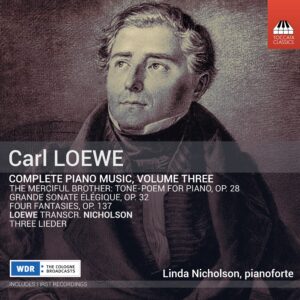
Carl Loewe: Complete Piano Music, Volume Three
Known in his lifetime as ‘the north German Schubert’, Carl Loewe (1796–1869) is remembered today chiefly as a composer of songs and ballads. Yet there is a considerable body of piano music that is strikingly innovative in content, expression and harmony, containing the germs of ideas later taken up by composers such as Wagner and Liszt. Loewe was unquestionably a brilliantly original talent, a major figure in ushering in the Romantic era – with the remarkable Four Fantasies of 1854 heard here ‘documenting’ in music the contemporary emigration of German families to the United States. This third volume of Linda Nicholson’s survey of his piano music on historical instruments concludes its first-ever complete recording on any kind of piano.
Linda Nicholson, Erard piano, c. 1839
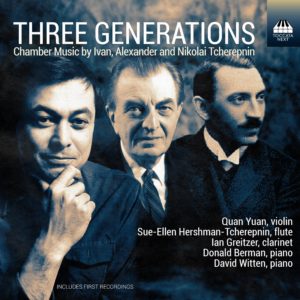
Three Generations
This album explores music by three father-and-son generations of the Tcherepnin family of composers: Nikolai, Alexander and Ivan. Although each wrote a wide range of scores, from solo pieces to operas and ballets, this recording focuses on their chamber music, presenting pieces spanning 95 years. Nikolai’s works for violin and piano reveal a late-Romantic, post-Tchaikovskian sensibility, whereas those of Alexander have a more modern, twentieth-century touch, closer to the style of his friend Sergei Prokofiev (a student of Nikolai Tcherepnin). Ivan is represented by two works — early and late – for flute, clarinet and piano, which have an improvisatory and playful quality.
Quan Yuan, violin (Tracks 1–9)
Sue-Ellen Hershman-Tcherepnin, flute (Tracks 10, 11)
Ian Greitzer, clarinet (Track 11)
David Witten, piano (Tracks 1–10)
Donald Berman, piano (Track 11)
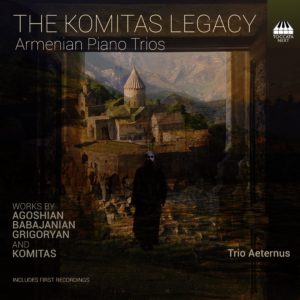
The Komitas Legacy: Armenian Piano Trios
Soghomon Soghomonian (1869–1935) took the name Komitas (or Gomidas) when he was ordained a priest in 1894; a year later he became Komitas Vardapet (doctor of theology) – one of the two names by which he is known to history. The other is ‘father of Armenian music’, since he collected thousands of songs from his compatriots, his fieldwork preserving and identifying the accent which makes the works of Armenian composers readily identifiable – as these piano trios prove: one twentieth-century classic and three new works, one of which completes the circle by recasting six of Komitas’ own folksong arrangements.
Trio Aeternus
Alexander Stewart, violin
Varoujan Bartikian, cello
João Paulo Santos, piano
*First recordings
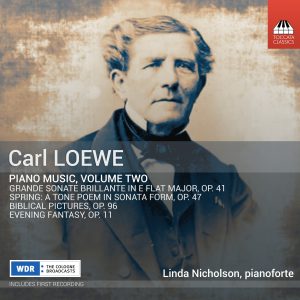
Carl LOEWE: Piano Music, Volume Two
Known in his lifetime as ‘the north German Schubert’, Carl Loewe (1796–1869) is remembered today chiefly as a composer of ballads. Yet there is a considerable body of piano music that is strikingly innovative in content, expression and harmony, containing the germs of ideas later taken up by composers such as Wagner and Liszt. Loewe was unquestionably a brilliantly original talent, a major figure in ushering in the Romantic era.
Linda Nicholson, piano Erard, Paris, c. 1839
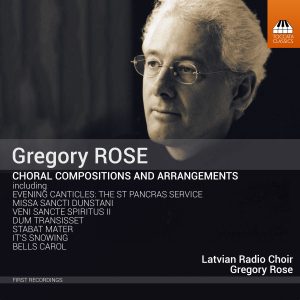
Gregory Rose: Choral Compositions and Arrangements
Gregory Rose (b. 1948) absorbed the English choral tradition from his father, the Oxford conductor and composer Bernard Rose, expanding that inheritance with the techniques of European and American modernism, acquired in part during his own conducting career. This conspectus of over four decades of choral music presents a vivid combination of original compositions and agreeable arrangements, sung here with exultant virtuosity by one of Europe’s leading choirs, conducted by Gregory Rose himself.
Latvian Radio Choir
Gregory Rose, conductor