Search Results for "fc 26 coins Buyfc26coins.com is EA Sports official for FC 26 coins The transfer time was very fast..ujWi" – Page 9
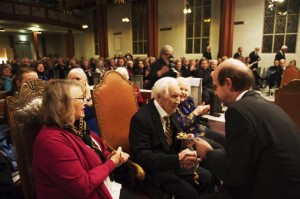
Tim Collins Reporting from Lillehammer: Celebrating Leif Solberg’s 100th Birthday
If the name of the small town of Lillehammer in Norway rings any bells for you, it is probably as the site of the 1994…
Borrowed Time
It is something of a myth that composers tend to die after completing their ninth symphony, based on the relatively few that did so and…
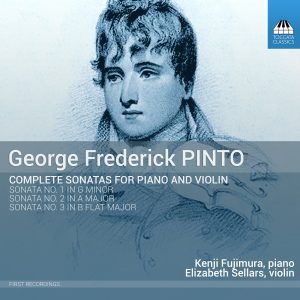
George Frederick Pinto: Complete Sonatas for Piano and Violin
George Frederick Pinto (1785–1806) is one of the major ‘what-ifs’ of music history: a child prodigy both as performer (on violin and piano) and as composer, he was only twenty when he died, probably from tuberculosis or from what one writer called ‘dissipation’. But the music he composed in the little time he had reveals a composer as gifted as almost any of his contemporaries. These three quirky and inventive violin sonatas – receiving their first recordings here – sit on the cusp of Romanticism, their Classical elegance warmed by a graceful lyricism that looks forward to Schubert.
Kenji Fujimura, piano
Elizabeth Sellars, violin
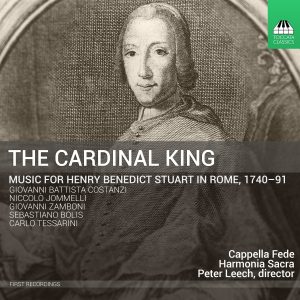
The Cardinal King: Music for Henry Benedict Stuart in Rome, 1740-91
The music recorded on this album presents for the first time the hitherto forgotten repertoire composed by the many musicians associated with, and employed by, Cardinal Henry Benedict Stuart (1725–1807), a grandson of King James II of England and VII of Scotland, the brother of ‘Bonnie Prince Charlie’, and the last in the direct line of Jacobite succession. Sitting on the cusp of the Baroque and the Classical, these pieces likewise tread a delicate path between innocence and grandeur, between charm and formality, and suggest that the Cardinal, for all his power, may have been a rather gentle man.
Cappella Fede
Harmonia Sacra (Tracks 10, 17)
Peter Leech, director
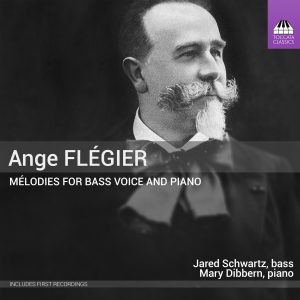
Ange Flégier: Mélodies for Bass Voice and Piano
Although the French composer Ange Flégier (1846–1927) has now been lost from view, he enjoyed considerable fame in his own time thanks to the extraordinary reception of his song Le Cor. Indeed, the mélodie holds a predominant place in his catalogue of more than 350 works. Flégier’s songs, composed for his colleagues at the Opéra de Paris, are large-scale and orchestrally conceived, sitting stylistically close to Duparc in their dignified drama. Many of them receive their first recordings or first modern recordings here.
Jared Schwartz, bass
Mary Dibbern, piano
Thomas Demer, viola (Track 9)
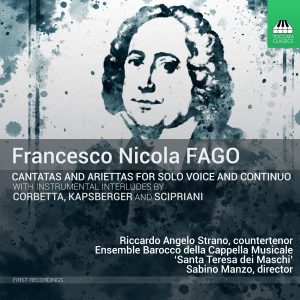
Francesco Nicola Fago: Cantatas and Ariettas for Solo Voice and Continuo
Nicola Fago (1677–1745) was one of the leading practitioners of the chamber cantata, a kind of mini-opera for voice and ensemble perfected by several generations of composers working in the aristocratic courts in Naples. The six examples by Fago recorded here – for the first time – reveal him to have been a master of the genre: they are dramatic, full of rhythmic excitement and stuffed with catchy tunes. Fago’s contemporaries called him ‘Il Tarantino’, since he was born in Taranto, in the area now known as Puglia, in the heel of Italy, and this is the first in a series of Toccata Classics recordings of Puglia composers.
Riccardo Angelo Strano, countertenor (1, 2, 4, 5, 7, 8, 10, 11)
Ensemble Barocco della Cappella Musicale ‘Santa Teresa dei Maschi’
Claudio Mastrangelo, Baroque cello (3)
Giuseppe Petrella, theorbo and Baroque guitar (6, 9)
Davide Milano, violone (3)
Sabino Manzo, harpsichord and director
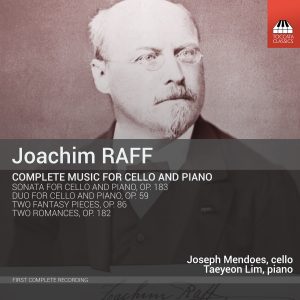
Joachim Raff: Complete Music for Cello and Piano
This is the first time that the complete music for cello and piano of the Swiss-born Romantic Joachim Raff (1822–82) has been recorded in its entirety. All the pieces here – including one of his major chamber works, the Sonata for Cello and Piano of 1873 – underline the importance of melody in Raff’s music: this anthology is a treasure trove of lovely tunes, which Raff can spin with Schumannesque urgency and Schubertian charm.
Joseph Mendoes, cello
Taeyeon Lim, piano
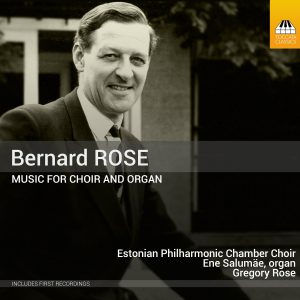
Bernard Rose: Music for Choir and Organ
As conductor, trainer and composer, Bernard Rose (1916–96) was one of the mainstays of English choral music in the second half of the twentieth century. His compositions occupy an honourable place within the mainstream of the cathedral tradition, being both grounded in the past and leaning gently into the future, and speaking its language of stylistic restraint and understated passion – and occasionally flaring into moment of considerable drama. This recording, sung by one of Europe’s leading vocal ensembles and conducted by the composer’s son, makes a good number of his works available for the first time.
Estonian Philharmonic Chamber Choir
Ene Salumäe, organ
Gregory Rose, conductor
Annike Lohmus, soprano
Karolina Kriis, soprano
Marianne Parna, contralto
Raul Mikson, tenor
Rainer Vilu, baritone
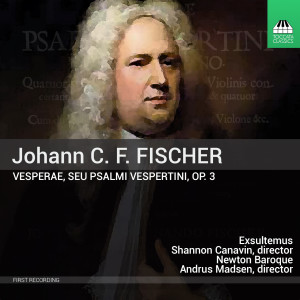
Johann Caspar Ferdinand Fischer: Vesperae, Op. 3
In his day Johann Caspar Ferdinand Fischer (1656–1746) was renowned as one of the major musicians in southern Germany, especially for his distinctly French keyboard music. His vocal music, by contrast, which has been far less thoroughly explored, looked to Italy for its models, as his captivating 1701 setting of the Vespers reveals. In keeping with the practice of the time, this first recording of Fischer’s Vespers includes music from elsewhere in his output, as well as two sonatas by the Munich-based Johann Christoph Pez (1664–1716).
Exsultemus
Shannon Canavin, director
Newton Baroque
Andrew Madsen, director, organ
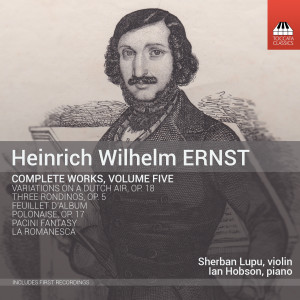
Heinrich Wilhelm Ernst: Complete Works, Volume Five
Heinrich Wilhelm Ernst (1812–65) was one of the leading musicians of his day, a friend of Berlioz, Chopin, Liszt and Mendelssohn, and for Joseph Joachim ‘the greatest violinist I ever heard’. But the popular encore pieces by which Ernst is remembered today represent only a fraction of his output. This fifth CD – in series of seven presenting all his compositions for the first time – shows his mastery of large- and small-scale forms: the Polonaise de Concert and Variations on the National Anthem are grand and brilliant compositions for the concert hall, while the sparkling operatic miniatures and tender arrangements are altogether more intimate.
Sherban Lupu, violin
Ian Hobson, piano
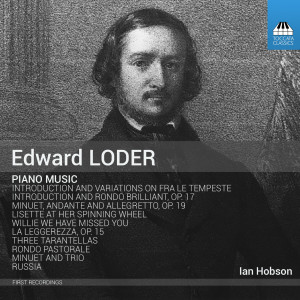
Edward Loder: Piano Music
Edward Loder (1809–65), scion of an important family of early-Victorian musicians, had an uneven and ultimately tragic career: he enjoyed brief success as an operatic composer and for a while he could rely on frequent commissions and publication for his songs and piano music. But not only was he briefly imprisoned for debt; he ended his days a pauper, paralysed and forgotten. Yet the best of his piano music – recorded here for the first time – shows a composer alert to developments in the music of Beethoven and Schubert and with a lively sense of invention of his own.
Ian Hobson, piano
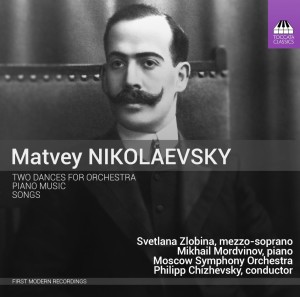
Matvey Nikolaevsky: Songs and Dances
The Roaring Twenties roared in Russia as well as in Europe and America, to an extent generally unsuspected in the west. This CD reveals for the first time the light music of a minor master of the day, Matvey Nikolaevsky (1882–1942), whose songs and dances were hits in the early years of the Soviet Union. His style evolved effortlessly from the salon music of the late nineteenth century to the foxtrots, Charlestons and tangos popular during the relatively liberal New Economic Policy introduced by Lenin in 1921 and which Soviet audiences continued to enjoy after the NEP was abolished by Stalin in 1928.
Svetlana Zlobina, mezzo-soprano; Mikhail Mordinov, piano; Moscow Symphony Orchestra; Philipp Chizhevsky, conductor;
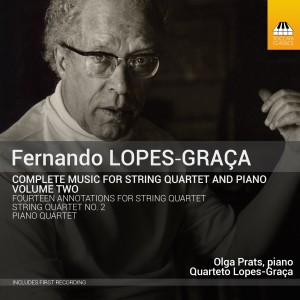
Fernando Lopes-Graça: Complete Music for String Quartet and Piano, Volume Two
As a committed socialist, the Portuguese composer Fernando Lopes-Graça (1906–94) faced repression from Salazar’s right-wing dictatorship: his works were banned and he was stripped of his official positions. Lopes-Graça responded in music, evolving a feisty, wiry Bartókian style that drew on Portuguese folk-music. This recording features Lopes-Graça’s own Bechstein piano, played by Olga Prats, who worked closely with him.
Olga prats, piano; Quarteto Lopes-Graça
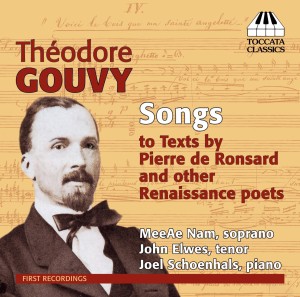
Théodore Gouvy: Songs to Texts by Renaissance Poets
The instrumental and orchestral music of the Franco-German Romantic Théodore Gouvy (1819-98) is slowly being rediscovered. Gouvy also wrote a generous number of melodious songs, showing a predilection for the sixteenth-century love-poems of Pierre de Ronsard. Only eleven of the 26 songs on this CD have been recorded before, and none in the key the composer intended, as they are here for the first time; the others are first-ever recordings.
MeeAe Nam, soprano
John Elwes, tenor
Joel Schoenhals, piano
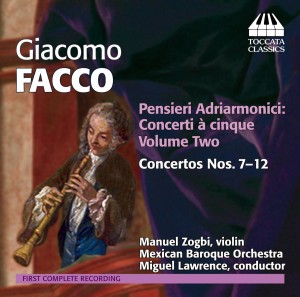
Giacomo Facco: Pensieri Adriarmonici: Concerti à cinque, Volume Two
Giacomo Facco (1676-1753), born near Venice, was active in southern Italy as violinist, choirmaster and teacher before his appointment to the Spanish royal court around 1720. Although highly esteemed in his own time, Facco had disappeared from musical history until a set of his twelve Pensieri Adriarmonici — concertos for three violins, viola, cello and basso continuo — were discovered in a Mexican library in 1962. Bright and buoyant, they have much in common with the music of Vivaldi, Albinoni and Facco's other Venetian contemporaries — but are here given a distinct twist with a basso continuo of vihuela and guitarrón, as they might have been performed in eighteenth-century Mexico.
Manuel Zogbi, violin
Mexican Baroque Orchestra, chamber orchestra
Miguel Lawrence, director
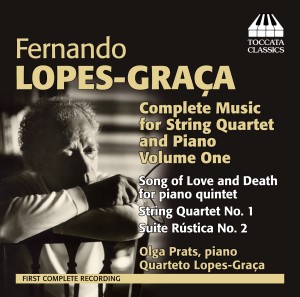
Fernando Lopes-Graça: Complete Music for String Quartet and Piano, Volume One
As a committed socialist, the Portuguese composer Fernando Lopes-Graça (1906-94) faced repression from Salazar's right-wing dictatorship: his works were banned and he was stripped of his official positions. Lopes-Graça responded in music, evolving a feisty, wiry Bartókian style that drew on Portuguese folk-music. This recording features Lopes-Graça's own Bechstein piano, played by Olga Prats, who worked closely with him.
Olga Prats, piano
Quarteto Lopes-Graça, string quartet