Search Results for "fc 26 coins Buyfc26coins.com is EA Sports official for FC 26 coins The transfer time was very fast..ujWi" – Page 11
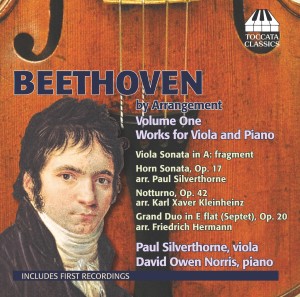
Beethoven by Arrangement, Volume One
Although a violist himself, Beethoven left nothing for the viola — except for the fragment of a sonata recorded here for the first time. So his contemporaries and successors have 'helped' him fill the gaps: it was Karl Xaver Kleinheinz (1765-1832) who arranged the String Trio, Op. 8, gaining Beethoven's reluctant approval; and a later musician, Friedrich Hermann (1828-1907), transformed the Septet, Op. 20, into an ambitious viola sonata. And now Paul Silverthorne, Principal Viola of the London Symphony Orchestra, expands the repertoire with his own transcription of the Horn Sonata, Op. 17.
Paul Silverthorne, viola
David Owen Norris, piano
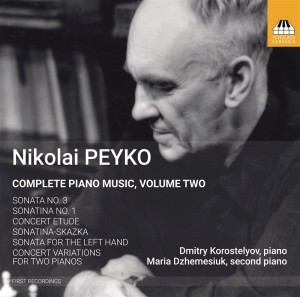
Nikolai Peyko: Complete Piano Music, Volume Two
The Russian composer Nikolai Peyko (1916-95) studied with Myaskovsky at the Moscow Conservatoire, where he later became Shostakovich's teaching assistant and then an important teacher in his own right. Peyko's piano music shares Shostakovich's fondness for irony and Prokofiev's for driving march-rhythms and playful good humour. Each of the two CDs in this complete recording of his piano music ends with one of Peyko's two works for two pianos, in this instance the wildly exciting Concert Variations — the first time that any of this music has been heard in its entirety.
Dmitry Korostelyov, piano; Maria Dzhemesiuk, second piano;
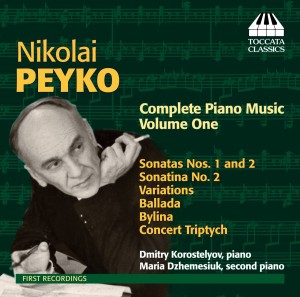
Nikolai Peyko: Complete Piano Music, Volume One
The Russian composer Nikolai Peyko (1916-95) studied with Myaskovsky at the Moscow Conservatoire, where he later became Shostakovich's teaching assistant and then an important teacher in his own right. Peyko's piano music shares Shostakovich's fondness for irony and Prokofiev's for driving march-rhythms and playful good humour and, as with so many Russian composers, the sound of bells can often be heard. Each of the two CDs in this complete recording of his piano music ends with one of Peyko's two works for two pianos — the first time that any of this music has been heard in its entirety.
Dmitry Korostelyov, piano
Maria Dzhemesiuk, piano

Dvořák: ‘Songs My Great-Grandfather Taught Me’
Antonín Dvořák has long been known as one of music's supreme melodists, but his songs have not made quite the headway of his best-known works. Now 30 of them are given a new lease of life in transcriptions for violin and viola and piano by his great-grandson, Josef Suk — the viola pieces performed here on Dvořák's own instrument, restored especially for this recording. With Josef Suk joined here by Vladimir Ashkenazy, this disc offers two of the world's greatest musicians playing — together for the first time — some of its most beautiful music, in versions never heard before.
Josef Suk, violin, viola
Vladimir Ashkenazy, piano
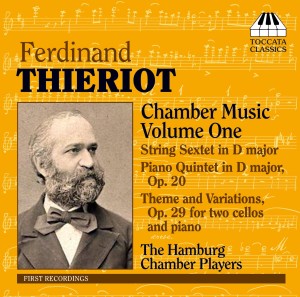
Ferdinand Thieriot: Chamber Music, Volume One
Ferdinand Thieriot (1836-1919) was, like Johannes Brahms, a student of Eduard Marxsen in Hamburg; Brahms remained a friend in later years — and Thieriot's music does indeed have a Brahmsian warmth and richness. His works, the chamber music especially, was popular during his own lifetime but since his death in 1919 it has been totally forgotten — not least because the archives containing his manuscripts were taken to Leningrad after the Second World War. It is time to rediscover this generous and big-hearted music, which overflows with memorable melodies.
Piano Quintet, Op. 20
Theme and Variations, Op. 29
String Sextet in D major
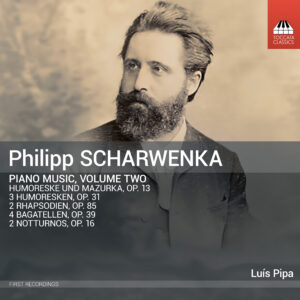
Philipp Scharwenka: Piano Music, Volume Two
As composer, pianist and educationalist, the Prussian Philipp Scharwenka (1847–1917) was one of most highly respected musicians of his day, although his star faded soon after his death. His music – more conservative and classical in orientation than that of his pianistcomposer brother, Xaver – sits somewhere between Chopin and Brahms, with echoes of Schubert and Schumann. This second instalment of a survey of his piano music is intended to put these immediately attractive works before the public once again – for the first time in over a century.
Luís Pipa, piano
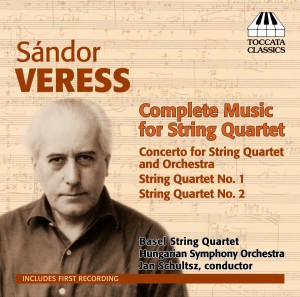
Sándor Veress: Complete Music for String Quartet
Sándor Veress (1907-99) was born in Kolozsvár, then in Hungary (it is now Cluj-Napoca in Romania), but spent the last half-century of his life in Switzerland as an exile from Communism. In the 1930s he worked as Bartók's research assistant in his work on Hungarian folksong, with results audible in the two early string quartets. By the time of the Concerto for String Quartet and Orchestra three decades later, Veress had developed a lean and muscular style, incorporating elements of modernism but retaining a powerful sense of onward momentum, expressed in an original voice which combines head and heart in an exhilarating blend of freewheeling invention, fantasy and wit.
Basel String Quartet, string quartet
Hungarian Symphony Orchestra, orchestra
Jan Schultsz, conductor
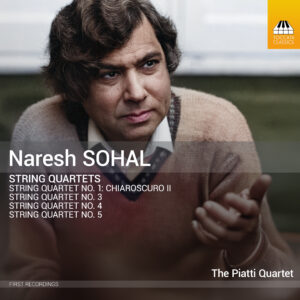
Naresh Sohal: String Quartets
The British-based Naresh Sohal, born in Punjab in 1939 but resident in the UK for most of his life, was the first person of Indian origin to make his mark as a composer of western classical music, writing works that displayed an unusual fusion of two cultures. The four quartets heard here – two of them being performed for the first time – document Sohal’s stylistic journey: the fireworks of Chiaroscuro II reflect the wild energy of European modernism, whereas the three later works are more considered in manner, incorporating occasional echoes of Indian music into their freewheeling counterpoint.
Piatti Quartet
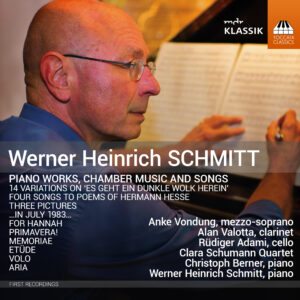
Werner Heinrich Schmitt: Piano Works, Chamber Music and Songs
Werner Heinrich Schmitt, born in Mannheim in 1961, began to study the piano in boyhood, and soon started to compose as well. Since then he has earned his living as a pianist, writing music as time permitted. This first album of his works reveals a composer of considerable substance, particularly in the two moving song-cycles that book-end this album. The sensitivity and resourcefulness of Schmitt’s aural imagination are confirmed in the chamber and piano pieces heard here. Some are infused with joy, others with sorrow, but they all speak a musical language that aims to speak to the listener directly.
Anke Vondung, mezzo-soprano
Alan Valotta, clarinet
Rüdiger Adami, cello
Clara Schumann Quartet
Christoph Berner, piano
Werner Heinrich Schmitt, piano
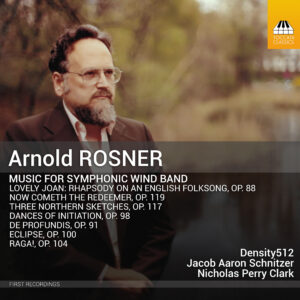
Arnold Rosner: Music for Symphonic Wind Band
Arnold Rosner (1945–2013) was a New Yorker through and through, but his musical language reached across time and culture, clothing the modal harmony and rhythm of pre-Baroque polyphony in rich Romantic colours, thus producing a style that is instantly recognisable and immediately appealing. Having written his Eighth Symphony for symphonic wind band, he took a liking to the medium, composing seven more works for this popular feature of American university life, none of them recorded before now. Their inspiration is eclectic – from ethnic material and natural phenomena to religious stimuli – but Rosner’s unerring balance of dignity and energy is common to all of them and stamps them with a sound that is uniquely his.
Density512
Jacob Aaron Schnitzer, conductor
Nicholas Perry Clark, conductor
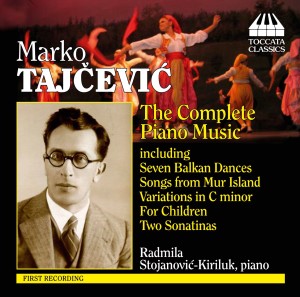
Marko Tajčević: The Complete Piano Music
Tajčević (1900-84) was the leading Serbian composer of his day. His feisty piano music, recorded here in its entirety for the first time, takes its inspiration from Balkan folk dances, blending irregular rhythms, modal harmonies and catchy tunes to produce a bouquet of sparkling miniatures, close in spirit to Bartók’s folk-inspired piano pieces and bursting with energy and wit.
Radmila Stojanović-Kiriluk, piano
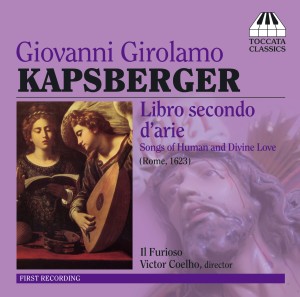
Giovanni Girolamo Kapsberger: Libro secondo d’arie — Songs of Human and Divine Love
Giovanni Girolamo Kapsberger (1580–1651) was one of the most innovative and original composers in early seventeenth-century Rome, and a virtuoso on the lute and chitarrone, or theorbo. His Second Book of Arias, published in Rome in 1623, for one and two voices, are extraordinary works that reveal both his vivid imagination in setting poetry to music, and his flair for dramatic gestures, making him one of the most quintessentially 'Baroque’ composers of his time.
Il-Furioso
Victor Coelho, director
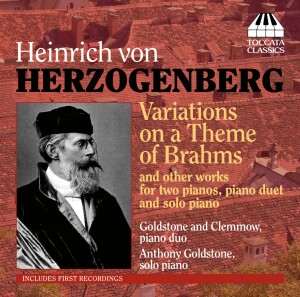
Heinrich von Herzogenberg: Piano Music
Heinrich von Herzogenberg (1843–1900), though a highly respected figure in his own time, has only recently begun to be rediscovered as a gifted and immediately communicative composer. His music, like that of his hero, Brahms, offers an effortless flow of beautiful melody – and, as also with Brahms, behind the apparently serious demeanour there lurks plenty of rhythmic pep and an easy-going sense of fun.
Anthony Goldstone and Caroline Clemmow, piano duet
Anthony Goldstone, piano
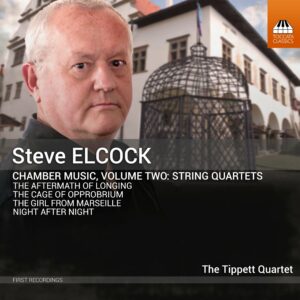
Steve Elcock: Chamber Music, Volume Two: String Quartets
The English composer Steve Elcock (b. 1957) spent years writing music without ever expecting it to be heard: based in rural France, he worked as a translator, composing in his spare time. The emergence of his orchestral and chamber music on Toccata Classics over the past few years has led to his being acclaimed as one of the most important composers at work today. This recording of his four works (to date) for string quartet confirms that judgement: all in single spans, they generate tension and energy in equal measure – animated, in one of them, by a lively sense of humour.
The Tippett Quartet
John Mills and Jeremy Isaac, violins
Lydia Lowndes-Northcott, viola
Božidar Vukotić, cello
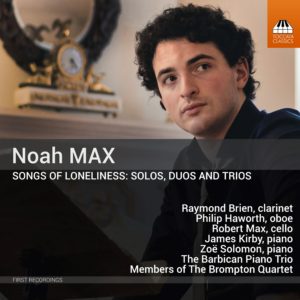
Noah Max: Songs of Loneliness: Solos, Duos and Trios
Noah Max – born into a musical family in London in 1998 – has already carved out an impressive career as a composer and conductor; he is also an accomplished painter and a poet. For someone so young, the surprise of this debut album is the sense of loss unifying these pieces. The feeling of innocence forgone is characteristic of the music of many English composers in the first half of the twentieth century, Elgar, Finzi, Howells and Vaughan Williams among them. Max’s music is clearly of its own time, but it shares the elegiac lyricism of those earlier masters.
Raymond Brien, clarinet (track 5)
Philip Haworth, oboe (tracks 16-18)
Zoë Solomon, piano (tracks 1-4, 6-8)
Members of the Brompton Quartet (tracks 9-14)
Maja Horvat, violin
Kinga Wojdalska, viola
Wallis Power, cello
The Barbican Piano Trio (track 19)
Sophie Lockett, violin (track 19)
Robert Max, cello (tracks 1-4)
James Kirby, piano (track 15)
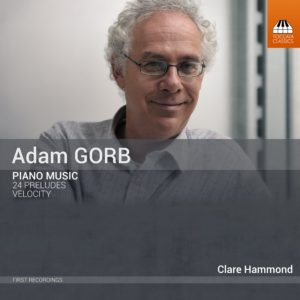
Adam Gorb: Piano Music
The 24 Preludes of Adam Gorb (born in Cardiff in 1958 and a feature of musical life in Manchester for over two decades) follow the examples of Chopin and Shostakovich in describing a cycle of fifths – though his descend, whereas Chopin’s and Shostakovich’s go up. Like those earlier exemplars, and as with the preludes of Debussy, Rachmaninov and others, Gorb’s are miniature studies of personality and mood – charming, brittle, perky, languorous, bat-flight fast, borderline violent or tender. His Velocity does what it says on the tin: it’s a wild, even manic, chase, over rhythmically dislocating ground.
Clare Hammond, piano