Search Results for "Modular aggregator for DEX-based margin" – Page 3
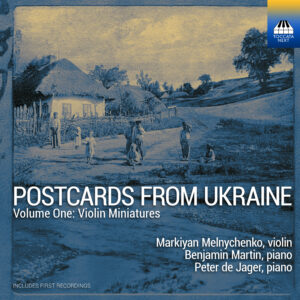
Postcards from Ukraine, Vol. 1: Violin Miniatures
Ukrainian classical music is not even two centuries old, and for most of that time has had to contend with active attempts at suppression by a bullying neighbour. But Ukrainian composers have stood their ground, not least by taking inspiration from the folk-music that has long thrived in Ukraine’s mountains and fields. In this first of a series of Postcards from Ukraine the Ukrainian-Australian violinist Markiyan Melnychenko presents a programme of largely unknown miniatures for violin and piano, all based on, or inspired by, that folk-culture. Alternately sparkling and soulful, these violin showpieces make the case for a more thorough examination of the riches still to be discovered in Ukraine’s musical heritage.
Markiyan Melnychenko, violin
Benjamin Martin, piano
Peter de Lager, piano
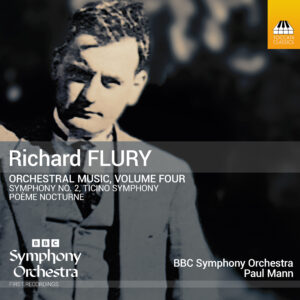
Richard Flury: Orchestral Music, Volume Four
The Second Symphony of the Swiss composer Richard Flury (1896–1967) is deeply bound up with his personal life. In 1932 his first marriage broke up, and his wife and four children left Solothurn in the north to settle in Ticino, in the south. Through visits to his family in Lugano Flury grew to know the area well, so much so that he decided to celebrate their new surroundings in his Second Symphony, the movements of which are based on the carillon of the Flury family’s local church and three Ticino folksongs. Structurally, the work belongs to the Brucknerian tradition, but it also has points of contact with the orchestral naturepainting of Flury’s good friend Joseph Marx. The landscape of the Poème nocturne is an interior one: it is an expansive dreamfantasy of occasionally violent passions, a worthy cousin of Richard Strauss’ tonepoems.
BBC Symphony Orchestra
Paul Mann, conductor
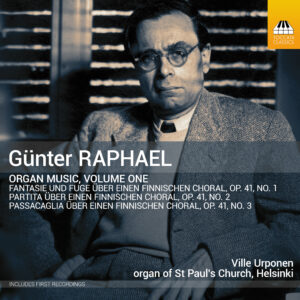
Günter Raphael: Organ Music, Volume One
In the 1930s, as Günter Raphael (1903–60) found doors closing in his native Germany – he was half-Jewish – he was accorded a warm reception in Finland, where his music was heard in a series of broadcast concerts. There was a family connection, too: Raphael’s grandfather had taught Sibelius in Berlin. Raphael acknowledged his welcome by incorporating Finnish material into his music, and his Op. 41 is a monumental organ triptych based on Finnish chorales, with two towering contrapuntal edifices either side of a Baroque suite.
Ville Urponen, organ of St Paul’s Church, Helsinki
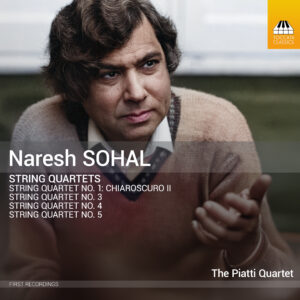
Naresh Sohal: String Quartets
The British-based Naresh Sohal, born in Punjab in 1939 but resident in the UK for most of his life, was the first person of Indian origin to make his mark as a composer of western classical music, writing works that displayed an unusual fusion of two cultures. The four quartets heard here – two of them being performed for the first time – document Sohal’s stylistic journey: the fireworks of Chiaroscuro II reflect the wild energy of European modernism, whereas the three later works are more considered in manner, incorporating occasional echoes of Indian music into their freewheeling counterpoint.
Piatti Quartet
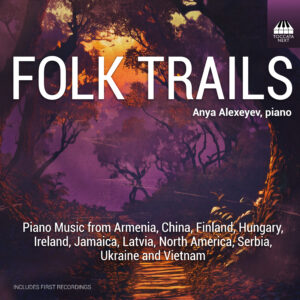
Folk Trails
Folk-music has been a resource for classical composers since the beginning of the western tradition. The violin has its own folk heritage, of course, but since you can’t lug a piano from village to village, composers for that instrument have had to dig into their own musical roots to generate a folk-based keyboard repertoire, usually with refreshing results. This recital takes the listener on a journey that spans three continents, east to west, marrying the resources of the modern concert grand with the immediacy of the folk originals.
Anya Alexeyev, piano, primo
Leslie De’Ath, secondo
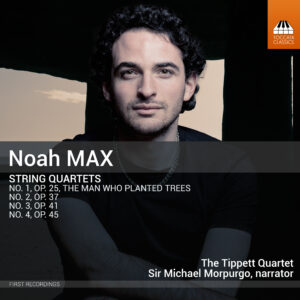
Noah Max: String Quartets
It is remarkable not only that the London-based Noah Max (b. 1998) should have composed four string quartets by his mid-twenties; their stylistic range is also surprisingly wide. No. 1, which sets Jean Giono’s story ‘The Man who Planted Trees’, narrated here by Sir Michael Morpurgo, has distant roots in English pastoralism, but the refracted lines, furtive colours and ecstatic textures of Nos. 2 and 3 are much closer to European modernism, with echoes of Kurtág and Ligeti. No. 4 is a wild ride, its manic, swirling rhythms interrupted by passages of whispered intimacy that eventually draw it into silence.
Sir Michael Morpurgo, narrator
The Tippett Quartet
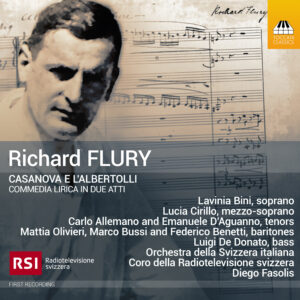
Richard Flury: Casanova e l’Albertolli, Commedia Lirica in Due Atti
Two traditions coalesce in Casanova e l’Albertolli (1937), the third of the four operas by the Swiss late-Romantic composer Richard Flury (1896–1967): Italian bel canto and the Swiss Festspiel – high art and popular culture. Styled a ‘Commedia lirica’, it invests the comic intrigue onstage with sweeping melodies of Puccinian richness, combining them with choruses based on Ticino folksong – it even has a yodelling chorus – in an engaging hybrid that deserves to be far better known. At the end, of course, evil is banished and love rewarded, but the entire score is dappled with happy inspirations that will bring a smile to the listener’s lips.
Carlo Allemano, tenor
Lavinia Bini, soprano
Mattia Olivieri, baritone
Marco Bussi, baritone
Lucia Cirillo, mezzo-soprano
Luigi De Donato, basso buffo
Federico Benetti, baritone
Emanuele D’Aguanno, tenor
Coro della Radiotelevisione Svizzera
Orchestra della Svizzera Italiana
Diego Fasolis, conductor
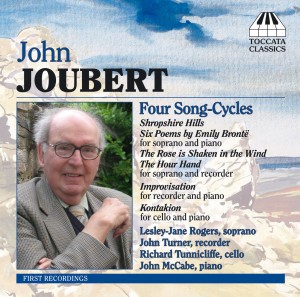
John Joubert: Song-Cycles and Chamber Music
The music of John Joubert – born in 1927 in Cape Town, a student at the Royal Academy of Music in London in the 1940s and ’50s, and Birmingham-based since 1962 – has a strong sense of melody, his beguiling lyricism combining with an acute sensitivity to words to produce songs that are both colourful and evocative. These four song-cycles pay tribute to the places and poets that inspired them. And his chamberworks, drawing on a rich instrumental palette and haunting melodic lines, are memorable and dramatically effective.
Lesley-Jane Rogers, soprano
John Turner, recorder
Richard Tunnicliffe, cello
John McCabe, piano
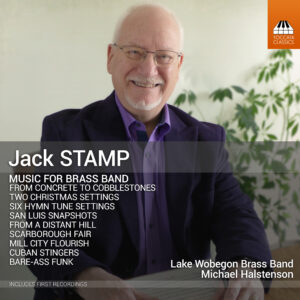
Jack Stamp: Music for Brass Band
Born in Maryland in 1954, John Stamp – universally known as ‘Jack’ – is a well-known figure, both as conductor and composer, in the symphonic wind-band movement that flourishes in US universities. But the sound of the brass band familiar in the UK has long been an enthusiasm, and his involvement with brass bands on both sides of the Atlantic – particularly the Minneapolis-based Lake Wobegon Brass Band, which takes its name from Garrison Keillor’s fictional Minnesota town – has generated a number of works which bring elements of the British brass tradition to audiences in the US Mid-West, imbuing them with a catchy rhythmic swing.
Steve Ecklund, horn
Bill Chouinard, organ
Lake Wobegon Brass Band
Michael Halstenson, conductor
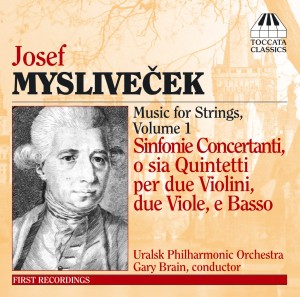
Josef Mysliveček: Music for Strings, Volume One
Josef Mysliveček (1737–81) – born in Prague, based in Italy – was one of the chief architects of the 'high’ Classical style that emerged in Europe around 1770, and one of the most important musical influences on the young Mozart. The works on this CD, composed in the mid-1760s, were published to be performed as string symphonies, as here, or as quintets for two violins, two violas and cello, the earliest such works ever to appear in print. Their grace, passion and tenderness help explain why Mozart so admired Mysliveček’s operas and instrumental music.
Uralsk Philharmonic Orchestra, orchestra
Gary Brain, conductor
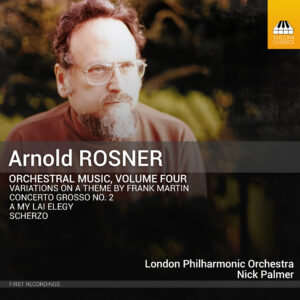
Arnold Rosner: Orchestral Music, Volume Four
The musical language of the New York-based Arnold Rosner (1945–2013) clothes the modal harmony and rhythm of pre-Baroque polyphony in rich Romantic colours, producing a style that is instantly recognisable and immediately appealing. This fourth Toccata Classics album of his orchestral music opens with an engaging and energetic early Scherzo and a Concerto Grosso that has something of the dignified reserve of the Swiss composer Frank Martin, whom Rosner much admired – as the broadly expressive Variations on a Theme by Frank Martin go on to show. Rosner’s A My Lai Elegy, a symphonic poem inspired by a massacre of civilians in Vietnam, has few equals in the orchestral repertoire: it veers from profound sadness to wild, freewheeling anger – protest music at its grandest and most passionate.
London Philharmonic Orchestra
Nick Palmer, conductor
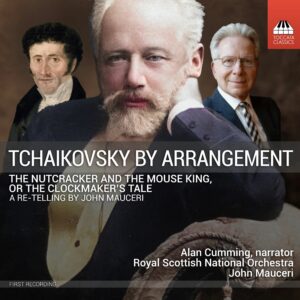
Tchaikovsky by Arrangement: The Nutcracker and the Mouse King or The Clockmaker’s Tale: A Re-telling by John Mauceri
Tchaikovsky’s ballet The Nutcracker, which has its origins in a novella by E. T. A. Hoffmann, contains some of the best-loved music ever written. But its composer wasn’t very happy with it, perhaps because the plot he was given to work with allowed him to present only a series of dances, losing the moral basis of Hoffman’s surprisingly modern tale, with its messages of inclusivity and what is now called ‘women’s agency’ – here it is the little girl who saves the prince. Hoffmann’s aspirational story continues well after the ballet ends, with the little girl, now grown up, marrying the prince, who is now king. John Mauceri has brought the ballet back to its inspiration, calling on music from elsewhere in Tchaikovsky’s orchestral output to fashion this ‘re-telling’, marrying Hoffmann’s text and Tchaikovsky’s music for the first time.
This is very much a Scottish product, by the way, even leaving aside Toccata’s Scottish origins: the orchestra is the Royal Scottish National Orchestra, John Mauceri spent seven years as music director of Scottish Opera in Glasgow, and the narrator is Alan Cumming, now a NY-based gay icon but born in Aberfeldy and brought up in Carnoustie.
Alan Cumming, narrator
Royal Scottish National Orchestra
John Mauceri, conductor
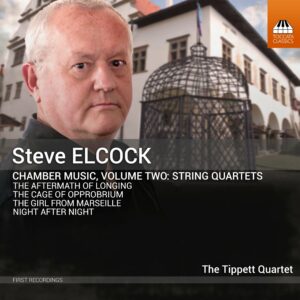
Steve Elcock: Chamber Music, Volume Two: String Quartets
The English composer Steve Elcock (b. 1957) spent years writing music without ever expecting it to be heard: based in rural France, he worked as a translator, composing in his spare time. The emergence of his orchestral and chamber music on Toccata Classics over the past few years has led to his being acclaimed as one of the most important composers at work today. This recording of his four works (to date) for string quartet confirms that judgement: all in single spans, they generate tension and energy in equal measure – animated, in one of them, by a lively sense of humour.
The Tippett Quartet
John Mills and Jeremy Isaac, violins
Lydia Lowndes-Northcott, viola
Božidar Vukotić, cello
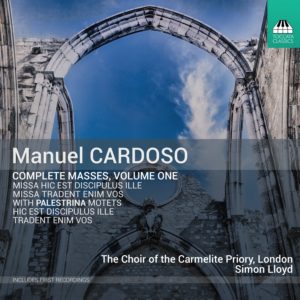
Manuel Cardoso: Complete Masses, Volume One
Manuel Cardoso (1566–1650) was one of the most important composers of the golden age of Portuguese polyphony around the turn of the seventeenth century. But history has not been kind to him: the 1755 Lisbon earthquake that ruined the Convento do Carmo, where he spent most of his working life, also resulted in the loss of the only attested image of the composer and a good deal of his music – and much of that which survived has been neglected, his Masses included. This series will shed long-overdue light on these forgotten masterpieces, beginning with two ‘parody’ Masses, so called because they are based on existing music, in this instance two Palestrina motets.
The Choir of the Carmelite Priory, London
Simon Lloyd, director
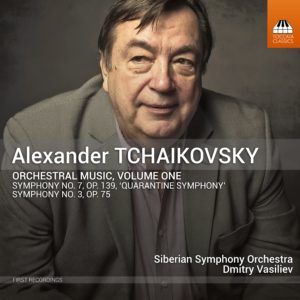
Alexander Tchaikovsky: Orchestral Music Volume One
The Muscovite Alexander Tchaikovsky (b. 1946) – nephew of Boris Tchaikovsky but no relative to Pyotr Ilich – is one of the most highly respected composers at work in contemporary Russia, and yet his music has had little exposure to western audiences. His symphonic style owes something to that of his uncle: it likewise patiently develops enormous power over large expanses of sound, although there is also room for gently ironic touches of nostalgia. Much of the Third Symphony (1995–2002), scored for a huge orchestra, is infused with waltz rhythms: it uses material from sketches for an abandoned ballet based on Dostoyevsky’s The Devils. The Seventh Symphony is very much a work de nos jours: Tchaikovsky composed it during the Covid-19 pandemic, scored it for a socially distanced orchestra of strings, percussion and piano – at which point, as he writes, ‘the virus then took revenge’, and he fell ill himself. The message of the work is clear, as the turmoil of the first movement gives way to a message of hope in the second.
Siberian Symphony Orchestra
Andrey Lopatin, violin (Track 4)
Dmitry Vasiliev, conductor
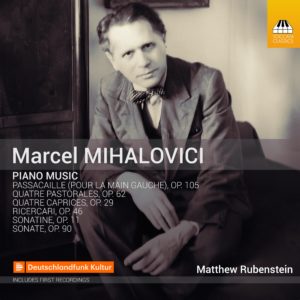
Marcel Mihalovici: Piano Music
The ‘École de Paris’ was a group of composers from central and eastern Europe who made the French capital their home in the 1920s and ’30s. One of their number was the Romanian Marcel Mihalovici, born in Bucharest in 1898 and based in Paris from 1919 until his death in 1985 – one of the most significant of twentieth-century composers who has yet to receive the recognition he deserves. This first album dedicated to his piano music traces his stylistic evolution, the early blend of French insouciance, echoes of eastern European folk-music and Neo-Classical contrapuntal clarity gradually taking a tougher turn and blending Bartók and Bach. It ends with a monumental passacaglia for the left hand alone, one of the most daunting summits of the piano literature.
Matthew Rubenstein, piano
All Except * First recordings