Search Results for "eu quis meu irmão parte 3"
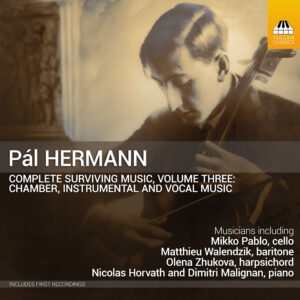
Pál Hermann: Complete Surviving Music, Volume Three – Chamber Instrumental and Vocal Music
Pál Hermann, born in Budapest in 1902, was not only one of the leading cellists of his generation; he was also an important composer, one of the major figures in Hungarian music in the generation after his teachers Bartók and Kodály. But since only two of his works were published before his early death – in 1944, at the hands of the Nazis – and many more of them were lost, he has not had the esteem that he deserves. The kaleidoscopic variety of the works on this third, and final, volume of his surviving compositions – biting Bartókian piano pieces, Neo-Baroque essays of considerable contrapuntal ingenuity, songs with a French Impressionist flavour, even a sly transcription of a foxtrot – underlines how much was lost with his murder.
Nicolas Horvath, piano
Dimitri Malignan, piano
Elizaveta Agrafenina, soprano
Sára Gutvill, mezzo-soprano
Irina Bedicova, mezzo-soprano
Paul van Gastel, tenor
Pierre Mak, baritone
Matthieu Walendzik, baritone
Reine-Marie Verhagen, soprano recorder
Inês d’Avena, alto recorder
Dante Jongerius, tenor recorder
Punto Bawono, Baroque lute
Olena Zhukova, harpsichord
Olena Matselyukh, organ
Jean-Pierre Dassonville, horn
Sadie Fields, violin
Mikko Pablo, cello
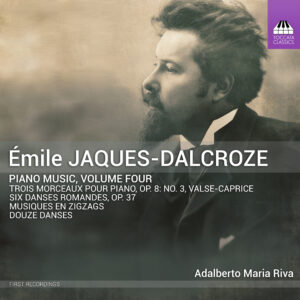
Émile Jaques-Dalcroze: Piano Music, Volume Four
The Swiss composer Émile Jaques-Dalcroze (1865–1950) is best remembered for his development of Eurhythmics, which teaches the appreciation of music through movement. The buoyant miniatures recorded on this fourth album of his piano music document his fascination with dance, but nonetheless display a degree of variety: some are winsome and charming, others vigorous and folk-like, and occasionally they suggest echoes of some of his French contemporaries, not least Chabrier, Debussy, Fauré and Ravel.
Adalberto Maria Riva, piano
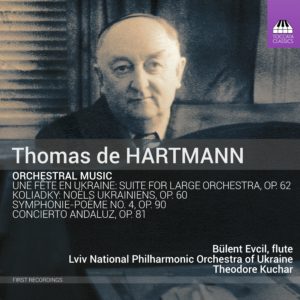
Thomas de Hartmann: Orchestral Music
Born in Ukraine, Thomas de Hartmann (1885–1956), a student of both Arensky and Taneyev, achieved fame as a composer in Russia in the early 1900s, and his concert music was later played by some of the major musicians of the day, primarily in Paris. Since his death, he has been remembered mainly for his association with the Caucasian mystic G. I. Gurdjieff, whom he met in 1916, and his output for the concert hall has fallen into obscurity. The four works receiving their first recordings here reveal a major late-Romantic voice, downstream from Tchaikovsky, contemporary with Rachmaninov, and alert to the discoveries of Stravinsky and Prokofiev
Bülent Evcil, flute (Track 11-13)
Lviv National Philharmonic Orchestra of Ukraine
Theodore Kuchar, conductor
Too Many Symphonies? — Part two: Fridrich Bruk
Having traversed the symphonies of Robert Keeley in Part One of this brief survey (Too Many Symphonies – Part One – posted on 9 March…
Ottorino Respighi: L’Opera Per Pianoforte Solo
di Potito Pedarra Scrive Lorenzo Arruga presentando alcune “liriche più famose [di Respighi]: una volta le ho persino accompagnate in un piccolo concerto, accettando a…
Thym for a Song
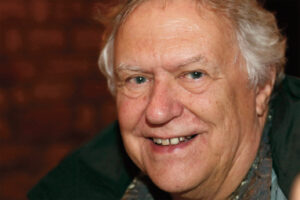
Music: A Connected Art/Die Illusion der absoluten Musik: A Festschrift for Jürgen Thym on his 80th BirthdayVerlag Valentin Koerner, Baden-Baden, 2023Reviewed by Niall Hoskin Jürgen Thym…
Recording my Tone Poems in Liepāja
The first thing I noticed was the trees. Once we were out of Riga airport, they soon crowded up to the edge of the road;…