Search Results for "工银瑞信前沿医疗股票-【✔️推荐KK37·CC✔️】-哈尔滨做双眼皮最好的医院-工银瑞信前沿医疗股票8kri7-【✔️推荐KK37·CC✔️】-哈尔滨做双眼皮最好的医院cz9s-工银瑞信前沿医疗股票w7ggo-哈尔滨做双眼皮最好的医院fqwq"
Showing results for czesław cuckoo csáki cuckoo cook czesław czesław cuckoo csáki cuckoo czeslaw csaki czeslaw czeslaw csaki cook’s
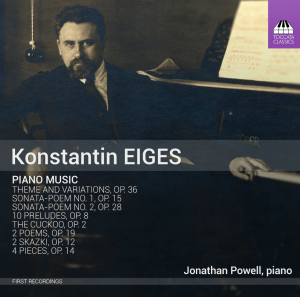
Konstantin Eiges: Piano Music
Konstantin Romanovich Eiges (1875–1950), a member of a gifted Jewish family from eastern Ukraine, studied both in medicine and music in Moscow, but soon became known as an outstanding composer and pianist. His music bears the impress of Taneyev, his teacher, and of Skryabin and has points in common with his friends Medtner and Rachmaninov, but this first recording of his piano music reveals a figure who deserves to be remembered in his own right.
Jonathan Powell, piano
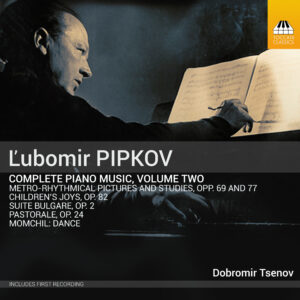
Ľubomir Pipkov: Complete Piano Music, Volume Two
Ľubomir Pipkov (1904–74) was one of the leading members of the so-called ‘second generation’ of Bulgarian composers. In later life he became fascinated with the ancient heritage of Bulgarian folk-music, producing a series of what he called ‘metro-rhythmical studies’ – piano miniatures that combine melodic immediacy and rhythmic complexity, with a character that might be loosely characterised as sounding like ‘Prokofiev meets Bartók in the Balkans’. Indeed, Pipkov saw in the irregular rhythms of Bulgarian folk-dance a parallel with the rhythmic experimentation in contemporary composers like Debussy, Ravel and Stravinsky.
Dobromir Tsenov, piano
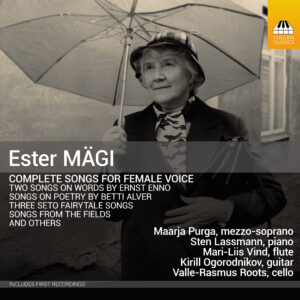
Ester Mägi: Complete Songs for Female Voice
For the latter part of her long life, Ester Mägi (1922–2021) was known as ‘the First Lady of Estonian music’, her modest, charming disposition endearing her to all who met her. But her music reveals the true strength of her personality, and this first complete recording of her songs for female voice – over half a century of compositional activity – covers a striking emotional range, from the ambivalent feelings of falling in love to dramatic ritual invocations of startling force and power. Many of the earlier songs are openly romantic, but Mägi soon began to tap into the hypnotic energy of Estonian runic folksong, with its echoes of village life and its incantations intended to placate a hostile environment.
Maarja Purga, mezzo-soprano
Valle-Rasmus Roots, cello
Mari-Liis Vind, flute
Kirill Ogorodnikov, guitar
Sten Lassmann, piano
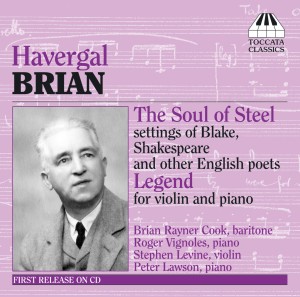
Havergal Brian: Songs for baritone and piano, Legend for violin and piano
Havergal Brian (1876–1972) is renowned as the composer of 32 powerful symphonies (then the largest symphonic cycle since Haydn), 21 of them composed after his 80th birthday; his First Symphony, The Gothic, is reputed to be the largest ever composed. But in the first part of his career Brian was also active on a smaller scale, his songs attracting the advocacy of singers as prominent as John McCormack and John Coates. The range of emotion in these songs is nonetheless vast, from folky innocence via Shakespearean irony to deep tragedy. Brian Rayner Cook’s performances can be taken as authoritative: he studied the songs with the composer. The CD is completed by the Legend for violin and piano, Brian’s only surviving piece of chamber music.
Brian Rayner Cook, baritone
Roger Vignoles, piano
Stephen Levine, violin
Peter Lawson, piano
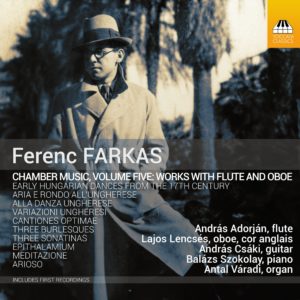
Ferenc Farkas: Chamber Music, Volume Five – Works for Flute and Oboe
This twelfth release in the Toccata Classics exploration of the music of Ferenc Farkas (1905–2000) once again puts his chamber music with flute in the spotlight – here with an oboe chaser. As with previous albums in this series, the music highlights the characteristics that make Farkas’ music so appealing: catchy tunes, transparent textures, buoyant rhythms, a fondness for Baroque forms and a taste for the folk-music of his native Hungary that marks him out as a true successor to Bartók and Kodály. The works in this recording are almost all reworkings – by Farkas or the two soloists here – of music first written for different forces and now taking on a new lease of life.
András Adorján, flute (Tracks 1–15)
Lajos Lencsés, oboe (Tracks 15, 19–22), oboe d’amore (Tracks 23–26), cor anglais (Track 27)
András Csáki, guitar (Track 12)
Balázs Szokolay, piano (Tracks 1–11, 13–21)
Antal Váradi, organ (Tracks 22–27)
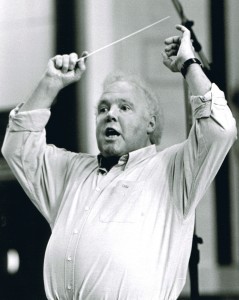
Gary Brain Remembered
It has not been a good week. On Friday Yodit, my beloved fiancée, partner of the past seven years and mother of our five-year-old Alex,…
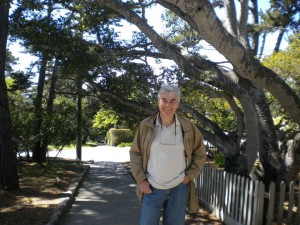
Discovering Henry Cotter Nixon
Given my long involvement with The Havergal Brian Society – I was its Secretary and Newsletter editor from 1976 to 1992 and Chairman from 1994…
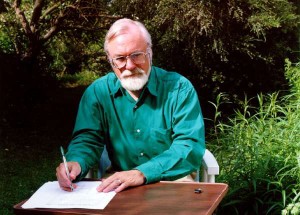
John McCabe in his Own Words
John’s death on 13 February was not unexpected – indeed, he had given his brain tumour a good fight and long outlived his doctors’ prognoses.…
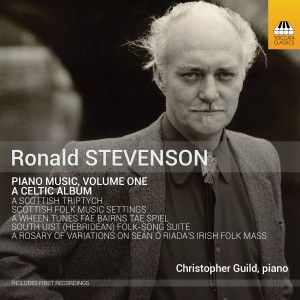
Ronald Stevenson: all-too-brief encounters, and an astounding legacy.
I met Ronald only once. I simply came to his music too late in his life — which came to a peaceful end on 28…
Ottorino Respighi: L’Opera Per Pianoforte Solo
di Potito Pedarra Scrive Lorenzo Arruga presentando alcune “liriche più famose [di Respighi]: una volta le ho persino accompagnate in un piccolo concerto, accettando a…