Mieczysław Weinberg: Complete Works for Violin and Piano, Volume Four
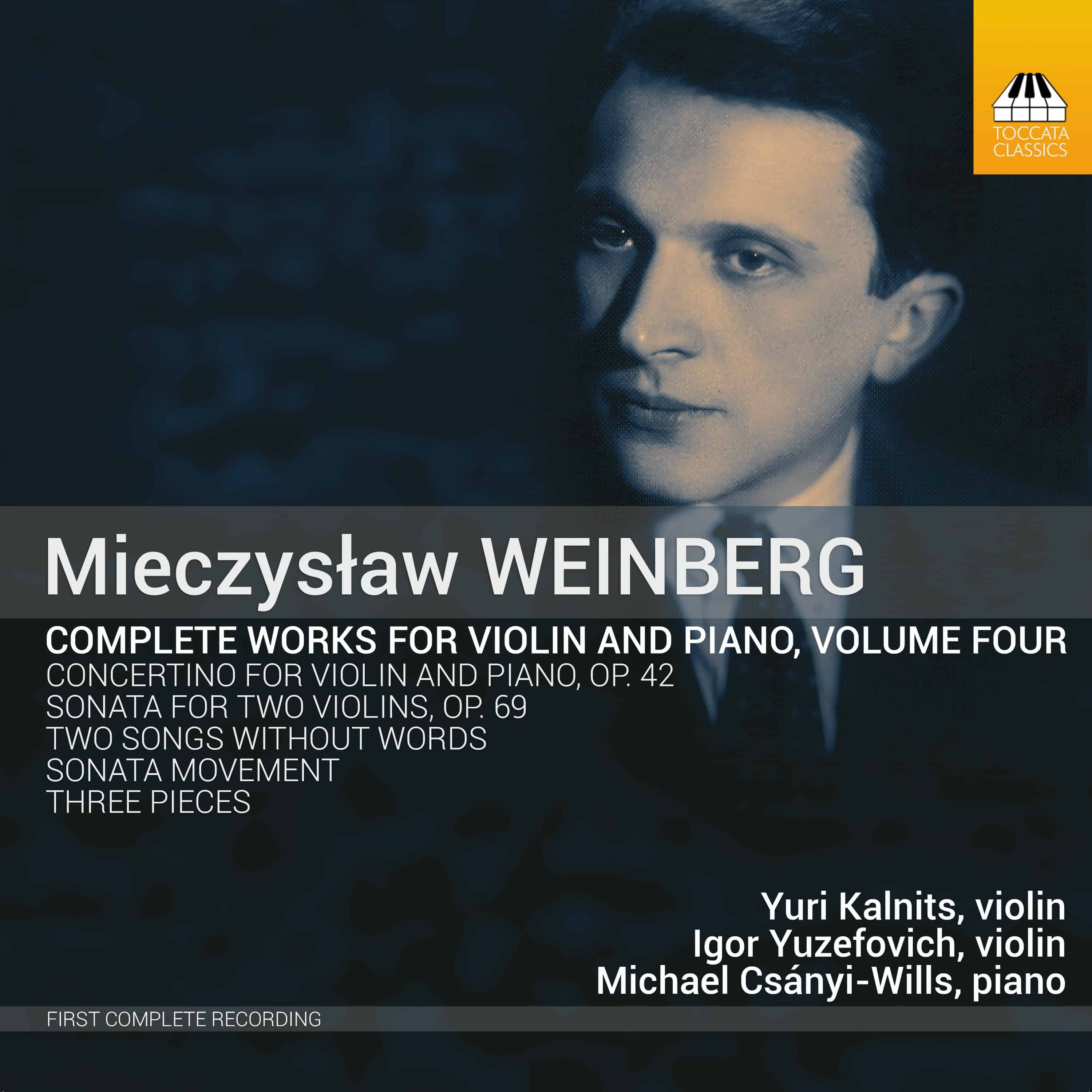
In the past twenty years the Polish-born, Moscow-based Mieczysław Weinberg (1919–96) has been recognised as one of the major voices in twentieth-century music, equivalent in stature to his close friend Dmitry Shostakovich. This fourth and final volume of his music for solo violin, violin and piano and two violins completes the only survey to take all of these works into account. It presents music ranging from a startingly assured early score by the teenage Weinberg to works in which his personality is fully established and instantly recognisable.
Yuri Kalnits, violin
Igor Yuzefovich, violin (10–12)
Michael Csányi-Wills, piano (1–9)
Listen To This Recording:
- I Allegretto cantabile
- II Cadenza. Lento – Adagio
- III Allegro moderato poco rubato
- No. 1 Andantino
- No. 2 Larghetto
- No. 1 Nocturne. Moderato
- No. 2 Scherzo. Allegro
- No. 3 Dream about a Doll. Moderato
- Largo in F
- I Allegro molto
- II Adagio
- III Allegro
Concertino in A minor for Violin and Piano, Op. 42 (1948)
Two Songs without Words (1947)
Three Pieces for Violin and Piano (1934–35)
Sonata Movement (1944)
Sonata for Two Violins, Op. 69 (1959)
FIRST COMPLETE RECORDING
The Whole Note :
‘Mieczysław Weinberg Complete Works for Violin and Piano, Volume Four completes the series of music by the Polish-born Soviet composer and close friend of Shostakovich that began in September 2010. Yuri Kalnits is the excellent violinist and Michael Csányi-Wills the equally fine pianist.
[…] excellent disc and series.’
—Terry Robbins, The Whole Note
Classical Music Sentinel :
‘This release concludes the noteworthy complete overview of the works for solo violin, and violin and piano, by Polish composer Mieczyslaw Weinberg (1919-1996), performed by violinist Yuri Kalnits and pianist Michael Csányi-Wills. A highly credible and authentic grasp of his music has been apparent right from the start, as the previous reviews of Volume 1 and Volume 3 will affirm. […]
In the end though, [his music] always a highly rewarding and penetrating musical experience. A composer well worth investigating.
—Jean-Yves Duperron, Classical Music Sentinel
Strad :
‘Sympathetic performances of a composer overshadowed by Shostakovich.’
—Matthew Rye, Strad
BBC Music Magazine :
‘These solo and chamber works burnish Weinberg’s reputation as a composer of of ten extraordinarily heartfelt music. The Concertino for Violin and Piano is lyrical; the Three Pieces for Violin and Piano, written in adolescence, already show great command of form and mood.’
—BBC Music Magazine, March 2023
Opus Klassiek :
‘Nu dan dus het vierde en tevens laatste deel in opnieuw overweldigende uitvoeringen. Het duo Yuri Kalnits en Michael Csányi-Wills mocht voor de eerste twee delen meerdere belangrijke prijzen in ontvangst nemen, waaronder de niet alleen in Frankrijk gewaardeerde Diapason d’Or. Of er (nog) meer prijzen in het verschiet liggen nu de cyclus is voltooid moet uiteraard worden afgewacht, maar voor de hand ligt het wel. […]
Ik ben het zeker met Dijkstra eens dat de beide musici excelleren in een onopgesmukte weergave van deze partituren . Partituren die niet los gezien kunnen worden van Weinbergs moeilijke leef- en werkomstandigheden als joodse vluchteling in de toenmalige Sovjet-Unie. Tegen deze achtergrond zijn het – gelukkig! – geen vertolkingen geworden die de musici hebben verleid tot – het ligt wel degelijk voor de hand – exessieve uitvergroting ervan. Wat trouwens ook voor het werk van Dmitri Sjostakovitsj behoren te gelden: laat de muziek voor zich spreken, eenvoudig gezegd. Dat het altijd de voorkeur verdient om te streven naar wat in feite niet bestaat: pure authenticiteit. Omdat alleen al dat streven voldoende is om expressieve uitwassen te voorkomen. Dat is, afgezien van zoveel andere aspecten, wat deze vertolkingen zo buitengewoon fascinerend en tegelijkertijd innemend maakt. Er is wat dit betreft een duidelijk parallel met de literatuur (denk, om bij Rusland te blijven, aan bijvoorbeeld het werk van Varlam Sjamalov en Konstantin Paustovski). Bovendien: Weinberg componeerde in een heldere, (vrij) toegankelijke stijl die het absoluut niet moet hebben van siervuurwerk of welke maniertjes ook. Van dat besef zijn deze uitvoeringen van begin tot eind doordesemd. […]
Weinbergs beladen muzikale scheppingen komen in deze uitvoeringen door het duo Kalnits-Csányi-Wills wel heel overtuigend tot leven. Zoals eigenlijk reeds gezegd: de indrukwekkende zeggingskracht ervan schuilt niet in gezochte expressieve nadruk maar in de nagestreefde objectiviteit. En dat gebeurt hier ook, nog aangevuld door het niet minder schitterende spel van Igor Yuzefovich in de Sonate voor twee violen. Al met al vormt dit drietal daardoor voor mij de beste pleitbezorger van deze helaas zo lang onder de westelijke radar gebleven muziek. […]
Of het muzieklabel Toccata later een 4-cd-set zal uitbrengen moet uiteraard worden afgewacht, maar het lijkt mij zo dat de echte liefhebber daarop niet zal wachten.’
‘”I certainly agree with Dijkstra that both musicians excel in an unadorned rendition of these scores. Scores that cannot be viewed separately from Weinberg’s difficult living and working conditions as a Jewish refugee in the then-Soviet Union. Against this background, these are—fortunately!—not interpretations that tempt the musicians to—it is indeed obvious—excessive exaggeration. What should also apply to the work of Dmitri Shostakovich, by the way: let the music speak for itself, simply put. That it is always preferable to strive for what does not actually exist: pure authenticity. Because that striving alone is enough to prevent expressive excesses. That, apart from so many other aspects, is what makes these interpretations so extraordinarily fascinating and at the same time engaging. In this respect, there is a clear parallel with literature (think, staying with Russia, for example, of the work of Varlam Shamalov and Konstantin Paustovsky). Moreover, Weinberg composed in a clear, (relatively) accessible style that absolutely relied on no ornamental flourishes or any mannerisms whatsoever. This awareness permeates these performances from beginning to end. […]
Weinberg’s emotionally charged musical creations come to life quite convincingly in these performances by the Kalnits-Csányi-Wills duo. As already mentioned, their impressive expressiveness lies not in forced expressive emphasis, but in the desired objectivity. […]
Whether the music label Toccata will later release a 4-CD set remains to be seen, of course, but it seems to me that true music enthusiasts won’t be waiting for that.’
—Aart van der Wal, Opus Klassiek