Search Results for "kupi lover nangis original" – Page 8
Showing results for kbp lover nazis original
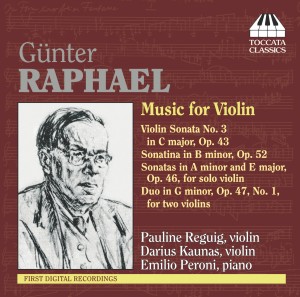
Günter Raphael: Music for Violin
In the first part of his career Günter Raphael (1903-60) enjoyed performances of his music by Germany's leading musicians, among them the Busch Quartet and Wilhelm Furtwängler. But declared a 'half-Jew' by the Nazis in 1934, he was forced from his prestigious teaching position in Leipzig. Confined to hospital by tuberculosis during the War years, he continued to compose while his doctors protected him from persecution. These violin works — strongly melodic and rhythmically vital — continue the mainstream of German Romanticism as refracted through Hindemith; the two solo sonatas have echoes of Bach.
Pauline Reguig, violin
Darius Kaunas, violin
Emilio Peroni, piano
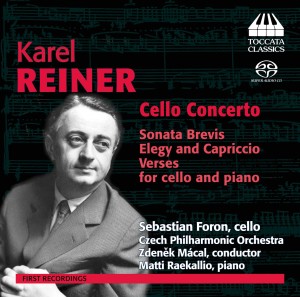
Karel Reiner: Music for Cello
Karel Reiner (1910-79) — a major missing voice in Czech music — suffered under both of twentieth-century Europe's major tyrannies. As a Jew he was imprisoned by the Nazis, miraculously surviving a series of atrocities: Terezín, Auschwitz, a camp near Dachau and a death march. Then, back in Prague after the War, he was accused of 'formalism’ by the Communists. This first CD of a series reviving Reiner's music presents the large-scale Concerto he completed just before his internment in Terezín — and first heard, in this live performance, only in 2010 — and three chamber pieces which evolve though echoes of Janáček and Martinů to the brittle humour of the Stravinskyan Verses, one of his last works.
Sebastian Foron, cello
Czech Philharmonic Orchestra, orchestra
Zdeněk Mácal, conductor
Matti Raekallio, piano
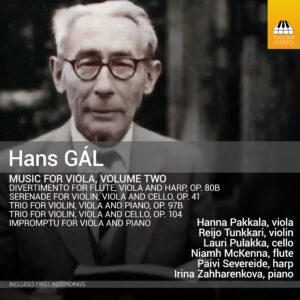
Hans Gál: Music for Viola, Volume Two
Hans Gál (1890–1987) wrote extensively for the viola, first as a major composer in the German-speaking world in the 1920s and ’30s, and then as a leading cultural figure in post-War Edinburgh, where he had taken refuge after the Nazis seized power in his native Austria. This second volume of his music for viola spans four decades, with four trios from before and after that dislocation, each with its own background, sound-world and personality, although they are unified by Gál’s gift for melody, counterpoint and poised, elegant chamber writing.
Hanna Pakkala, viola
Reijo Tunkkari, violin
Lauri Pulakka, cello
Niamh McKenna, flute
Päivi Severeide, harp
Irina Zahharenkova, piano
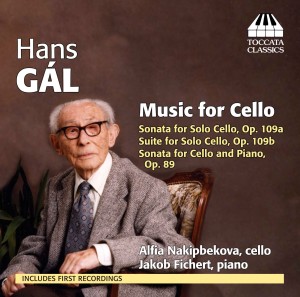
Hans Gál: Music for Cello
The Vienna-born Hans Gál (1890–1987) settled in Edinburgh after fleeing from the Nazis in 1938 and became a much-loved figure in his adoptive town. But he never lost his Viennese fondness for melody, as these three works demonstrate – the Sonata with piano composed in 1953 and the two works for solo cello in 1982, when he was 92, almost the last music he wrote.
Alfia Nakipbekova, cello
Jakob Fichert, piano
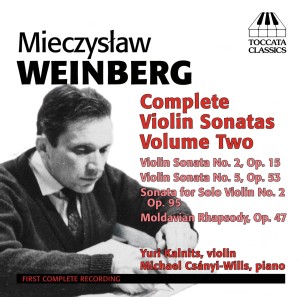
Mieczysław Weinberg: Complete Violin Sonatas, Volume Two
Mieczysław Weinberg, born in Warsaw in 1919, became a close friend of Shostakovich in Moscow, after fleeing eastwards before the invading Nazis in 1939. His style has much in common with Shostakovich, as these four violin works show: fluent contrapuntal skill, a keen feeling for melody, often inflected with Jewish cantilena, and an acute sense of drama which combines a natural narrative manner with an extraordinary ability to create atmosphere, often from just a handful of notes. Since his death in 1996, his music has increasingly been recognised as some of the finest by any twentieth-century composer.
Yuri Kalnits, violin
Michael Csányi-Wills, piano
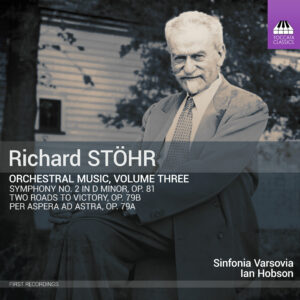
Richard Stöhr: Orchestral Music, Volume Three
Like so many important Austrian musicians forced into American exile by the Nazis, Richard Stöhr (1874–1967) suddenly found himself cast from celebrity into obscurity, The optimism and energy, even defiance, of these three works from 1942 suggest that he took it in his stride, with his musical language retaining its Viennese accent in an individual amalgam of Bruckner, Mahler, Schmidt and Korngold. Indeed, the echoes of Mahler in Stöhr’s Second Symphony may be a deliberate homage if, as seems possible, this score is a revision of a now-lost work first composed shortly after Mahler’s death.
Sinfonia Varsovia
Ian Hobson, conductor
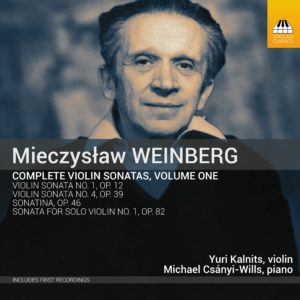
Mieczysław Weinberg: Complete Violin Sonatas, Volume One
Mieczysław Weinberg, born in Warsaw in 1919, became a close friend of Shostakovich in Moscow, after fleeing eastwards before the invading Nazis in 1939. His vast output includes 26 symphonies, seven operas, seventeen string quartets and much other chamber music and some 200 songs. His style has much in common with Shostakovich, as these four violin works show: fluent contrapuntal skill, a keen feeling for melody, often inflected with Jewish cantilena, and an acute sense of drama which combines a natural narrative manner with an extraordinary ability to create atmosphere, often from just a handful of notes. Since his death in 1996, his music is being discovered by musicians and listeners all around the world.
Yuri Kalnits, violin
Michael Csányi-Wills, piano
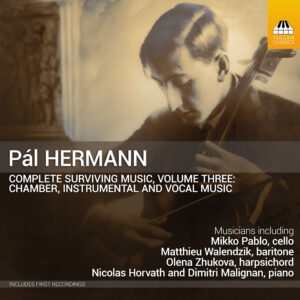
Pál Hermann: Complete Surviving Music, Volume Three – Chamber Instrumental and Vocal Music
Pál Hermann, born in Budapest in 1902, was not only one of the leading cellists of his generation; he was also an important composer, one of the major figures in Hungarian music in the generation after his teachers Bartók and Kodály. But since only two of his works were published before his early death – in 1944, at the hands of the Nazis – and many more of them were lost, he has not had the esteem that he deserves. The kaleidoscopic variety of the works on this third, and final, volume of his surviving compositions – biting Bartókian piano pieces, Neo-Baroque essays of considerable contrapuntal ingenuity, songs with a French Impressionist flavour, even a sly transcription of a foxtrot – underlines how much was lost with his murder.
Nicolas Horvath, piano
Dimitri Malignan, piano
Elizaveta Agrafenina, soprano
Sára Gutvill, mezzo-soprano
Irina Bedicova, mezzo-soprano
Paul van Gastel, tenor
Pierre Mak, baritone
Matthieu Walendzik, baritone
Reine-Marie Verhagen, soprano recorder
Inês d’Avena, alto recorder
Dante Jongerius, tenor recorder
Punto Bawono, Baroque lute
Olena Zhukova, harpsichord
Olena Matselyukh, organ
Jean-Pierre Dassonville, horn
Sadie Fields, violin
Mikko Pablo, cello
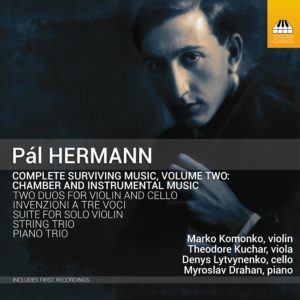
Pál Hermann: Complete Surviving Music, Volume Two
Pál Hermann, born in Budapest in 1902, was not only one of the leading cellists of his generation; he was also an important composer, one of the major figures in Hungarian music in the generation after his teachers Bartók and Kodály. But since only two of his works were published before his early death – in 1944, at the hands of the Nazis – and many more of them were lost, he has not had the esteem that he deserves. The works on this second volume of his surviving compositions – here mostly chamber works for strings, several in their first recordings – have the wiry humour, sprung and spiky rhythms and Hungarian melos that mark him out as a worthy successor to Bartók – and hints at how much was lost with his murder.
Marko Komonko, violin
Theodore Kuchar, viola (Tracks 9, 10, 15)
Denys Lytvynenko, cello (Tracks 1–3)
Myroslav Drahan, piano (Track 16)
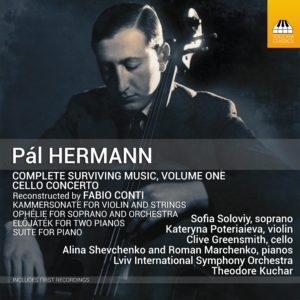
Pál Hermann: Complete Surviving Music, Volume One
Pál Hermann, born in Budapest in 1902, was not only one of the leading cellists of his generation: he was also an important composer, one of the major figures in Hungarian music in the generation after his teachers Bartók and Kodály. But since only two of his works were published before his early death, in 1944, at the hands of the Nazis, and many more of them were lost, he has not had the esteem that he deserves. This series will present all his surviving compositions, most of them in first recordings. The major work on this first album, Hermann’s Cello Concerto of 1925 in a reconstruction by the Italian composer Fabio Conti (b. 1967), sits somewhere between Bartók and Korngold and bids fair to become a staple of the cello repertoire.
Clive Greensmith, cello (Tracks 1-5)
Kateryna Poteriaieva, violin (Tracks 6-9)
Alina Shevchenko, piano (Tracks 10-13)
Roman Marchenko, piano (Track 10)
Sofia Soloviy, soprano (Track 14)
Lviv International Symphony Orchestra (Tracks 1-9, 14)
Theodore Kuchar, conductor (Tracks 1-9, 14)
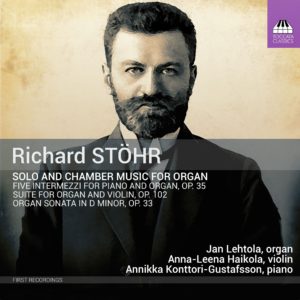
Richard Stöhr: Solo and Chamber Music for Organ
Like Korngold, Toch, Schoenberg, Zeisl and Zemlinsky, Richard Stöhr (1874–1967) was one of many Austrian composers driven into American exile by the Nazis. His generous output of music, being rediscovered at last in these Toccata Classics recordings, includes seven symphonies, much chamber music, songs, and choral and piano pieces. His output for organ is not extensive, but its quality is high: the instrument plays an important role in a number of Stöhr’s orchestral works, and here Stöhr presents the organ in two thoroughly attractive duos and an imposing solo sonata. The Sonata and Intermezzi sit downstream from Brahms in the tradition of Viennese classicism; the chromatic touches in the later Suite lean towards the language of Korngold.
Jan Lehtola, organ
Anna-Leena Haikola, violin
Annikka Konttori-Gustafsson, piano
First recordings
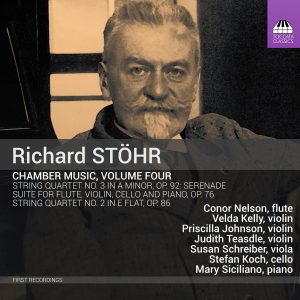
Richard STÖHR: Chamber Music, Volume Four
Like Korngold, Toch, Schoenberg, Zeisl and Zemlinsky, Richard Stöhr (1874–1967) was another Austrian composer driven into American exile by the Nazis. His generous output of music, being rediscovered at last in these Toccata Classics recordings, includes seven symphonies, much chamber music, songs, and choral and piano pieces. These chamber works, from his first years in the United States, show him in surprisingly relaxed mood, the Viennese lyricism of his native city maintained in his US refuge.
Stefan Koch, cello
Conor Nelson, (Tracks flute 1 – 4)
Velda Kelly, (Tracks violin 1 – 4)
Priscilla Johnson, (Tracks violin 5 – 9)
Judith Teasdle, (Tracks violin 5 – 9)
Susan Schreiber, (Tracks viola 5 – 9)
Mary Siciliano (Tracks 1 – 4)
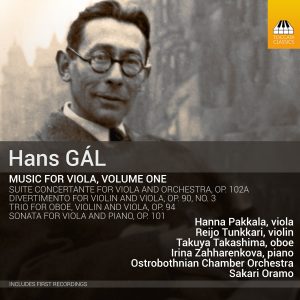
Hans GÁL: Music for Viola, Volume One
Hans Gál (1890–1987) wrote extensively for the viola, including several remarkable works dating from the first decade of his new life in Edinburgh, where he took refuge after the Nazis seized power in his native Austria. His poignant Suite Concertante for viola and orchestra – effectively a concerto for the instrument – is joined here by three substantial chamber works, all infused with Gál’s trademark lyricism.
Hanna Pakkala, viola
Reijo Tunkkari, violin (Tracks 5-8, 12-15)
Irina Zahharenkova, piano (Tracks 9–11)
Takuya Takashima, oboe (Tracks 12–15)
Ostrobothnian Chamber Orchestra (Tracks 1–4)
Sakari Oramo, conductor (Tracks 1–4)
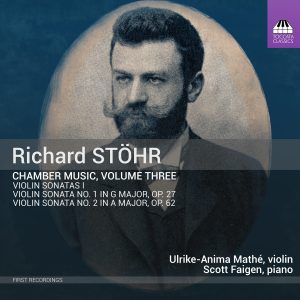
Richard Stöhr: Chamber Music, Volume Three: Violin Sonatas I
Like Korngold, Schoenberg, Toch, Zeisl and Zemlinsky, Richard Stöhr (1874–1967) was another Austrian composer driven into American exile by the Nazis. His generous output of music, being rediscovered at last in these Toccata Classics recordings, includes seven symphonies, much chamber music, songs, and choral and piano pieces. The first two of his fifteen violin sonatas offer a seamless outpouring of fin de siècle Viennese lyricism, with one good tune following another, in a style somewhere between Brahms and Korngold.
Ulrike-Anima Mathé, violin
Scott Faigen, piano
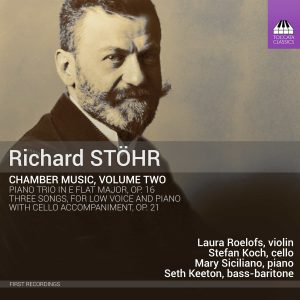
Richard Stöhr: Chamber Music, Volume Two
Like Korngold, Toch, Schoenberg, Zeisl and Zemlinsky, Richard Stöhr (1874–1967) was another Austrian composer driven into American exile by the Nazis. His generous output of music – ripe for rediscovery – includes seven symphonies, fifteen violin sonatas among much other chamber music, songs, and choral and piano pieces. His expansive E flat Piano Trio of 1905 sits firmly in the Viennese Romantic tradition downstream from Schubert and Brahms, with one lovely tune following another, whereas the Three Songs, written only four years later, look forward to the lyrical intensity of Korngold.
Laura Roelofs, violin (Tracks 1-4)
Stefan Koch, cello
Mary Siciliano, piano
Seth Keeton, bass-baritone (Tracks 5-7)
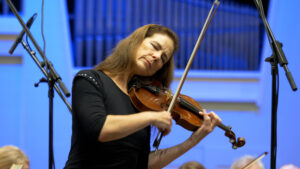
Concertos from the Caucasus: A Conversation about the Creation of the Recording
Posted by Martin Anderson, Producer, Toccata Classics (MA), Karen Bentley Pollick, violinist (KBP), and John McLaughlin Williams, conductor (JMW): MA: Let me start with the…