Search Results for "kupi lover nangis original" – Page 2
Showing results for kbp lover nazis original
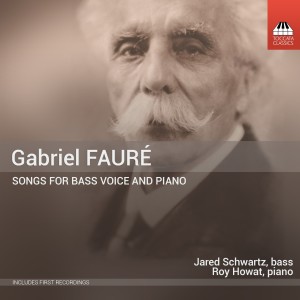
Gabriel Fauré: Songs for Bass Voice and Piano
This collection of Fauré’s mélodies – the first recording to be conceived for a bass voice – juxtaposes some of the composer’s best-loved songs with some of his lesser-known works. Going beyond the often arbitrary ordering of early editions, this programme draws out connections of poets and poetic themes, some of which restore the composer’s own original groupings. This is the first recording to be based on the new Peters Edition, which eliminates countless errors in older publications.
Jared Schwartz, bass; Roy Howat, piano;
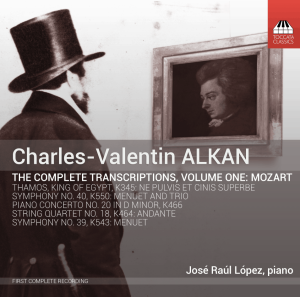
Charles-Valentin Alkan: The Complete Transcriptions, Volume One: Mozart
The gloriously maverick music of Charles-Valentin Alkan (1813–88) is more familiar now than ever before. But even though his original compositions are now beginning to be heard in concert programmes, his equally idiosyncratic transcriptions have not yet been systematically documented in recordings – an omission this series, which begins with Alkan’s complete transcriptions of Mozart, seeks to redress.
José Raúl López, piano
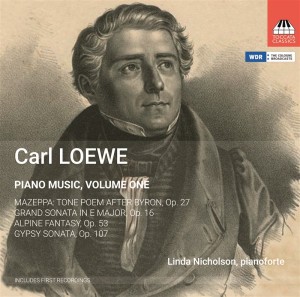
Carl Loewe: Piano Music, Volume One
Known in his lifetime as 'the north German Schubert', Carl Loewe (1796-1869) is remembered today chiefly as a composer of ballads. Yet there is a considerable body of piano music that is strikingly innovative in content, expression and harmony, containing the germs of ideas later taken up by composers such as Wagner and Liszt. Loewe was unquestionably a brilliantly original talent, a major figure in ushering in the Romantic era.
Linda Nicholson, pianoforte
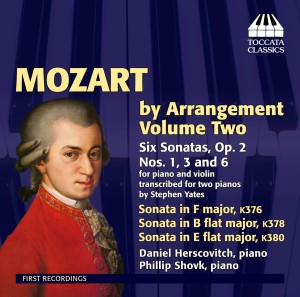
Mozart by Arrangement, Volume Two
The violinist and conductor Andrew Manze recently remarked that the six violin sonatas published as Mozart's Op. 2 in 1781 might also be effective as sonatas for piano duet. The Australian composer Stephen Yates has taken him up on the idea, adding six sparkling new two-piano sonatas to the single original one that Mozart himself produced.
Phillip Shovk, piano
Daniel Herscovitch, piano
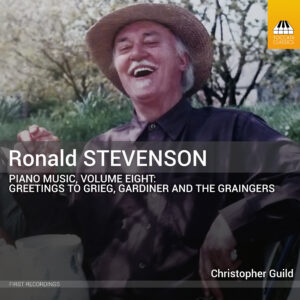
Ronald Stevenson: Piano Music, Volume Eight – Greetings to Grieg, Gardiner and the Graingers
Ronald Stevenson (1928–2015) was perhaps the only virtuoso pianist-composer in the manner of Rachmaninov and Liszt to have Celtic origins, and so it is natural to find a Celtic flavour emerging in his music – his transcriptions as well as his original compositions. It also helps explain his affinity for fellow composers like Grieg and Grainger, whose creative efforts looked to the north. But Stevenson’s openness of spirit put the whole world of music within his reach, and so piano rags can here rub shoulders with works more directly concerned to express his humanist impulse.
Christopher Guild, piano
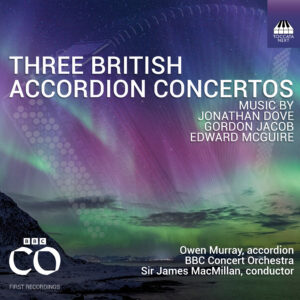
Three British Accordion Concertos
The development of an original classical repertoire for the accordion began with Mogens Ellegaard in his native Denmark and his student, the Scot Owen Murray, in the UK. In 1976 Ellegaard gave the first broadcast performance of Gordon Jacob’s pastoral, elegant concerto, which treats the accordion almost as a chamber organ. A generation and more later, two concertos written for Owen Murray open out the possibilities of the accordion much more adventurously, exploiting its extraordinary range of colour, its striking range of expression and its mercurial ability to weave through orchestral textures.
Owen Murray, accordion
BBC Concert Orchestra
Sir James MacMillan, conductor
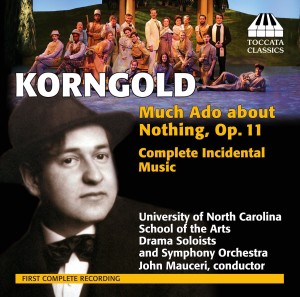
Erich Wolfgang Korngold: Much Ado about Nothing
Korngold's incidental music for Shakespeare's comedy Much Ado about Nothing, premiered in Vienna in 1920, enjoyed instant success and soon spread round the world in a series of arrangements that are still performed today. But the music has not been heard as Korngold intended since that first production. For this recording, made in conjunction with its fully staged US premiere, Korngold's complete score was reconstructed from the original Viennese materials and is played here by the chamber-orchestral forces for which it was written.
University of North Carolina School of the Arts Drama Soloists, actors
University of North Carolina School of the Arts Symphony Orchestra, orchestra
John Mauceri, conductor
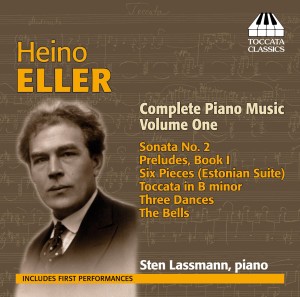
Heino Eller: Complete Piano Music, Volume One
The Estonian Heino Eller (1887-1970) is probably best known as the teacher of Arvo Pärt — but he was a prolific and original composer in his own right. His substantial output for piano — this series will contain seven CDs — was written over a period of six decades and thus reflects a range of styles. Taking the lyricism of Chopin and Grieg as its starting point, it combines the influence of Estonian folksong, Scriabin's troubled harmonies, the epic northern colouring of Sibelius and, at times, Prokofiev's motoric energy into an attractively individual manner.
Sten Lassmann, piano
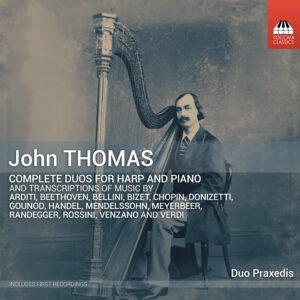
John Thomas: Complete Duos for Harp and Piano
Harpist to Queen Victoria, the Welsh composer John Thomas (1826–1913) also wrote prolifically for his own instrument, both for solo harp and for duos of two harps or harp and piano – a combination where the different sounds of the two instruments enhance the clarity of the texture. Thomas’ original works use the elegant Romantic style of his own day, but he often drew on Welsh folksong for his inspiration and also left a generous legacy of transcriptions, especially of operatic favourites. Although some of his music was intended for the Victorian drawing room, other pieces require a virtuoso technique – and all of it has a thoroughly engaging melodic appeal.
Duo Praxedis
5 CD Box Set Includes:
TOCC0561 – John Thomas: Complete Duos for Harp and Piano, Vol. 1
TOCC0566 – John Thomas: Complete Duos for Harp and Piano, Vol. 2
TOCC0578 – John Thomas: Complete Duos for Harp and Piano, Vol. 3
TOCC0582 – John Thomas: Complete Duos for Harp and Piano, Vol. 4
TOCC0711 – John Thomas: Complete Duos for Harp and Piano, Vol. 5
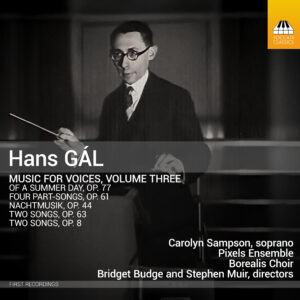
Hans Gál: Music for Voices, Volume Three
Whether in his original home of Vienna, as a conservatoire director in Mainz, or as an émigré in Edinburgh, where he became one of the mainstays of musical life, Hans Gál (1890–1987) championed choral singing as a way of directly involving people in making music: he founded and conducted a number of choirs and provided an extensive output of choral compositions. This third album of his choral music offers a vivid cross-section of music for chamber choir, featuring mixed voices, women’s voices and male-voice choir, a cappella, with solo soprano, with piano and with chamber accompaniment.
Carolyn Sampson, soprano
Pixels Ensemble
Borealis Choir
Bridget Budge, director
Stephen Muir, director
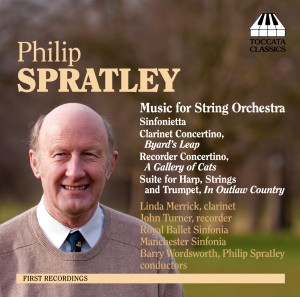
Philip Spratley: Music for String Orchestra
This CD reveals a fresh, original and immediately attractive voice in British music. Philip Spratley, born in Nottinghamshire in 1942, has his roots in English folksong and his compositions are strongly evocative of the countryside — though animated by a rhythmic vivacity and drive that recalls Shostakovich, Britten and Tippett. Spratley's music also abounds in memorable melodies, and his ability to write tunes with the ring of folksong about them reveals him as a true heir of Holst and Vaughan Williams.
Philip Spratley, conductor
Linda Merrick, clarinet
John Turner, recorder
Tracey Redfern, trumpet
Eira Lynn Jones, harp
Royal Ballet Sinfonia, orchestra
Barry Wordsworth, conductor
Manchester Sinfonia, orchestra
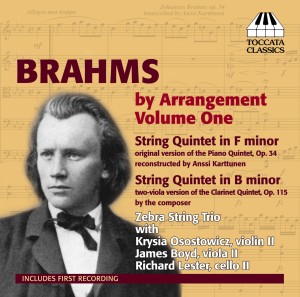
Brahms by Arrangement, Volume One
Brahms first wrote his Op. 34 as a string quintet before recasting it for two pianos and then as the version for piano quintet known today. In this imaginative reconstruction as a string quintet by the Finnish cellist Anssi Karttunen, the Zebra Trio is joined by some of Britain’s most outstanding string-players, allowing modern listeners to hear a version of the work in textures closer to Brahms’ original thoughts. It is coupled in this recording by Brahms’ own rarely heard version of the Clarinet Quintet, Op. 115, as a string quintet, with a viola replacing the clarinet.
Zebra String Trio, string trio
Anssi Karttunen, cello
Ernst Kovacic, violin
Steven Dann, viola
Krysia Osostowicz, violin
James Boyd, viola
Richard Lester, cello
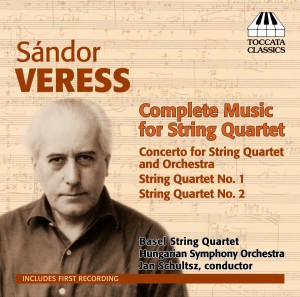
Sándor Veress: Complete Music for String Quartet
Sándor Veress (1907-99) was born in Kolozsvár, then in Hungary (it is now Cluj-Napoca in Romania), but spent the last half-century of his life in Switzerland as an exile from Communism. In the 1930s he worked as Bartók's research assistant in his work on Hungarian folksong, with results audible in the two early string quartets. By the time of the Concerto for String Quartet and Orchestra three decades later, Veress had developed a lean and muscular style, incorporating elements of modernism but retaining a powerful sense of onward momentum, expressed in an original voice which combines head and heart in an exhilarating blend of freewheeling invention, fantasy and wit.
Basel String Quartet, string quartet
Hungarian Symphony Orchestra, orchestra
Jan Schultsz, conductor
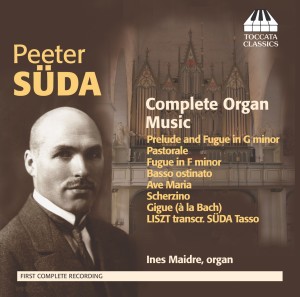
Peeter Süda: Complete Organ Music
The music of the Estonian organist-composer Peeter Süda (1883–1920) combines contrapuntal mastery with a virtuosic command of the Romantic organ. Süda’s brief life and his perfectionism meant that his output – exclusively for the organ – remained small, but it is beautifully crafted and highly expressive. This handful of original works is complemented by a mighty transcription of Liszt’s symphonic poem Tasso.
Ines Maidre, organ
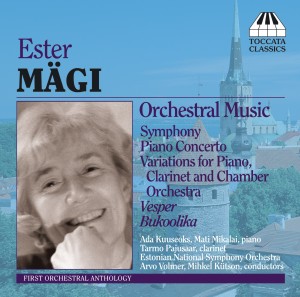
Ester Mägi: Orchestral Music
In her native country Ester Mägi (b. 1922) is known as 'the First Lady of Estonian music’. A much-loved figure at home, Mägi is now beginning to enjoy a reputation further afield, where her incorporation of elements of Estonian folk-music into classical forms is being recognised as a fresh and original contribution to European art-music.
Ada Kuuseoks, piano
Mati Mikalai, piano
Tarmo Pajusaar, clarinet
Estonian National Symphony Orchestra, orchestra
Arvo Volmer, conductor
Mihkel Kütson, conductor
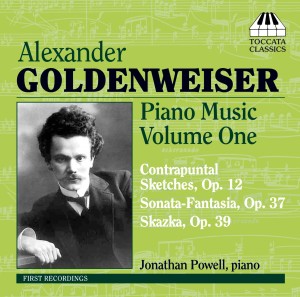
Alexander Goldenweiser: Piano Music, Volume One
Alexander Goldenweiser (1875–1961) is remembered as a major pianist, one of the founders of the Russian school of playing, and a friend of Rachmaninov, Scriabin and Tolstoy. He was also a prolific composer but rarely played his own works in public. His Contrapuntal Sketches, written in the early 1930s, are probably the first Russian cycle of polyphonic pieces encompassing all the major and minor keys; they fuse Goldenweiser’s compositional and pianistic virtuosity with an empathy for Russian folksong. The Sonata-Fantasia presents other, contrasting facets of his complex personality: although demonstrating his link to the Russian Romantics, it is resolutely modern and original. Jonathan Powell studied with one of Goldenweiser’s students, Sulamita Aronovsky.
Jonathan Powell, piano