Search Results for "holy father prime era ml"
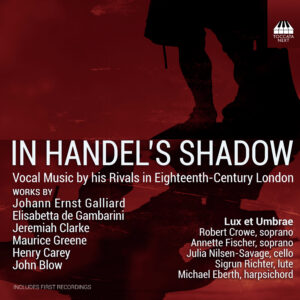
In Handel’s Shadow: Vocal Music by his Rivals in 18th-Century London
The figure of George Frideric Handel cast a long shadow over musical London in the first half of the eighteenth century, condemning many of his contemporaries – fine composers themselves – to long years of obscurity. This recording throws light into forgotten corners and discovers some glittering gems, some of them demanding dazzling vocal fireworks from their performers. Several of these composers set scenes from Classical mythology or Old Testament narratives – but they also explore the underside of the Baroque psyche in one of David’s darkest psalms and in a representation of Arcadian madness.
Lux et Umbrae
Robert Crowe, soprano and artistic director
Annette Fischer, soprano
Julia Nilsen-Savage, cello
Sigrun Richter, archlute
Michael Eberth, harpsichord
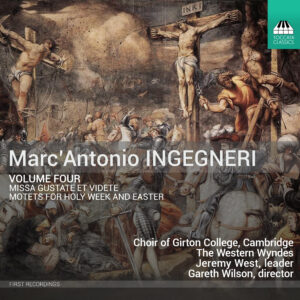
Marc’Antonio Ingegneri: Volume Four – Missa Gustate et videte; Motets for Holy Week and Easter
The Cremonese composer Marc’Antonio Ingegneri (c. 1535/36–92) is chiefly remembered as the teacher of Claudio Monteverdi while, for well-nigh 500 years, his own achievements were left to sit in the shadows. This fourth in a series of pioneering recordings from the Choir of Girton College, Cambridge, presents a sequence of music for Holy Week and Easter, confirming Ingegneri to have been one of the masters of his age. The striking range of moods heard here will confound conventional expectations of Renaissance polyphony: Ingegneri’s emotional palette extends from tender intimacy in some of these motets to dancing, celebratory jubilation in the Mass setting – all of it music of breathtaking richness and beauty.
Choir of Girton College, Cambridge
The Western Wyndes
Jeremy West, leader
Gareth Wilson, director
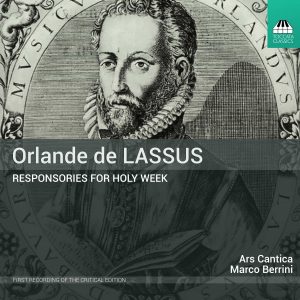
Orlande De Lassus: Responsories for Holy Week
Around 1580 Lassus composed a four-voice setting of the eighteen Responsories for the second and third Nocturnes of Holy Week, probably intended for the services in the private chapel of his employer, Wilhelm V, Duke of Bavaria. In these miniature dramas Lassus skilfully supports the text, as was then required by the Council of Trent, illustrating the human tragedy of the Easter story with exquisite music that is all the more moving for its restraint.
Ars Cantica
Marco Berrini, conductor
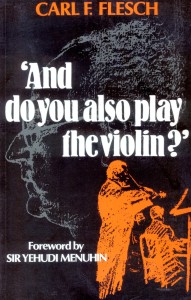
‘And do you also play the violin?’
Foreword by Sir Yehudi Menuhin
Extant: 382
Composition: Demy octavo ~ Profusely illustrated with facsimiles and photographs ~ Index
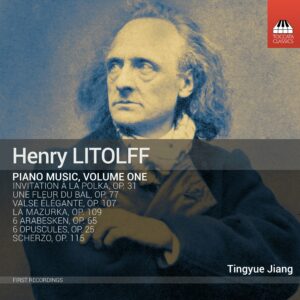
Henry Litolff: Piano Music, Volume One
The British-born Henry Litolff (1818–91) maintains a toehold on the repertoire thanks to the enduring popularity of the Scherzo of his Concerto symphonique No. 4 for piano and orchestra. Litolff’s substantial output of music for solo piano – mostly virtuoso salon miniatures – has entirely slipped from sight, even though in his prime as composer and pianist he was often compared with Liszt, a personal friend. This first album devoted to Litolff’s piano music reveals a fondness for atmospheric character pieces and vigorous dances, not least the polka, mazurka and waltz.
Tingyue Jiang, piano
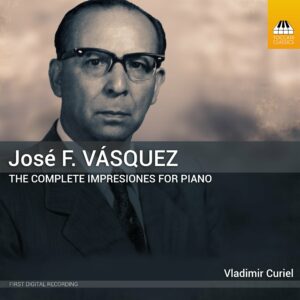
José F. Vásquez: The Complete Impresiones for Piano
José F. Vásquez (1896‒1961) – composer, pianist, conductor and educationalist – was one of the leading figures in Mexican classical music from the 1910s to the 1950s, but since many of his scores were lost after his death, his star soon sank from the sky. Four decades of research by his son, the writer José Jesús Vásquez Torres, have recovered much of the missing music, allowing a re-assessment of his father’s standing. These five books of Impresiones for piano (from c. 1922‒27) – fifteen predominantly slow, introspective miniatures – reveal a debt to French Impressionism, Debussy in particular, with occasional nods to Schumann, Liszt and Brahms, and some harmonies that suggest Wagner. Vásquez was a fine pianist himself, but the textures here have a surprising simplicity, throwing the emphasis on tonal colour.
Vladimir Curiel, piano
Three Centuries of Russian Viola Sonatas
The Russian viola sonata is a rare bird, not least because the instrument itself was frowned upon by the Soviet authorities; as a result Russian music for the viola has a rather patchy history. It begins in earnest in 1931, when the 1825 Sonata by Mikhail Glinka, ‘the father of Russian music’, was reconstructed from his sketches by Vadim Borisovsky, ‘the father of the Russian viola’. Thereafter, musicians and composers worked together to expand the repertoire. The relationship between the composer Revol Bunin and the violist Rudolf Barshai resulted in a sonata of 1955 which deserves wider currency. Although half a century apart, the Shebalin and Sokolov sonatas have something unusual in common: both were created as part of a triptych, alongside sonatas for violin and cello. All four composers knew how to make the viola sing – though this lyricism is often animated by moments of drama and excitement.
Basil Vendryes, viola
William David, piano
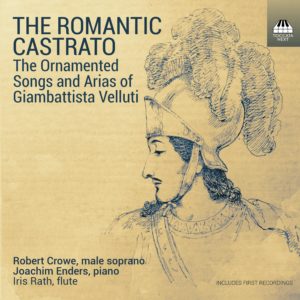
The Romantic Castrato
Giovanni Battista Velluti (1780–1861) was one of the last of the larger-than-life castrati who had dominated operatic life in the seventeenth and eighteenth centuries. Velluti, though, spent his career almost entirely in the Romantic era, singing the music of his day. His style of ornamentation attracted widespread admiration and set the standard for the prime donne who were emerging as the stars of their age in operas by such composers as Rossini, Bellini and Donizetti. Here the American male soprano Robert Crowe recreates Velluti’s extraordinary sound-world, in a recording that helps explain why such diverse luminaries as Stendhal, Mary Shelley and the Duke of Wellington admired Velluti as one of the most accomplished and inventive singers of his time.
Robert Crowe, male soprano
Iris Rath, flute (Track 21)
Joachim Enders, piano
ALL EXCEPT * FIRST RECORDINGS
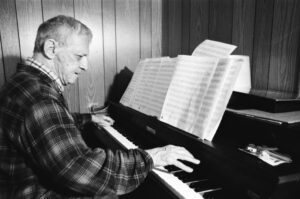
My Father and His Music: A Voyage of Discovery
As the Bulgarian-born Viktor Valkov picks up the baton of Leo Ornstein’s piano music from Arsentiy Kharitonov with a third volume from Toccata Classics, the…
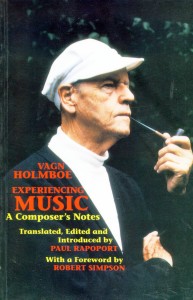
Experiencing Music: A Composer’s Notes
Translated, Edited, and Introduced by Paul Rapoport
With a Foreword by Robert Simpson
Extent: 142 pages
Composition: Demy octavo ~ Illustrated ~ Bibliography ~ Index
Illustrations: 14 b/w
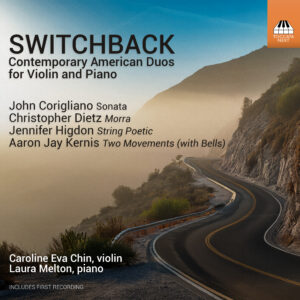
Switchback: Contemporary American Duos for Violin and Piano
Modern American music has long been characterised by kaleidoscopic variety, reflecting the vigour and optimism of American culture more generally. John Corigliano’s early Violin Sonata is a work of the mid-twentieth century. But his own assessment of the piece – ‘Its eclecticism, its rhythmic energy, and its bright character give the Sonata a very American quality’ – could be applied with equal merit to the three 21st-century scores that accompany it here, all four switching easily between gentle introspection and buoyant exuberance.
Caroline Eva Chin, violin
Laura Melton, piano
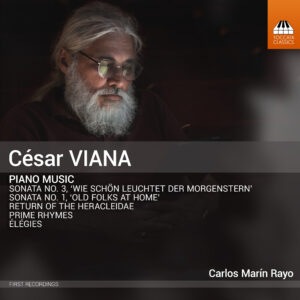
César Viana: Piano Music
The Portuguese composer César Viana – born in England, in 1963, and now resident in Spain – is an all-round musician: conductor, pianist, early-music enthusiast, folklorist and flautist, with a special interest in the shakuhachi, the Japanese bamboo flute. His resulting familiarity with Zen Buddhism has left its mark on his music, where the clean lines of Japanese art combine with a fondness for the contrapuntal textures that form the basis of much European art-music – imagine Bach and Hindemith in the formal elegance of a stone garden, warmed by a touch of western wit.
Carlos Marin Rayo, piano
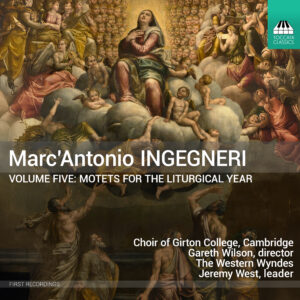
Marc’Antonio Ingegneri, Volume Five: Motets for the Liturgical Year
The Choir of Girton College, Cambridge, continues its pioneering exploration of the music of the Italian Renaissance master Marc’Antonio Ingegneri (c. 1535/36–92) with a journey through the liturgical year, as mirrored in Ingegneri’s motets. A ‘concept album’ of Renaissance polyphony may be an unusual undertaking, but this one illustrates how Ingegneri took his lead from the emotions implicit in each major celebration of the church – from sorrow and awe to joy and jubilation – expressed in music of extraordinary beauty, belying the internal complexity that gives it its emotional power.
Choir of Girton College, Cambridge
Gareth Wilson, director
The Western Wyndes
Jeremy West, leader
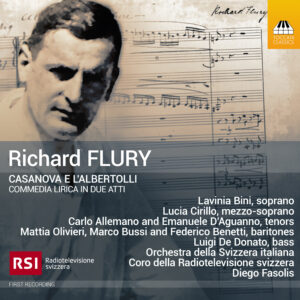
Richard Flury: Casanova e l’Albertolli, Commedia Lirica in Due Atti
Two traditions coalesce in Casanova e l’Albertolli (1937), the third of the four operas by the Swiss late-Romantic composer Richard Flury (1896–1967): Italian bel canto and the Swiss Festspiel – high art and popular culture. Styled a ‘Commedia lirica’, it invests the comic intrigue onstage with sweeping melodies of Puccinian richness, combining them with choruses based on Ticino folksong – it even has a yodelling chorus – in an engaging hybrid that deserves to be far better known. At the end, of course, evil is banished and love rewarded, but the entire score is dappled with happy inspirations that will bring a smile to the listener’s lips.
Carlo Allemano, tenor
Lavinia Bini, soprano
Mattia Olivieri, baritone
Marco Bussi, baritone
Lucia Cirillo, mezzo-soprano
Luigi De Donato, basso buffo
Federico Benetti, baritone
Emanuele D’Aguanno, tenor
Coro della Radiotelevisione Svizzera
Orchestra della Svizzera Italiana
Diego Fasolis, conductor
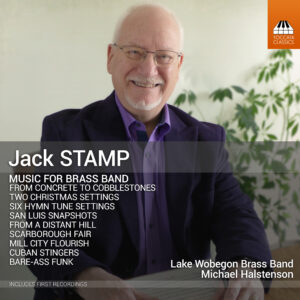
Jack Stamp: Music for Brass Band
Born in Maryland in 1954, John Stamp – universally known as ‘Jack’ – is a well-known figure, both as conductor and composer, in the symphonic wind-band movement that flourishes in US universities. But the sound of the brass band familiar in the UK has long been an enthusiasm, and his involvement with brass bands on both sides of the Atlantic – particularly the Minneapolis-based Lake Wobegon Brass Band, which takes its name from Garrison Keillor’s fictional Minnesota town – has generated a number of works which bring elements of the British brass tradition to audiences in the US Mid-West, imbuing them with a catchy rhythmic swing.
Steve Ecklund, horn
Bill Chouinard, organ
Lake Wobegon Brass Band
Michael Halstenson, conductor
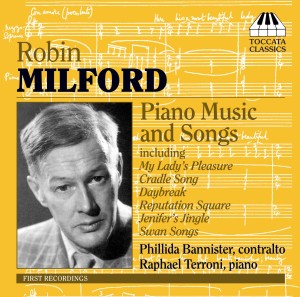
Robin Milford: Piano Music and Songs
The music of Robin Milford (1903-59) taps into that distinctly English vein of pastoral melancholy. Lying on a continuum between the work of his friends Gerald Finzi and Ralph Vaughan Williams, Milford’s voice is nonetheless unique: lyrical, gentle, unemphatic – quietly individual. The dark lyricism of the songs on this CD, reflecting the composer’s troubled life, offers a striking contrast with the buoyant, folksong-inspired dances for solo piano – Milford at his happiest.
Phillida Bannister, contralto
Raphael Terroni, piano