Search Results for "fc 26 coins Buyfc26coins.com is EA Sports official for FC 26 coins The transfer time was very fast..ujWi" – Page 5
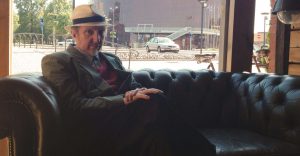
Recording my Tone Poems in Liepāja
The first thing I noticed was the trees. Once we were out of Riga airport, they soon crowded up to the edge of the road;…
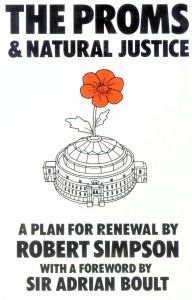
The Proms and Natural Justice: A Plan for Renewal
With a Forward by Sir Adrian Boult
Extent: 72 pages
Composition: Crown octavo; no illus or exx. vi+66 pages
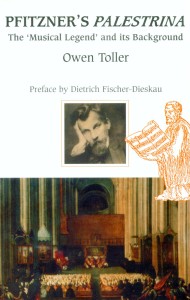
Pfitzner’s Palestrina: The ‘Musical Legend’ and its Background
Preface by Dietrich Fischer-Dieskau
Extent: 310 pages
Composition: Demy octavo ~ Illustrations ~ Bibliography ~ Discography ~ List of Works ~ Index
Illustrations: 23 b/w; 89 music exx.
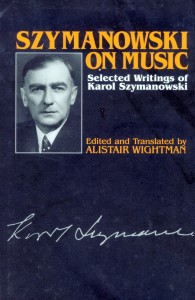
Szymanowski on Music: Selected Writings of Karol Szymanowski
Edited and Translated by Alistair Wightman
Extent: 390 pages
Composition: Demy octavo ~ Illustrated ~ List of Szymanowski’s Writings ~ Bibliography ~ Index
Illustrations: 15 b/w
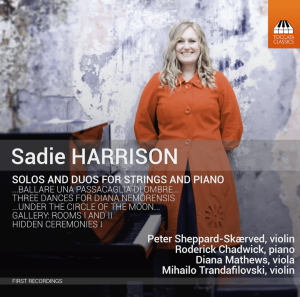
Sadie Harrison: Solos and Duos for Strings and Piano
The Australian-British Sadie Harrison is no ordinary composer: she is also an archaeologist and a professional gardener. So it is hardly surprising that a fascination with historical artefacts and biological processes filters into her music. The instrumental miniatures on this recording are both slow and brutal, some of them mirroring ancient worlds and natural phenomena and others taking their starting point in the paintings of Brian Graham and Peter Sheppard Skærved, expressing visual and textural ideas in sound.
Peter Sheppard-Skærved, violin; Roderick Chadwick, piano; Diana Mathews, viola; Mihailo Trandafilovski, violin;
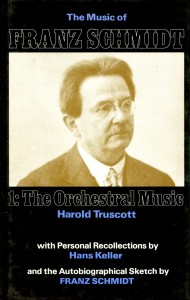
The Music of Franz Schmidt: Volume 1: The Orchestral Music
With Personal Recollections by Hans Keller and the Autobiographical Sketch by Franz Schmidt
Extent: 190 pages
Composition: Demy octavo ~ Illustrated ~ Bibliography ~ Index

Havergal Brian on Music: Volume One: British Music
Edited and introduced by Malcolm MacDonald
Extent: 438 pages
Composition: Demy octavo ~ Index
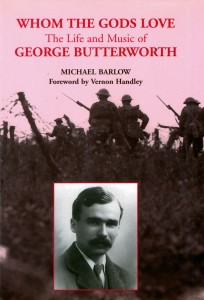
Whom the Gods Love: The Life and Music of George Butterworth
Forward by Vernon Handley
Extent: 204 pages
position: Demy octavo ~ Illustrated ~ List of Works ~ List of Songs Collected ~ Bibliography ~ Index
Illustrations: 26 b/w; 47 music exx.
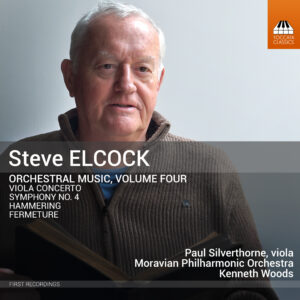
Steve Elcock: Orchestral Music, Volume Four
Steve Elcock – UK-born (in 1957) but long since based in France – was recently hailed by a fellow composer in the American magazine Fanfare as ‘the greatest living symphonist’. All eleven of the symphonies he has composed to date are, in various ways, concerned with the large-scale accumulation and dissipation of tension, rather in the manner of the later Nielsen symphonies – the half-hour span of his Fourth Symphony also reconciling tonality and atonality in its wild and energetic arch. Elcock is fond of bringing popular elements into his music, and a folk-like dance duly animates his Viola Concerto. These major works are book-ended here by two big-hearted orchestral showpieces that could become audience favourites.
Paul Silverthorne, viola
Moravian Philharmonic Orchestra
Kenneth Woods, conductor
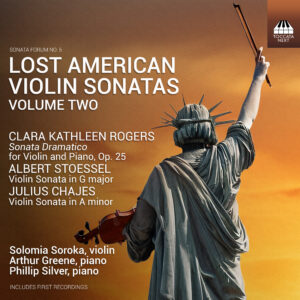
Lost American Violin Sonatas, Volume Two
In their second volume exploring lost American violin sonatas, Solomia Soroka, Phillip Silver and Arthur Greene survey a half-century of music-making, from the buoyant High Romanticism of the Bostonian Clara Rogers via the impassioned early Impressionism of the New York-based Albert Stoessel, to the explicitly Jewish sounds of Julius Chajes, who settled in Detroit, one of the many refugees from Nazism who added a new flavour to American music. All three works testify to the rich heritage of forgotten American music awaiting rediscovery by alert and curious musicians and listeners.
Solomia Soroka, violin
Phillip Silver, piano
Arthur Greene, piano
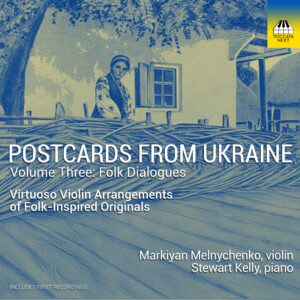
Postcards from Ukraine, Volume Three: Folk Dialogues
The first album of Postcards from Ukraine gave a potted history of Ukrainian music in the form of a series of miniatures for piano and violin, and the second presented four outstanding chamber works by important Ukrainian composers. This third instalment brings six new arrangements of Ukrainian folksongs, for violin and piano, by Markiyan Melnychenko, integrating them into a programme of folksong and -dance arrangements by some of his best-known virtuoso predecessors.
Markiyan Melnychenko, violin
Steward Kelly, piano
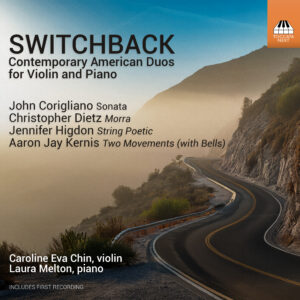
Switchback: Contemporary American Duos for Violin and Piano
Modern American music has long been characterised by kaleidoscopic variety, reflecting the vigour and optimism of American culture more generally. John Corigliano’s early Violin Sonata is a work of the mid-twentieth century. But his own assessment of the piece – ‘Its eclecticism, its rhythmic energy, and its bright character give the Sonata a very American quality’ – could be applied with equal merit to the three 21st-century scores that accompany it here, all four switching easily between gentle introspection and buoyant exuberance.
Caroline Eva Chin, violin
Laura Melton, piano
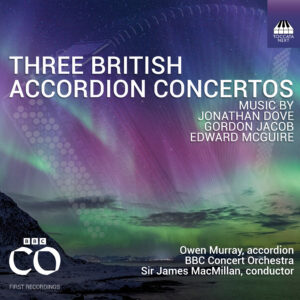
Three British Accordion Concertos
The development of an original classical repertoire for the accordion began with Mogens Ellegaard in his native Denmark and his student, the Scot Owen Murray, in the UK. In 1976 Ellegaard gave the first broadcast performance of Gordon Jacob’s pastoral, elegant concerto, which treats the accordion almost as a chamber organ. A generation and more later, two concertos written for Owen Murray open out the possibilities of the accordion much more adventurously, exploiting its extraordinary range of colour, its striking range of expression and its mercurial ability to weave through orchestral textures.
Owen Murray, accordion
BBC Concert Orchestra
Sir James MacMillan, conductor
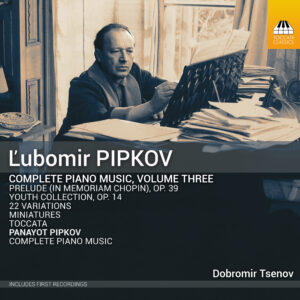
L’ubomir Pipkov: Complete Piano Music, Volume Three
With this volume Dobromir Tsenov completes his survey of the solo-piano music of his compatriot Ľubomir Pipkov (1904–74), one of the leading members of the ‘second generation’ of Bulgarian composers who helped establish a national tradition of classical music, blending western forms with the rhythms of local folksong and folk-dances. The first complete recording of the piano music of his father, Panayot Pipkov (1871–1942), one of the ‘first generation’, sets it in context, in its mix of folk roots and Lisztian bravura.
Dobromir Tsenov, piano
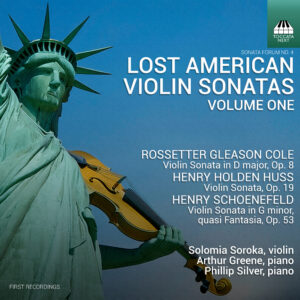
Lost American Violin Sonatas, Volume One
This anthology of unknown American violin sonatas – the first of a series – reveals music of astonishing craftsmanship and energy. All three composers – Rossetter Gleason Cole, Henry Holden Huss and Henry Schoenefeld, born less than ten years apart – went to Germany to study before returning to enrich American musical life at the turn of the nineteenth and twentieth centuries. The sheer confidence of their writing, for both violin and piano, in these sonatas, in a bold Brahmsian style, indicates how much more fine music still has to be discovered, in the output of these three men and from their ‘lost generation’ of American composers more generally.
Solomia Soroka, violin
Arthur Greene, piano
Phillip Silver, piano

Singing Into Space: Spatially Conceived Music for Men’s Voices
The two composers heard on this album, Giovanni Gabrieli (1553–1612) and Giovanni Bonato (born in 1961) have more in common than their first names: both hail from the Veneto in north-east Italy – there is no documentation of Gabrieli’s birth, but he was probably Venetian, and Bonato was born in nearby Schio. Their music, too, is conceived in terms of its sound in space, with Gabrieli using the cori spezzati that sang from the opposing galleries of St Mark’s Basilica in Venice, and Bonato employing cori spazzializati to build a spatial dimension into the music itself. Juxtaposed, their styles offer a striking contrast, with Gabrieli’s bold declamations set against Bonato’s shifting, timeless suspensions.
Estonian National Male Choir
Mikk Üleoja, conductor