Search Results for "compartidos vibes girl" – Page 2
Showing results for cambridge voices girl
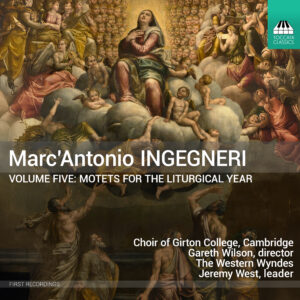
Marc’Antonio Ingegneri, Volume Five: Motets for the Liturgical Year
The Choir of Girton College, Cambridge, continues its pioneering exploration of the music of the Italian Renaissance master Marc’Antonio Ingegneri (c. 1535/36–92) with a journey through the liturgical year, as mirrored in Ingegneri’s motets. A ‘concept album’ of Renaissance polyphony may be an unusual undertaking, but this one illustrates how Ingegneri took his lead from the emotions implicit in each major celebration of the church – from sorrow and awe to joy and jubilation – expressed in music of extraordinary beauty, belying the internal complexity that gives it its emotional power.
Choir of Girton College, Cambridge
Gareth Wilson, director
The Western Wyndes
Jeremy West, leader
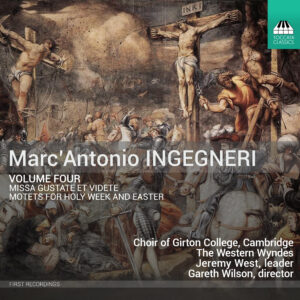
Marc’Antonio Ingegneri: Volume Four – Missa Gustate et videte; Motets for Holy Week and Easter
The Cremonese composer Marc’Antonio Ingegneri (c. 1535/36–92) is chiefly remembered as the teacher of Claudio Monteverdi while, for well-nigh 500 years, his own achievements were left to sit in the shadows. This fourth in a series of pioneering recordings from the Choir of Girton College, Cambridge, presents a sequence of music for Holy Week and Easter, confirming Ingegneri to have been one of the masters of his age. The striking range of moods heard here will confound conventional expectations of Renaissance polyphony: Ingegneri’s emotional palette extends from tender intimacy in some of these motets to dancing, celebratory jubilation in the Mass setting – all of it music of breathtaking richness and beauty.
Choir of Girton College, Cambridge
The Western Wyndes
Jeremy West, leader
Gareth Wilson, director
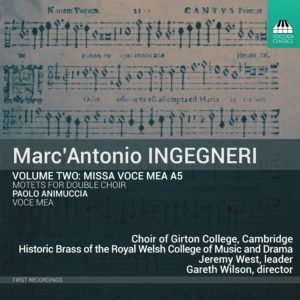
Marc’Antonio Ingegneri: Volume Two: Missa Voce Mea A5, Motets for double choir
The Cremonese composer Marc’Antonio Ingegneri (c. 1535/36–92) is chiefly remembered as the teacher of Claudio Monteverdi, while, for well-nigh 500 years, his own achievements were left to sit in the shadows. This second in a series of pioneering recordings from the Choir of Girton College, Cambridge, reveals Ingegneri to have been one of the masters of his age, writing music of breathtaking richness and beauty: the works heard here combine learned, intricate counterpoint with the kind of sheer sonic thrill that brings a shiver of physical excitement. It is, of course, religious music, but it is also extraordinarily passionate, to a degree not previously heard, nor for centuries to come, until the rise of the great Romantic choral works.
Choir of Girton College, Cambridge (Tracks 1–3, 5–8, 10, 12–14)
Historic Brass of the Royal Welsh College of Music and Drama (Tracks 1, 3–14)
Jeremy West, leader
Gareth Wilson, director
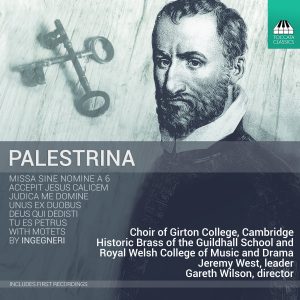
Palestrina: Missa sine nomine a6
Renaissance polyphony is generally held to be stately, calm, reassuring. But this pro- gramme of Palestrina’s six-part Missa sine nomine, complemented by five of his motets and three by Marc’Antonio Ingegneri (c. 1535/36–92), was recorded after the Choir of Girton College, Cambridge, had undertaken a tour of Israel and Palestine. There the music and its texts (‘How shall we sing the Lord’s song in a strange land?’) took on an extraordinary poignancy, with the dispossession and desperation of thousands of years ago animating the restrained dignity of Palestrina’s counterpoint with an unexpectedly topical intensity.
Choir of Girton College, Cambridge
Historic Brass of the Guildhall School and Royal Welsh College of Music and Drama
Jeremy West, leader
James Mitchell, organ (Track 8)
Lucy Morrell, organ (Track 13)
Gareth Wilson, director
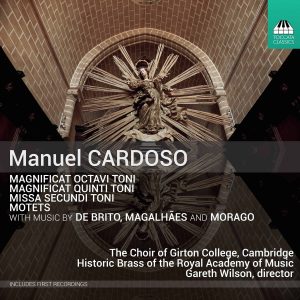
Manuel Cardoso: Missa Secundi Toni and Other Works
Manuel Cardoso (1566–1650) was one of the most important composers of the golden age of Portuguese polyphony around the turn of the seventeenth century. But modern choirs have been surprisingly slow to explore the rich legacy of his compositions: this is the first recording of his Missa Secundi Toni, and the first of any of his works with brass consort, its dark colours providing an effective contrast with the young voices of the Girton College Choir.
The Choir of Girton College, Cambridge (Tracks 1–2, 4–7)
Historic Brass of the Royal Academy of Music (Jeremy West, leader) (Tracks 1–5, 7 10–14, 16–17)
Lucy Morrell, organ (Tracks 1–5, 7–8, 10–13, 15–17)
Gareth Wilson, director (Tracks 1–7, 9–14, 16–17)
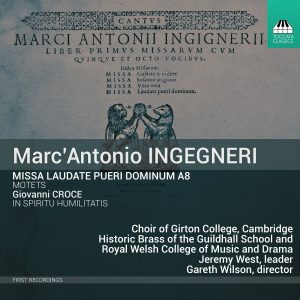
Marc’Antonio Ingegneri: Missa Laudate pueri Dominum
The Cremonese composer Marc’Antonio Ingegneri (c. 1535/36–92) is chiefly remembered as the teacher of Claudio Monteverdi while, for well nigh 500 years, his own achievements were left to sit in the shadows. This pioneering recording reveals Ingegneri to have been one of the masters of his age, writing music of breathtaking richness and beauty: the polychoral works heard here combine learned, intricate counterpoint with the kind of sheer sonic thrill that brings a shiver of physical excitement.
Choir of Girton College, Cambridge
Historic Brass of the Guildhall School and Royal Welsh College of Music and Drama
Jeremy West, leader
James Mitchell and Wayne Weaver, organ
Gareth Wilson, director
First recordings
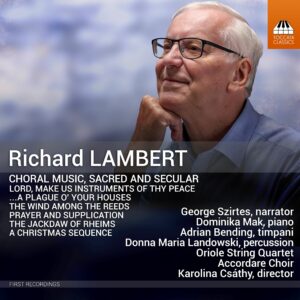
Richard Lambert: Choral Music, Sacred and Secular
The choral music of Richard Lambert, born in Bath in the English West Country in 1951, covers a wide range of expression, ranging on this album from straightforward SATB settings for church performance to a sardonic parody of the excesses of established religion. It also encompasses the timeless and the timely, with a number of contributions to the age-old tradition of Christmas music to a cantata inspired by the Covid pandemic.
This is the first recording of the Accordare Choir, founded and conducted by Karolina Csáthy, initially using former choral scholars of The Choir of Trinity College Cambridge; since then it has expanded in size, scope and accomplishment.
George Szirtes, narrator
Dominika Mak, piano
Adrian Bending, timpani
Donna Maria Landowski, percussion
Accordare Choir
Karolina Csáthy, director
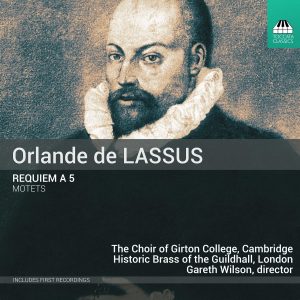
Orlande de Lassus: Requiem a 5; Motets
Lassus’ five-part setting of the Requiem is rarely heard; here it is recorded with brass for the first time, the sombre colours of the sackbuts further darkening the tone. Interweaving a number of motets, some also receiving first recordings, and a madrigal on death by one of Lassus’ contemporaries in an organ transcription, this innovative programme takes the listener on a spiritual journey, through the darkness of bereavement to the elevation of the Christian soul after death.
The Choir of Girton College, Cambridge (Tracks 1-4, 6-10, 12-14, 17)
Historic Brass of the Guildhall, London
(Jeremy West, leader) (Tracks 2-8, 10, 12-14, 17)
Lucy Morrell, organ (Tracks 3, 4, 6-8, 10-13, 16, 17)
Gareth Wilson, director
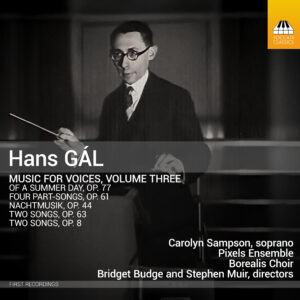
Hans Gál: Music for Voices, Volume Three
Whether in his original home of Vienna, as a conservatoire director in Mainz, or as an émigré in Edinburgh, where he became one of the mainstays of musical life, Hans Gál (1890–1987) championed choral singing as a way of directly involving people in making music: he founded and conducted a number of choirs and provided an extensive output of choral compositions. This third album of his choral music offers a vivid cross-section of music for chamber choir, featuring mixed voices, women’s voices and male-voice choir, a cappella, with solo soprano, with piano and with chamber accompaniment.
Carolyn Sampson, soprano
Pixels Ensemble
Borealis Choir
Bridget Budge, director
Stephen Muir, director
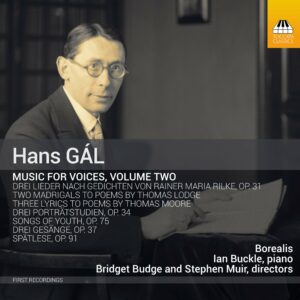
Hans Gál: Music for Voices, Volume Two
Whether in his original home of Vienna, as a conservatoire director in Germany, or as an émigré in Edinburgh, where he became one of the mainstays of musical life, Hans Gál (1890–1987) championed choral singing as a way of directly involving people in making music: he founded and conducted a number of choirs and provided an extensive output of choral compositions. This second album of Gál’s choral music offers a vivid cross-section of his music for chamber choir, featuring mixed voices, women’s voices and male-voice choir, both a cappella and with piano, and ranging across four decades
Borealis
Ian Buckle, piano (Tracks 1–3, 15–17, 23–25)
Bridget Budge, director (Tracks 1–17, 23–25)
Stephen Muir, director (Tracks 18–22)
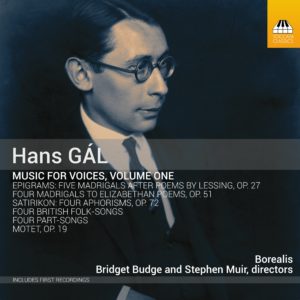
Hans GÁL: Music for Voices, Volume One
Whether in his original home of Vienna, as a conservatoire director in Germany, or as an émigré in Edinburgh, where he became one of the mainstays of musical life, Hans Gál (1890–1987) championed choral singing as a way of directly involving people in making music: he founded and conducted a number of choirs and provided an extensive output of choral compositions. This first volume in a long-term project to record his choral music presents a rich variety of works for a cappella voices, ranging from demanding eight-part choruses to charming folksong settings.
Borealis
Bridget Budge (1 –14, 19–22)
and Stephen Muir (15–18), directors
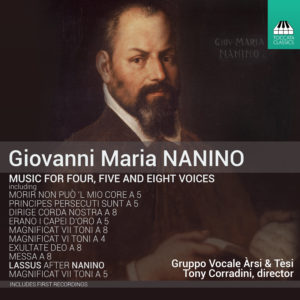
Giovanni Maria Nanino: Music for Four, Five and Eight Voices
Giovanni Maria Nanino (1544–1607) was one of the major Italian composers of late-Renaissance polyphony. A successor of Palestrina as maestro di cappella at Santa Maria Maggiore in Rome, Nanino produced a modest but expertly crafted body of sacred music, and his madrigals, too, enjoyed widespread popularity. He also became the most influential teacher of composition in late-sixteenth-century Rome. But despite the prestige he enjoyed in his own day, his music has been almost entirely forgotten. This recording – the first to be dedicated to his music – reveals it to have struck a remarkable balance between beauty, passion and dignity, between darkness and light.
Gruppo Vocale Àrsi & Tèsi
Tony Corradini, director
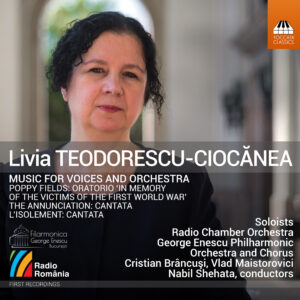
Livia Teodorescu-Ciocănea: Music for Voices and Orchestra
The composer and pianist Livia Teodorescu-Ciocănea, born in Galați, eastern Romania, in 1959, brings together ancient and modern in her music: echoes of the modal sounds of Romanian folk-music blend with considerations of timbre to generate a palette of colours that is both contemporary and ageless. All three works here use the voice – solo and in chorus – to touch on aspects of the human condition, suggesting both drama and ritual.
George Enescu Philharmonic Orchestra & Chorus
Radio Chamber Orchestra
Iosif Ion Prunner, chorus master
Cristian Brâncuși
Vlad Maistorovici
Nabil Shehata

Singing Into Space: Spatially Conceived Music for Men’s Voices
The two composers heard on this album, Giovanni Gabrieli (1553–1612) and Giovanni Bonato (born in 1961) have more in common than their first names: both hail from the Veneto in north-east Italy – there is no documentation of Gabrieli’s birth, but he was probably Venetian, and Bonato was born in nearby Schio. Their music, too, is conceived in terms of its sound in space, with Gabrieli using the cori spezzati that sang from the opposing galleries of St Mark’s Basilica in Venice, and Bonato employing cori spazzializati to build a spatial dimension into the music itself. Juxtaposed, their styles offer a striking contrast, with Gabrieli’s bold declamations set against Bonato’s shifting, timeless suspensions.
Estonian National Male Choir
Mikk Üleoja, conductor
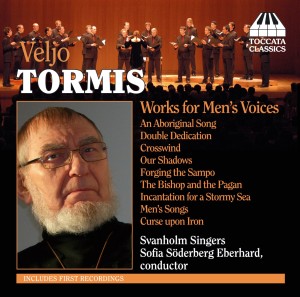
Veljo Tormis: Works for Men’s Voices
The Estonian composer Veljo Tormis (born in 1930) has carved a unique position for himself in contemporary music. By marrying the quasi-minimalist rhythmic vigour of Estonian runic singing – a tradition some 3,000 years old – with the extended techniques of modern choral writing, he has created a body of music tingling with excitement, energy and power. Many of the works on this CD – where the composer, playing shaman drum and anvil, joins one of Scandinavia’s brightest young choirs – draw on folk sources in a reaffirmation of Estonian identity; others evoke the forces of nature as a metaphor for political upheaval.
Svanholm Singers, choir
Sofia Söderberg Eberhard, conductor
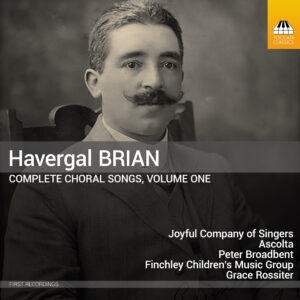
Havergal Brian: Complete Choral Songs, Volume One
The reputation of Havergal Brian (1876–1972) as a late-blossoming symphonist obscures the fact that he was an early-blossoming composer of choral music for the huge market of amateur choirs thriving in Edwardian England. His choral songs range from simple unison settings for children’s or women’s voices to harmonically complex essays intended to tax the ability of groups taking part in the choral competitions once popular in many parts of Britain.
Joyful Company of Singers
Peter Broadbent, conductor
Finchley Children’s Music Group
Grace Rossiter, conductor