George Frideric Handel: The ‘Amen, Alleluia’ Arias
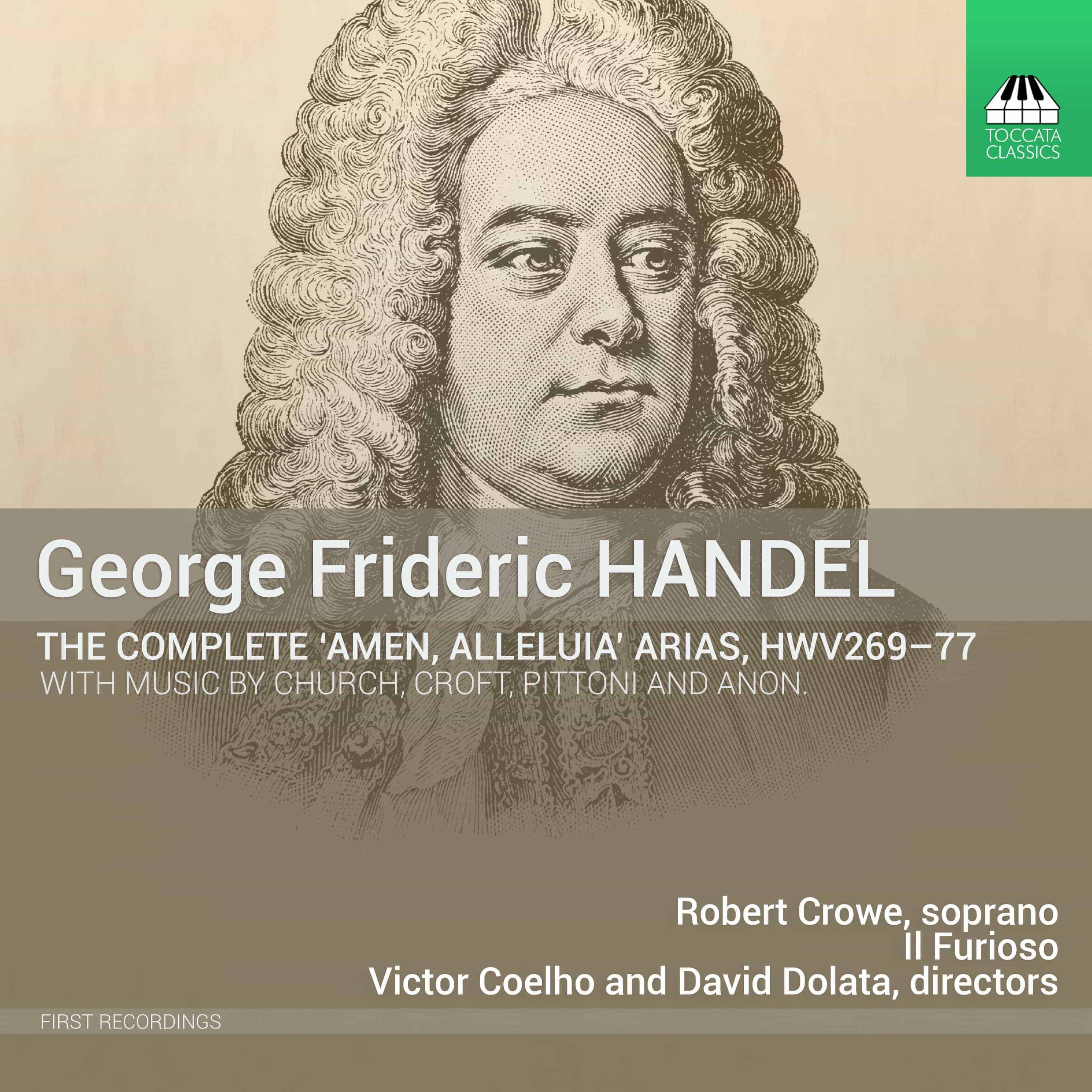
Over a period of some twenty years, from the late 1720s, Handel composed a series of virtuoso arias using only the words ‘Amen’ and ‘Allelujah’ as his texts, probably for use in private worship. Here they receive their first recordings, set in a context of contemporary sacred song and instrumental music – and are heard in the extraordinarily dramatic timbres of a male-soprano voice.
Robert Crowe, soprano (Tracks 1, 3–6, 10–12, 14, 17, 19, 21, 22)
II Furioso
Victor Coelho, theorbo (Tracks 1, 3–9, 11, 12, 19, 21, 22)
David Dolata, theorbo (Tracks 1-6, 11–13, 19–22)
Juvenal Correa-Salas, organ
Listen To This Recording:
- Amen No. 1 in F major, HWV 270
- Sonata Nona in D minor (1669), II. [Andante]
- A Hymn on Divine Musick (1700)
- Amen, Alleluja No. 5 in G major, HWV 273
- Amen No. 2 in G minor, HWV 271
- Amen, Alleluja No. 6 in A minor, HWV 274
- Sonata Decima in G major (1669), I. Grave
- Sonata Decima in G major (1669), II. Allegro
- Sonata Decima in G major (1669), III. Allegro
- Amen, Alleluja No. 7 in F major, HWV 276
- A Divine Song on the Passion of our Saviour (1693)
- Amen, Alleluja No. 9 in D minor, HWV 269
- Sonata Nona in D minor (1669), I. [Andante]
- Hallelujah! Amen No. 8 in F major, HWV 277
- Pieces from The Braamcamp Handel-Clay Clock (c. 1738); Minuet [HWV436]
- Pieces from The Braamcamp Handel-Clay Clock (c. 1738); Variation [HWV436]
- A Divine Hymn (1703)
- Sixth Air (from The Braamcamp Handel-Clay Clock, c. 1738)
- Amen, Alleluja No. 4 in D minor, HWV 272
- Sonata Undecima in A minor (1669), III. [Andante]
- [Amen, Alleluja] No. 3 in C major, HWV 275
- Amen No. 1 in F major, HWV 270 (ornamented version)
MusicWeb International :
‘[Crow’s] technique is undoubtedly remarkable and one cannot fault the control he asserts over the apparently wild effects of the music at times […].
—Curtis Rogers, MusicWeb International
Ealy Music America :
‘These works are technically involved and expressive, and the musicians approach them with obvious knowledge and affection. […] Crowe’s musical instincts are spot-on throughout as he explores each work’s unique character. […] Even during the most ornate line of the three Harmonia Sacra pieces, Crowe demonstrates fine diction and consistency of tone. […]
Even during the most ornate line of the three Harmonia Sacra pieces, Crowe demonstrates fine diction and consistency of tone.
[…] the origins of these works in private musicking, the spare accompaniment, and the musicians’ sensitive interplay make this a thoroughly intimate affair.’
—Andrew J. Sammut, Ealy Music America
musica Dei donum :
‘Undoubtedly this is a most interesting production, first of all because of the ‘Amen, Alleluja’ settings by Handel. In addition, the three hymns shed light on a part of the English sacred repertoire from the late 17th and early 18th centuries, which has remained largely under the radar, but which deserves much more attention.’
—Johan van Veen, musica Dei donum