Paul Ben-Haim: Chamber Music
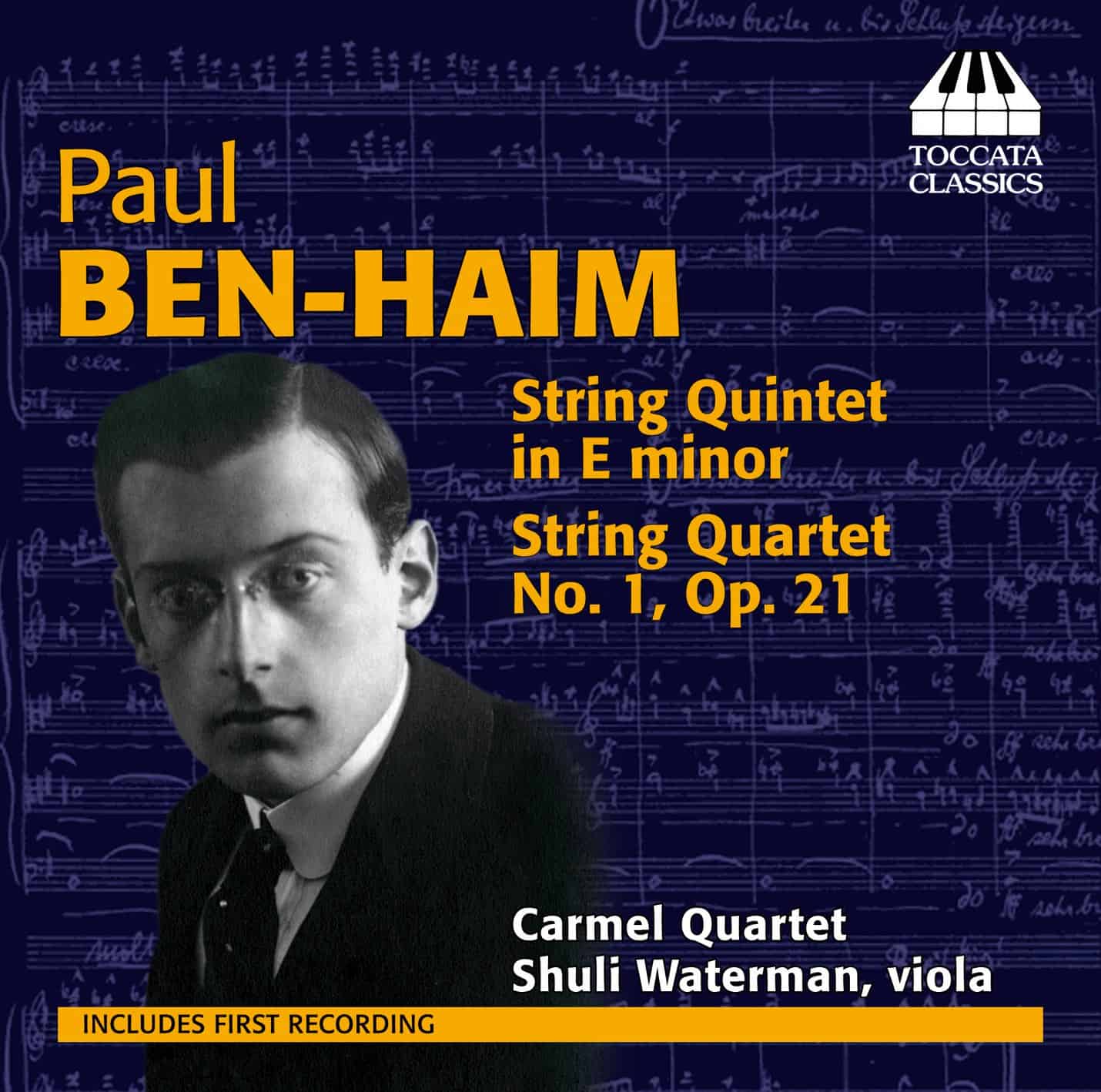
The Israeli composer Paul Ben-Haim (1897-1984) was born Paul Frankenburger and made his early career in his native Munich. Reading the danger signs earlier than most, he emigrated to Palestine in 1933 and soon became one of the leading figures in the musical culture of the emerging Jewish state. His music mirrors this change of circumstance: the early String Quintet (1919) taps a vein of rich late Romanticism influenced by Richard Strauss, but the rhapsodic First String Quartet (1937) is coloured by middle-Eastern melisma and folk-rhythms.
Carmel Quartet, string quartet
Shuli Waterman, viola
Listen To This Recording:
-
String Quartet No. 1, Op. 21 (1937)
- I Con moto sereno
- II Molto vivace
- III Largo e molto sostenuto
- IV Rondo – Finale (Allegretto commodo)
- I Leidenschaftlich bewegt
- II Sehr langsam, mit tiefster Empfindung
- III Finale: Rondo (Energisch bewegt)
String Quintet in E minor (1919)




MusicWeb International :
“…The firm-bowed, full-toned performances by the Carmel Quartet – joined by violist Shuli Waterman in the quintet – encompass both robust fortes and hushed pianos without losing tonal quality. The instrumental lines coalesce into vibrant, glowing ensemble sonorities without losing their individual character. With vivid recorded sound, it’s hard to imagine these pieces being done better.” MusicWeb International
Fanfare :
“…[String Quintet:] There’s a somewhat Modernistic, Hindemith-like approach to the announcement of themes in the outer movements, before the music moves into nostalgic, 19th-century material reminiscent of Brahms or Mahler (Mahler’s work serving as Frankenburger’s model when, later on, as Ben-Haim, he turned to symphonic writing). …[String Quartet No. 1] The work remains popular in Israel, and it’s easy to hear why. The dimensions of its first three movements are more compact than those of the quintet, and the use of modal, ethnic-sounding motives sounds natural and eloquent in the first, third, and fourth. …I commend Toccata Classics for the high level of its presentation of two little-known works of very high quality, by a composer who, while hardly unknown, deserves much more attention on recordings. The Carmel Quartet and violist Shuli Waterman play with the technical polish that these colorful, dynamic scores demand, along with obvious commitment and feeling. The recorded sound has good definition and clarity, and the booklet offers two substantial essays by experts on Ben-Haim.” Fanfare
Classical Lost and Found :
“…Established in 1999 the Carmel String Quartet is one of Israel’s most honored chamber ensembles. They give immaculate interpretations of both works with admirable assistance from Haifa-born violist Shuli Waterman in the quintet. …the soundstage projected is wide, sharply focused, and in a minimally reverberant acoustic engendering a clean lean sound. In that regard the instrumental placement and balance is superb…” Classical Lost and Found
Israel Studies in Musicology Online :
‘in both works, the performers display great musical sensitivity, producing a wide array of timbres and adapting themselves to the composer’s richstylistic palette. Their musicality and technical virtuosity dogreat service to Ben-Haim’s works; the performances are clear, impassioned, and committed.
The musicological apparatus that accompanies the recording is substantial and noteworthy. […]
Indeed, the themes of the three-movement quintet derive from widely varying source-material and stylistic templates, and the effectiveness of this recording is due in no small part to the performers’ abilities to capture each of these characters convincingly and expressively. […]
At its core, then, this recording by the Carmel Quartet constitutes an important contribution to our understanding of Ben-Haim and his music precisely because it is a musical contribution, and a testimony to Ben-Haim’s search for a personal compositional voice. The composer’s choices are valid and valuable witnesses to his capacity to regenerate and reshape his artistic identity in the wake of trauma and loss. The players of the Carmel Quartet have become powerful advocates for Ben-Haim’s music, and their recording prompts us as listeners and thinkers to engage with his work on its own terms.’
—Rebecca Cypess, Israel Studies in Musicology Online