In March 2020 my wife and I were all set to journey from our home in south-eastern France to Manchester to hear the BBC Philharmonic rehearse, perform and record my Fourth Symphony. The day before we were scheduled to leave, our eldest son, who was to go to Paris for a meeting that day, called us to tell us not to go to the UK. His boss had just warned him not to come to Paris: apparently there was some new virus on the rampage, and people were being advised to stay at home. To contextualise just how agonising a decision that was to make, this event was to have been, when I was aged 62, the first professional performance of any of my symphonies before an audience; in addition to the studio performance and recording, it was to have been broadcast on BBC Radio 3 and might have gone some way to putting me a little more on the map as a composer.
In the event, in not going, we didn’t miss much. During the rehearsals, those in charge at the BBC decided to pull the plug on the whole project, and so, in retrospect, not making the long trek north was the right thing to do. Like millions of others, we settled down to sit out the pandemic and wait for things to improve.
Now, I don’t know how these things work, but it seemed to me that since my project was one of the first things to be cancelled, it would also be one of the first to be rescheduled once the world got back to normal. Wouldn’t you think that would be a reasonable expectation? But months went by; years went by. Works that hadn’t even been written in 2020 were scheduled and performed, and still the BBC producer who had first mooted the project back in 2017 was unable to tell me when it would be rescheduled, while continuing to assure me that it would be, at some point in the future. There came a time when the managing director of the orchestra moved on to other things and was replaced, but still nothing changed.
By this time, despite the producer’s assurances, I knew it was never going to happen. Fortunately, plenty of other stuff was taking place over this period: I was not sitting twiddling my thumbs waiting for the BBC to get its act together. Most notably, the fabulous Siberian Symphony Orchestra recorded the Fifth Symphony and other orchestral pieces under Dmitry Vasiliev for a Toccata Classics recording that came out in 2020.1 And Covid brought an unexpected benefit in that the same orchestra, unable to perform in public, had time on its hands, and in August I received a message from Dmitry: ‘Steve, what do you like to record next time?’ Now, that isn’t something I’m often asked! In due course, the Orchestra recorded Symphonies Nos. 6 and 7 for Toccata Classics, a recording released in 2022.2 So I was kept busy with concerts, recordings and, of course, more composing, while this BBC project stayed on the back burner, but with the gas now clearly disconnected.
In early 2025, my producer contact at the BBC Phil retired and gave me the e-mail address of the new managing director. My exchanges with the latter were most cordial – after all, the perfunctory treatment I had encountered was not of his making – and he informed me that the orchestra was fully booked until summer 2026. When I told him that, after waiting for eight years, next summer was tomorrow as far as I was concerned, he sidestepped the issue and instead offered to pass me on to one of his colleagues in another BBC orchestra. This person proved to be equally sympathetic and went as far as to cost the project at today’s prices, pointing out that the BBC ‘can no longer work on a subsidised basis for commercial recordings’. Not surprisingly, given that change of policy and the wasted eight years, the cost was more than double what I had been quoted in 2017. So that was that: the project was finally dead and buried.
In stark contrast to the long gestation and still-birth of the BBC project, hardly had its pulse flickered out than Martin Anderson of Toccata Classics rode in to the rescue. ‘I’ve found you an orchestra’, he told me, as though it were the easiest thing in the world. That’s how I came to go to Olomouc.
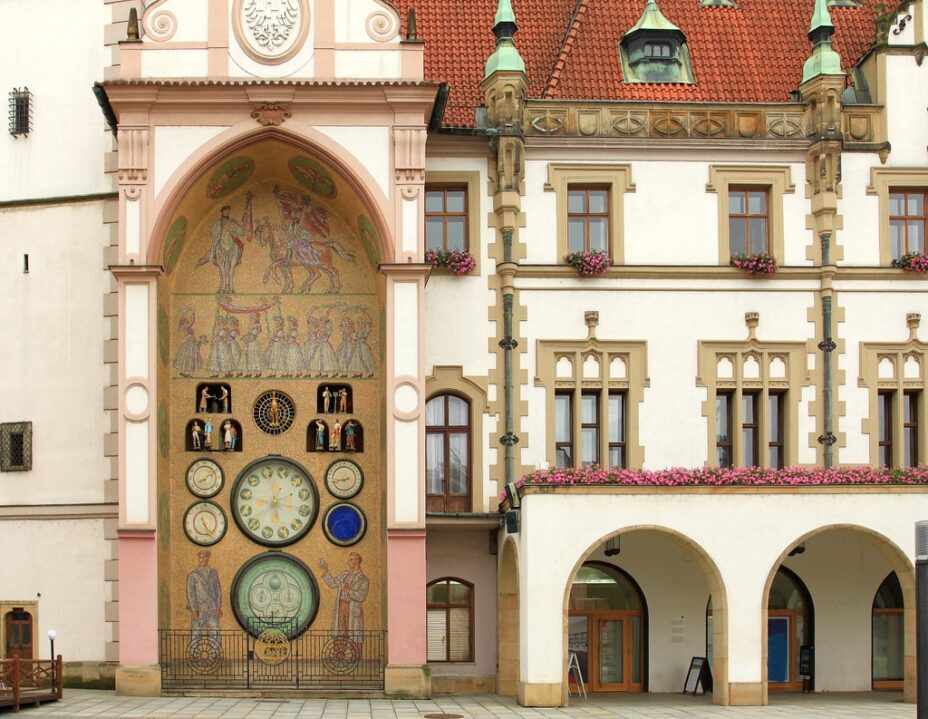
Olomouc is a beautiful city about 200 km southeast of Prague in the province of Moravia. If, before that, anyone had asked me to name cities in the Czech Republic, I think I could come up with Brno, because of Janáček, and Prague, because of Mozart, and that would be it. Olomouc (pronounced ‘ólomouts’) is the sixth largest city in the Czech Republic and is packed with a wealth of monuments and other stuff to visit: the World Heritage Holy Trinity Column, St Wenceslas’ Cathedral, the Town Hall, with its astronomical clock, no fewer than six Baroque fountains, splendid parks surrounding the city where the fortified walls used to be … and the Moravian Theatre on Horní náměstí, the Upper Square, the building being home to both the theatre (Moravské divadlo) and the Philharmonic Orchestra (Moravská filharmonie Olomouc), merged in 2023 into one institution.
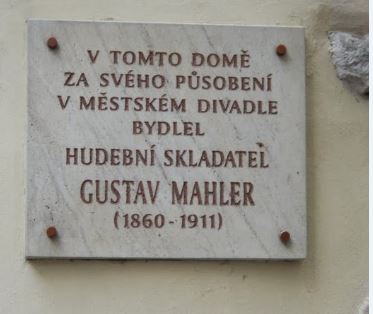
Gustav Mahler stayed in Olomouc from mid-January to mid-March 1883. He conducted briefly at what is today the Moravian Theatre, which has a bust of him commemorating this period. He lived near the theatre, in a house on the Upper Square. There is also a Café Mahler on the square.
Getting to Olomouc was in itself an adventure. To say I am terrified of flying would be an understatement, but I have managed it on two occasions when my music was being played in Slovakia. This time, I was prepared to bite the bullet and do it again. I found a direct flight from Lyons to Prague, and so booked that, but then couldn’t find a direct flight back. One take-off and landing I thought I could just about manage, but two or more? No way. So I planned the journey back by train. Hardly had I got my trip sorted out than a plane coming from India to Gatwick crashed on take-off, killing all but one person on board and nineteen more on the ground. That was enough for me. In a truly breathtaking display of irrationality I decided to do the whole thing by train. After all, why do a journey in two hours when you can do it in two days, and why spend four hundred euros when you can spend a thousand?
Well, the rail trip was a joy from start to finish. The trains were on time and comfortable, and just watching the countryside go by at eye-level rather than from miles above gave me a real sense of going somewhere. Also, I was perfectly relaxed and in no need of strong drink and medication. There was, too, the added novelty and a kind of low-key thrill (‘Will they let me in?’) of having to show my passport as we crossed from Strasbourg into Germany. After a night spent in a fine guesthouse in Schwandorf near the Czech border, I finally arrived in Olomouc in the afternoon of the second day, a Sunday.
On Monday morning I was relieved to find that Ken Woods, the conductor for these recordings, had arrived safely during the night. Among his many accomplishments, Ken is artistic director and principal conductor of the English Symphony Orchestra (which is where I had got to know him during my tenure as composer-in-association), the Colorado MahlerFest and the Elgar Festival. After a copious breakfast in the Hotel Arigone, which I would recommend highly, we strolled across the square to the theatre to meet the orchestra and our production team, Jiří Štilec and Václav Roubal.
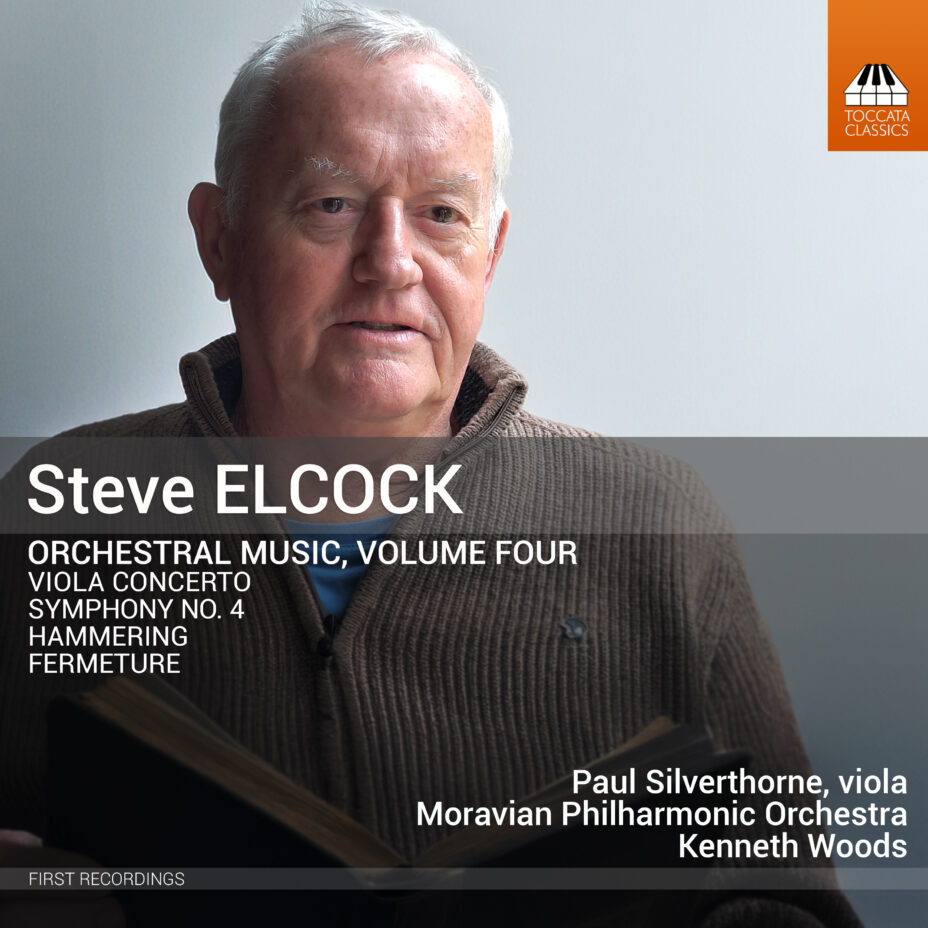
The string section of the orchestra was perhaps slightly smaller than I might have wished for, but was dimensioned to suit the size of the theatre and the acoustics therein, and at no time did I feel the need for anything bigger, such was the precision and commitment of their playing. The programme included my Viola Concerto (Op. 29, 2017–18) and Fourth Symphony (Op. 33, 2012–13, rev. 2017), as well as two smaller works. Recording began with them: Fermeture, my Op. 38, from 2020, and Hammering, Op. 15, from 2005.
Ken Woods had mentioned to me some time ago that he quite liked to end a concert with an overture and that it might be a good idea if such a piece were written especially for that purpose. I jokingly said that I was working on one, and that it would be called Fermeture, the French word for closure, just as ‘ouverture’ is French for opening. I wasn’t really, of course, but then I thought: ‘What if I did?’. The piece is short enough – and, I hope, exciting enough – not to bore an audience which has already sat through a full programme, and it comes complete with a central ‘big tune’, in the best English style. Instead of a triumphant ending, the final bars call to mind the curtain coming down to put an end to the proceedings.
Hammering was designed as a study in gradually and systematically building a structure starting out from just one note (E). After eight bars of 4/4, the notes either side of this E (E flat, F) become available. After seven bars and three beats, the next two neighbouring notes (D, F sharp) come into play, and so on. The piece grows not only by virtue of more and more notes being heard but also by the increasingly quick rate of their becoming available (after 32 beats, after 31 beats, after 30 beats…). This process all but guarantees a sense of growing excitement. It was only after I’d got started that I realised that an analogy with builders at work on a huge structure – a cathedral? – was not inappropriate. To start with, they have only a few bricks, and as more and more materials are delivered to the site, the structure grows exponentially. The cathedral is finally revealed in all its glory, only to come crashing down. The final bars suggest the possibility of a new beginning.
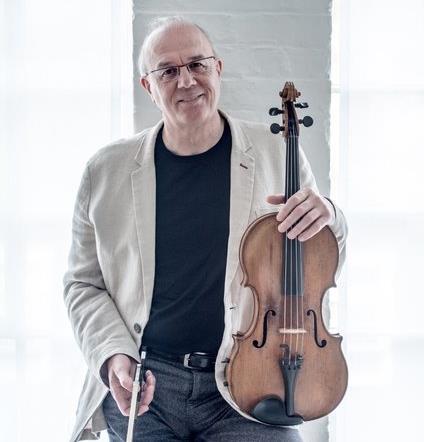
On Tuesday our soloist for the Viola Concerto, Paul Silverthorne, arrived and used the time while the symphony was being recorded to fine-tune his part. Paul has combined a prolific solo career with principal positions in two of the most prestigious ensembles in London: the London Symphony Orchestra (from 1990 to 2015) and the London Sinfonietta since 1988, as well as teaching positions at the Royal Academy of Music and the School of Music at Soochow University in Suzhou, China.
The Concerto is in one continuous movement, while suggesting the classical layout of three movements – fast, slow, fast. The work grows out of four notes played at the outset on solo clarinet. The central slow part is scored mainly for strings, and the final section is essentially a wild folk-dance, leading, after a return to the opening material, to a blazing climax based on the four notes, and a breathless conclusion.
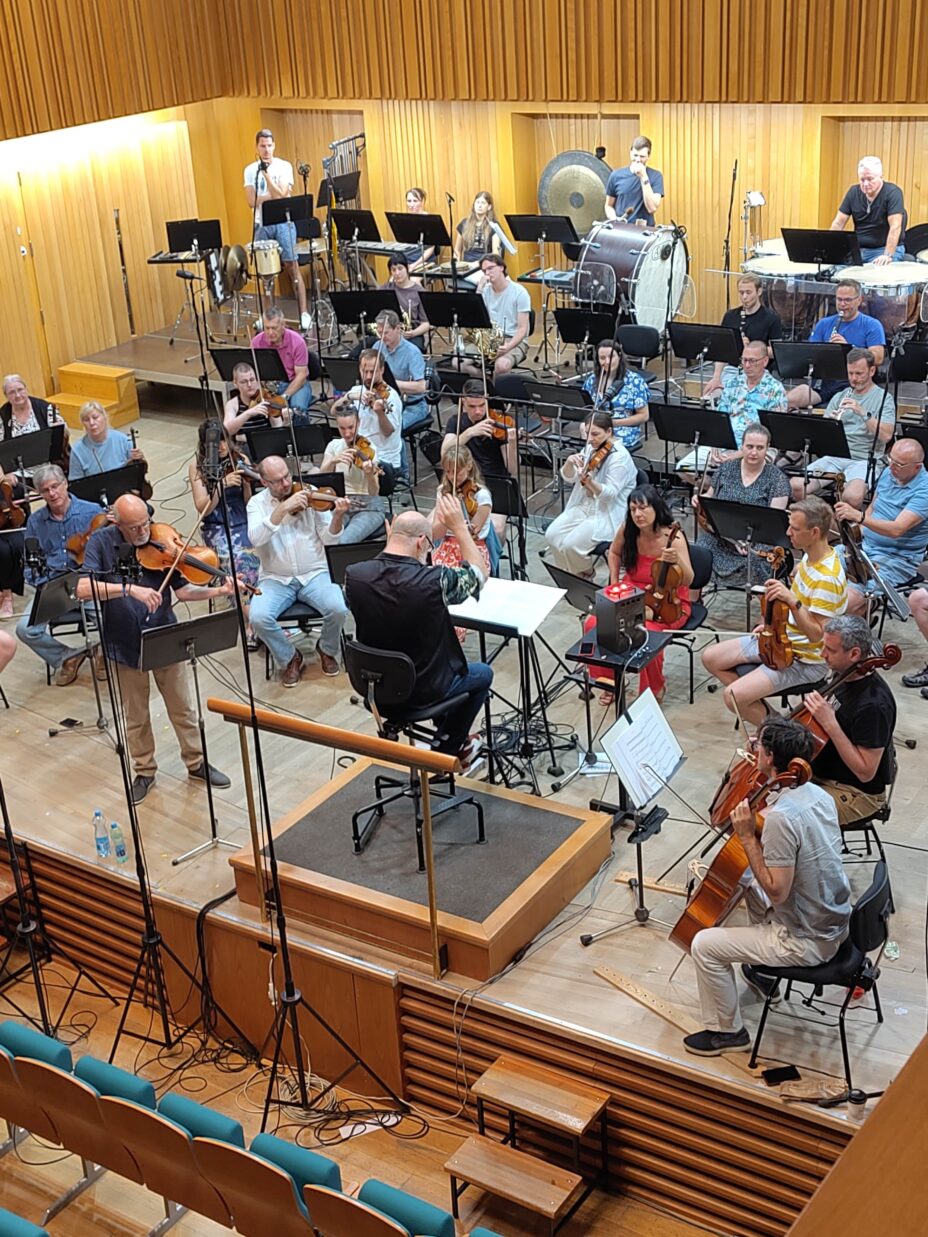
Before recording this piece, the orchestra had tackled the daunting Fourth Symphony: daunting because of its technical difficulties and its uncompromising nature. I wrote it at a time when I thought any performance of my work unlikely, and had therefore decided to throw off the shackles and write without any of the technical restraint I had applied formerly when writing for an amateur orchestra. Before we began, I could see that the harpist was struggling with a certain passage. I have never seen a terrified harpist before, but this lady looked as if she were about to run away. I quickly found her an easier alternative which seemed to meet with her approval, though the language barrier meant that I was not entirely sure. While we were discussing this solution, a member of the viola section came over and, as if in commiseration with the harpist, told me gloomily ‘This very difficult symphony’, shaking his head sadly from side to side.
In spite of this inauspicious start, things went very smoothly: passages that I thought would be problematic, such as some very fast music for the brass section, went off without a hitch. About two-thirds of the way through the symphony, the tentative, hushed opening returns as a massive fortissimo unison on the whole orchestra, fit to demolish the theatre. Such a shattering display of raw power left me trembling. The musicians took a break at this point, and I staggered down from the balcony in a daze to find Ken in his conductor’s den. I stood in the doorway, neither of us speaking, Ken looking at me expectantly, but, my usual eloquence having deserted me in the face of what I had just heard, all I could find to say was two words of expletive, both of them monosyllabic.