Music from Malmö, Volume 1: Three New Concertos for Bass Clarinet
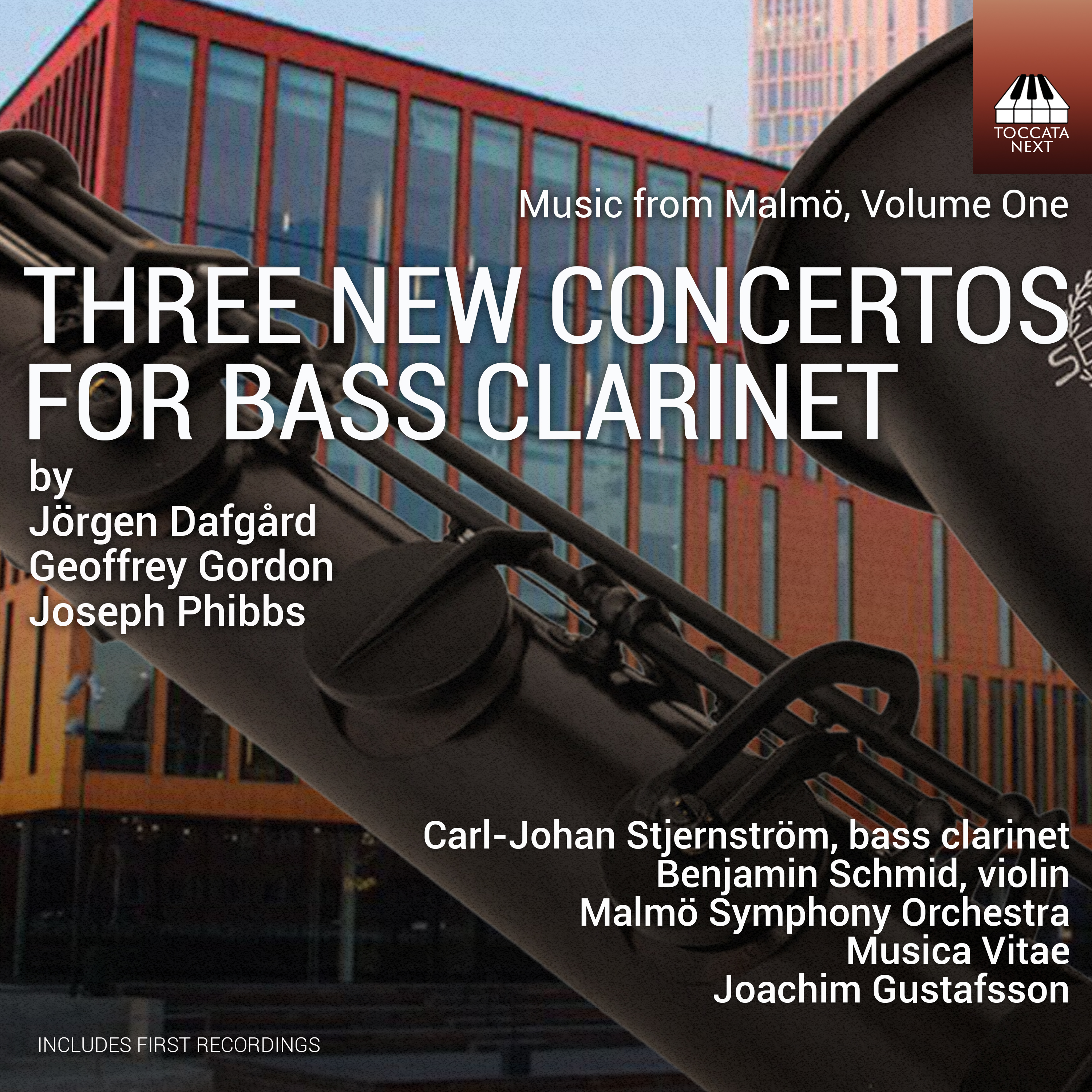
Concertos for bass clarinet are rare enough; this album brings three new ones to swell those limited ranks. It presents the fruit of a series of interlocking international co-operations, between orchestras in Sweden, the UK and USA, with American, British and Swedish composers and, at the heart of the undertaking, the bass clarinettist of the Malmö Symphony Orchestra, Carl-Johan Stjernström. All three composers exploit the huge range of colours the bass clarinet can offer, in music that ranges from the fierce and dramatic to the sunny and easy-going. The album also inaugurates a Toccata Next series providing a platform for the musicians of the Malmö Symphony Orchestra.
Carl Johan Stjernström, bass clarinet
Benjamin Schmid, violin
Musica Vitae
Malmö Symphony Orchestra
Joachim Gustafsson, conductor
Joseph Phibbs
Concerto for Bass Clarinet and Orchestra (2025)* (25:52)
- I. Largo (Notturno) – Presto (10:02)
- II. Presto (Scherzo-Rondo) (3:56)
- III. Larghetto (8:34)
- IV. Allegro (3:20)
Jörgen Dafgård
Tandem: Concerto for Violin and Bass Clarinet (2022)* (28:28)
- I. Con Freschezza (8:38)
- II. Misterioso (10:50)
- III. Rustico (9:00)
Geoffrey Gordon
Prometheus: Concerto for Bass Clarinet and Orchestra (2018) (27:07)
- I. According to the first… (6:13)
- II. According to the second… (4:55)
- III. According to the third… (7:31)
- IV. According to the fourth… (8:30)
*First Recording
MusicWeb International :
‘These performances are all authoritative, though I should note that this is not the first recording of Prometheus. It has previously appeared on an all-Gordon disc entitled Mythologies and Mad Songs, which was warmly received by my colleague Nick Barnard (review). It is perhaps also the highlight of the present disc, though all these works are worth hearing. I look forward to more concertos for the less common instruments. This disc is listed as Music from Malmö Volume One, so perhaps there will be.’
—Stephen Barber, MusicWeb International
MusicWeb International :
‘Credit, then, is due to all three composers and the excellence of bass clarinettist Carl-Johan Stjernström that this unlikely solo instrument emerges so impressively. This Toccata Next disc is titled “Music from Malmö, Volume One” and is designed to showcase the musicians of that fine orchestra. Stjernström is the principal bass clarinet of the orchestra and an interesting thread emerges from these three concertante works. The composers contribute useful liner notes and a recurring theme is them being buttonholed at a performance in Malmö by Stjernström suggesting that now might indeed be the time for them to write something for his instrument. Clearly his passion is persuasive, because the results are the works given here. […] Credit [in Concerto for Bass Clarinet and Orchestra] is due to both composer and engineers who manage the soundscape so effectively. […] Phibbs acknowledges the jazz-influenced style contributing to an entertaining and unbuttoned conclusion to this attractive – and very well performed – work. […]
Schmid is one of my favourite violinists, not just because he has a superlative technique but he is one of a handful of great players who is genuinely at ease across a wide range of idioms from straight classical through to contemporary and jazz. […] Stjernström’s playing is notable for the warmly even tone he produces across the entire range of the instrument and of course in this he is matched by Schmidt’s supremely beautiful lyrical playing. […] the performance here [of Tandem: Concerto for Violin and Bass Clarinet] is as skilled and sensitive as could be.
[…] I noted how successfully Gordon – as does Phibbs – creates ‘windows’ in the full orchestral texture to accommodate the tessitura of the bass clarinet. Likewise, Gordon points to a quasi-symphonic rather than concertante approach to this four-movement work and returning to this piece after a significant gap it does impress all over again. Both soloists – Stjernström here and Laurent Ben Slimane with Martyn Brabbins and the Philharmonia – are genuinely excellent. […] Certainly, the engineering on this new Toccata disc is excellent at maintaining a realistic balance between soloist and the large orchestra and the Malmö players perform with great skill and commitment. Again, the poise and beauty of Stjernström’s tone across the dynamic and pitched range of his instrument is striking with the final fade out into bleak darkness is perfectly poised. Although this is not a work I had returned to since my previous review, reacquaintance confirms the positive impressions.
Overall, this is a very interesting and stimulating disc with three diverse works receiving performances and recordings of exemplary quality. If the future releases in this series prove to be as rewarding then the stature of the excellent Malmö Symphony Orchestra will be increased.
—Nick Barnard, MusicWeb International
Fanfare :
‘Toccata Next titles this disc Music from Malmö, Volume 1. It is an attractive collection of concertos for bass clarinet, which isn’t usually thought of as a solo vehicle. Carl-Johan Stjernström is principal bass clarinet of the Malmö Symphony Orchestra, and based on this disc, has a strong enough musical personality to make an impression in these three new works, written between 2018 and 2025, one each from an American, English, and Swedish composer. […]
Phibbs is an English composer born in 1974, and his piece is well crafted, imaginatively scored, and inventive enough to hold the listener’s attention. […] I also hear a jazz influence in the playful rhythms that underlie much of the score. It is this playful quality that I very much enjoyed. […]
Clarinetists and woodwind players in general will certainly want to explore this release, as will those who are curious about new music for an instrument rarely heard in solo form. Stjernström is a brilliant player, and the performances overall are first-rate, as is the recorded sound. Toccata always provides excellent program notes.’
—Henry Fogel, Fanfare
Opus :
‘Carl-Johan Stjernström är en förstklassig solist som vårdar klangen föredömligt. Malmö symfoniorkester tar sig an musiken med övertygande fokus och utmärkt samspel medan Musica Vitae’s ljusa stråkar har en tilltalande luftighet. Ljudupptagningarna av samtliga tre verk är utmärkt balanserade.
Joseph Phibbs konsert har en fin blandning av vacker lyrik och lekfull spänst, medan Dafgårds dubbelkonsert (Benjamin Schmid är en utmärkt violinsolist) är mer avskalad ren komposition. Båda verken har sitt uttrycksfulla centrum i långsamma mellansatser.
Mest varierad, snarare en symfoni i förklädnad, är dock Geoffrey Gordons Prometheus-konsert. Tonsättaren utgår från Franz Kafkas prosafagment med olika tolkningar av myten.
Det inspirerar Gordon till verkligt dynamisk, ofta dramatisk musik, där även slagverk och bleckblås är en del av orkestersatsen. Det är skivans mest varierade verk, med en mer aktiv dialog mellan solist och ensemble, som också stannar längst i minnet.’
English translation:
‘Carl-Johan Stjernström is a first-class soloist who cultivates the tone admirably. The Malmö Symphony Orchestra approaches the music with convincing focus and excellent ensemble playing, while Musica Vitae’s bright strings have an appealing lightness. The recordings of all three works are excellently balanced.
Joseph Phibbs’s concerto offers a fine blend of beautiful lyricism and playful vitality, while Dafgård’s double concerto (Benjamin Schmid is an excellent violin soloist) is more stripped down and purely constructed. Both works have their expressive center in the slow middle movements.
The most varied work, almost a symphony in disguise, is Geoffrey Gordon’s Prometheus concerto. The composer draws on Franz Kafka’s prose fragment with different interpretations of the myth.
This inspires Gordon to create truly dynamic, often dramatic music, in which percussion and brass are integral parts of the orchestral texture. It is the most varied work on the disc, featuring a more active dialogue between soloist and ensemble, and it is the one that lingers longest in the memory.’
—JÖRGEN LUNDMARK, Opus
Fanfare :
‘Phibbs is an English composer born in 1974, and his piece is well crafted, imaginatively scored, and inventive enough to hold the listener’s attention. […]
Clarinetists and woodwind players in general will certainly want to explore this release, as will those who are curious about new music for an instrument rarely heard in solo form. Stjernström is a brilliant player, and the performances overall are first-rate, as is the recorded sound. Toccata always provides excellent program notes.’
—Henry Fogel, Fanfare, Jan 2026
Classical CD Reviews :
‘As a concerto for a somewhat challenging instrument, Phibbs succeeds completely – not unlike similar works by American composer, Kenneth Fuchs, whose concertos for electric guitar (ahem) and bass trombone are memorable almost entirely for the orchestral contribution and orchestration rather than the soloistic writing. But I realize this commission was for a bass clarinet concerto, and that is what Mr. Phibbs has expertly provided, with all the creative ingenuity he possesses. I would imagine bass clarinet players everywhere will find this piece a gift from the gods; and probably a lot of clarinetists will be dusting off their basses to play it as well!
Let me interject here that the recorded sound is superb, as is the orchestral contribution from the Malmo Symphony Orchestra conducted by Joachim Gustafsson. These attributes contribute significantly to the success of this piece. […]
The Vitae chamber group [in Dafgard’s double concerto] is enormously characterful and pleasantly energetic from beginning to end. Their contribution makes a significant and memorable impression in this.
[Geoffrey Gordon] skillfully incorporates the bass clarinet into his dark and very dynamic score, which predominantly features a massive orchestra in a massive way – replete with an absolutely awesome bass drum, cushioned on humongous pillows of air, captured with genuine size, weight and amplitude by the engineer. What a delectable sonic treat that is! (And surprisingly rare to hear with such stunning realism on a recording.) […]
While I wouldn’t have expected to enjoy an entire album of music featuring the bass clarinet, I must say this is a complete success – for several reasons. First and foremost is the mastery of the composers. Never did any of this music sound contrived; nor did any of it sound like just another “on-demand” commission. This music comes from truly accomplished composers – creative, innovative and inspired. Best of all, each of the three works sounds distinctly different from one another, providing enough variety in the program to hold one’s interest throughout. That 3 bass clarinet concertos can sound absolutely nothing alike is quite amazing, actually.
Second, the playing of Carl-Johan Stjernstrom is exceptional. Most impressive is the consistency of his sound from top to bottom – never strained (or screechy) up high and never honking down low. He truly is a world-class bass clarinet player. And the orchestral support he receives from conductor Joachim Gustafsson is simply superb. What an absolute pleasure (and real rarity) to hear an orchestra playing something completely out of their normal routine, encountering something so new (and so accomplished) that it inspires them to play with enthusiasm, commitment and engaging involvement. Their contribution alone makes this album worth hearing; it immerses the listener into the music in ways we rarely experience – especially in unusual concertos like these, especially on a recording.
And finally, the recorded sound is absolutely stupendous. Chandos has more than met its match with this CD from Toccata Classics. In some ways, this is more natural and realistic than the typical bold, upfront Chandos house sound. In fact, for sheer accomplishment of recorded orchestral sound, this is one of the most impressive orchestral recordings I’ve heard in a long time. The orchestra (particularly the full Malmo Symphony) expands effortlessly into the acoustic with stunning amplitude and breathtaking dynamic power. All the while, the hall envelopes them in spaciousness, adorned in rich color and beauty of sound, utterly natural in its portrayal of a magnificent symphony orchestra in all its glory.* And to the engineer, Daniel Davidsen’s inestimable credit, the soloist is never overwhelmed by it all – which is no mean feat, given its entire range is right there in the thick of the orchestra’s midrange.
As you might have guessed from the title of this review, I was afraid this was going to be too much of the same thing for an entire CD – over 81 minutes playing time! But that was not the case. There is so much variety on offer here, the program is rewarding musically, and a knockout sonically. This CD motivates me to explore more titles from Toccata Classics (and the Malmo Symphony – what a concert hall!). This is, quite simply, a fantastic recording.’
—Classical CD Reviews