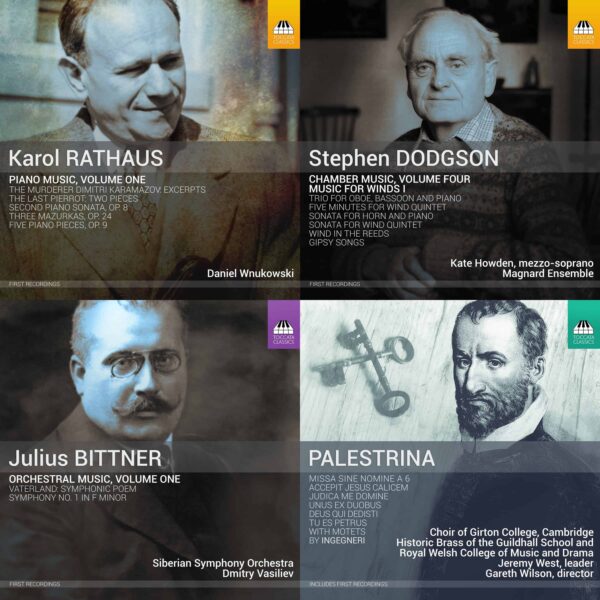
Karol Rathaus: Piano Music, Volume One

Karol Rathaus (1895–1954), born on the eastern fringes of the Austro-Hungarian Empire, was one of the myriad Jewish composers who had to abandon a successful career in Europe, where he wrote for stage, screen and concert hall, and flee to the USA; there he earned his living in academia, working in obscurity. This first recording of his piano music reveals a powerful and individual voice, where echoes of his distant homeland colour a musical language that is striking for its harmonic tension and rhythmic energy.
Daniel Wnukowski, piano
Listen To This Recording:
-
Fünf Klavierstücke, Op. 9 (1924)
- I Andante
- II Allegro
- III Andante
- IV Durchaus gemächlich
- V Presto
- I Allegro energico
- II Presto (rubato)
- III Andante con moto
- I Im Rhythmus einer Mazurka
- II Schnell, etwas flüchtig
- III Allegro vivace
- I Valse Sentimentale
- II Tanz der Arbeiter
- Lied der Gruschenka
- Lied vom weissen Schwan
- Bei den Zigeunern
Piano Sonata No. 2, Op. 8 (1924; rev. 1927)
Trois Mazurkas, Op. 24 (1928)
Zwei Stücke aus dem Ballet ‘Der letzte Pierrot’ (1926, arr. 1927)
Three Excerpts from the Film Music for Der Mörder Dimitri Karamasoff (‘The Murderer Dimitri Karamazov’; 1931)
MusicWeb International :
‘It’s Polish-Canadian Daniel Wnukowski who shoulders the filmic, ballet, sonata and other burdens in the recital and he proves a most able exponent, suggesting Rathaus’ vitality and also his more crabbed, harmonically aloof self. If anyone is going to write a booklet note on this subject, it’s Michael Haas.’
—Jonathan Woolf, MusicWeb International
Hoerbar :
‘Sie ist bei Daniel Wnukowski, der sich hörbar für Komponist und Œuvre engagiert, in besten Händen.’
English translation:
‘She is in the best hands with Daniel Wnukowski, who is clearly committed to the composer and his work.’
—Michael Kube, Hoerbar
Fanfare :
‘Daniel Wnukowski strikes me as an ideal advocate for this music. He is more than equal to its technical demands, and he brings subtle gradations of dynamics and shading to what could easily become an overwhelming welter of sound. More importantly, Wnukowski communicates the emotions within the music. I was moved at several points throughout the recital. Add Georg Burdicek’s expert sound engineering, which captures the full dynamic and color range of the Bösendorfer Imperial, into the mix, and this recording is a definite keeper. It is also a crucial addition to the library of anyone interested in interwar German music, Jewish composers, or music that packs an emotional wallop.’
—Myron Silberstein, Fanfare
American Record Guide :
‘These technically demanding works are played to the hilt by the Polish-Canadian Daniel Wnukowski. The booklet contains an essay by Michael Haas (producer of Decca’s Entartete Musik series and author of a fine book on Jewish composers banned by the Nazis), who points out that Rathaus’s earliest compositions were in a more conventional and accessible style. Regarding the present works, Haas aptly speaks of “abrasive Expressionism” and finds the sonata “brooding”, “apocalyptic” and demanding “unremitting brutality” from the pianist. It is to Wnukowski’s credit that he conveys the brutality without seeming brutal himself.’
—Bruno Repp, American Record Guide
Limelight :
‘Wnukowski plays with sympathetic understanding.’
—Limelight
Art Music Lounge :
‘To paraphrase the old Smuckers ad, if your name is Rathaus your product has better be good, but as it turns out Karl Rathaus, largely ignored for decades, was an awfully good composer. […]
As in the case of all his music, his harmonic language is modern but more bitonal than atonal. More importantly, he had a superb grasp of structure and, more importantly, was often an inspired composer whose music is full of surprises. […]
Despite [Klavierstücke’s] serious vein and brilliant construction, it is somehow entertaining at the same time, leading the attentive listener down unusual paths and alleys of the mind, and pianist Daniel Wnukowski clearly has the full measure of his intent and meaning under full control of his fingers. These are no shallow performances, but highly nuanced in a subtle manner. […]
As good as the Klavierstücke are, however, the second piano sonata is even better: more concise ideas, tighter structure and better development. […]
This is truly an outstanding CD. Rathaus continues to amaze me.’
—Lynn René Bayley, Art Music Lounge