Ronald Center: Instrumental and Chamber Music, Volume One
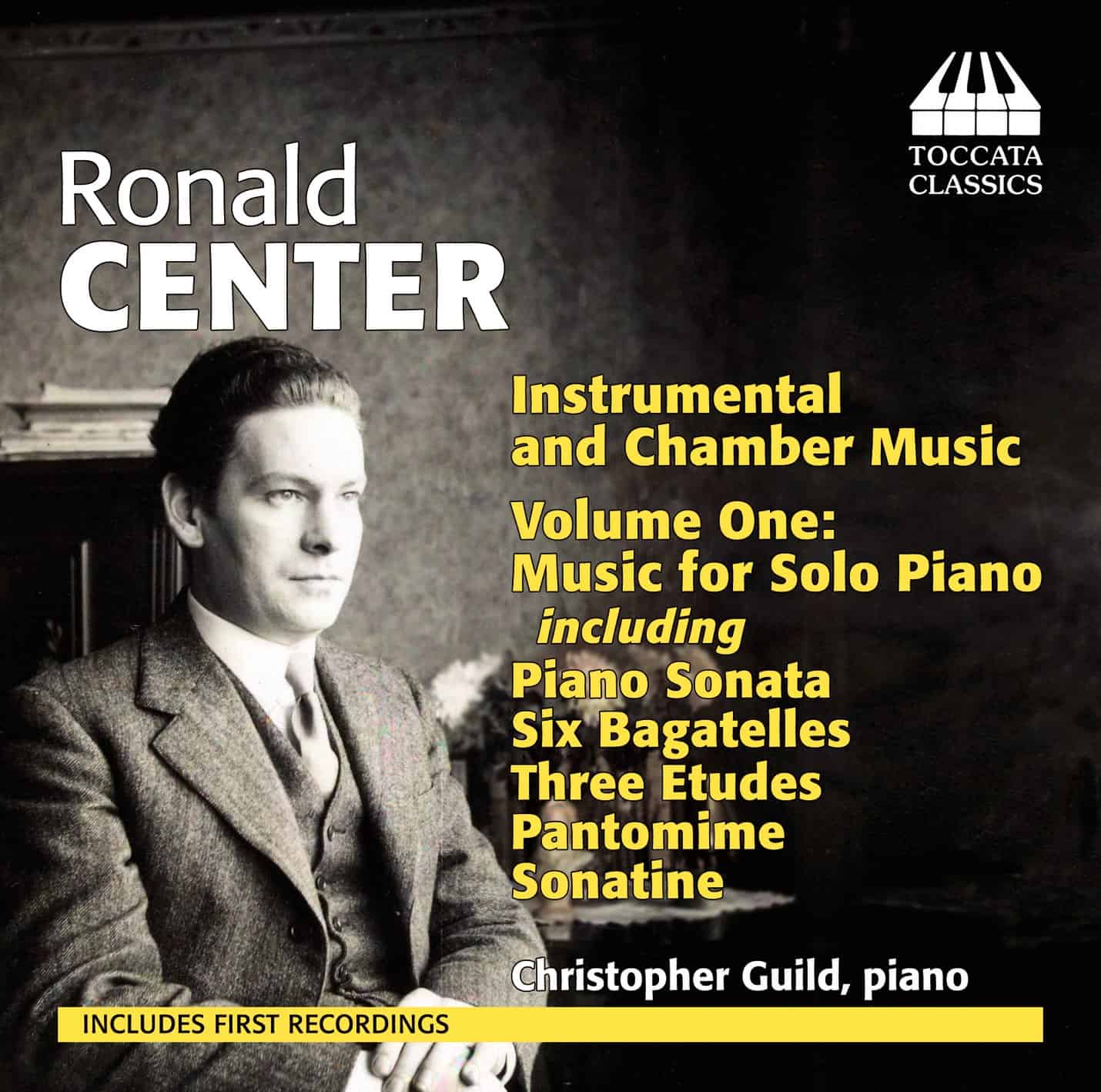
Ronald Center (1913-73) is sometimes described as 'the Scottish Bartók', and his music does indeed capture some of the wild energy of the Scottish landscape in a style of Bartókian asperity. It also shows affinities with the music of Busoni, Debussy, Prokofiev, Shostakovich and Vaughan Williams, absorbed into an individual style that is audibly Scots. Center wrote with striking concision and meticulous craftsmanship, his works encompassing a wide range of emotions — heart-felt sorrow, grim humour, relaxed lyricism, dark despair — in a crisp and succinct manner, animated by sharp wit and irony.
Christopher Guild, piano
Listen To This Recording:
-
Piano Sonata (c. 1958)
- I Allegro molto
- II Adagio
- III Andante – Presto ed appassionato – Allegro
- IV Molto allegro
- No. 1 Poco adagio e teneramente
- No. 2 Allegro
- No. 3 Mesto
- No. 4 Energico e ritmico
- No. 5 Andantino (tempo rubato)
- No. 6 Vivo
- Andante
- Sarabande
- Air
- No. 1 Pantaloon
- No. 2 Columbine
- No. 3 Harlequin
- Larghetto
- I Allegro
- II Poco adagio (tempo rubato)
- III Vivace
- Hommage
- No. 1 Presto
- No. 2 Andante
- No. 3 Allegro molto
- Impromptu
- No. 1 Prelude (Allegro)
- No. 2 Poco adagio
- No. 3 Toccata (Allegro molto)
Six Bagatelles, Op. 3
Pantomime (1950s)
Sonatine
Three Etudes
Three Movements for Piano
MusicWeb International :
‘…some bright spark did call him “The Scottish Bartók”. The notes suggest, quite wisely I feel, the “Scottish Prokofiev”… In fact the elusive Hommage is dedicated to the memory of Claude Debussy whom Center greatly loved indeed it has a touch of ‘Feux d’artifice’ about it towards the end. …There is much here to attract the attention and maintain emotional and musical interest. …This is a well recorded disc with a bloom but a natural sound. The Scottish pianist Christopher Guild is a fine advocate for this music.’
—Gary Higginson, MusicWeb International
The Cross-Eyed Pianist :
‘…There are intimations of the percussive spikiness of Prokofiev, the folk idioms and harmonies of Bartok, the simplicity of Poulenc, the wit and humour of Shostakovich, and the sensuality and stately parallel harmonies of Claude Debussy (in a work entitled ‘Hommage’ which is dedicated to Debussy). Hints of Scottish airs make intriguing appearances in the music, reminding us of the composer’s heritage… An excellent introduction to Ronald Center’s oeuvre.’
—Frances Wilson, The Cross-Eyed Pianist
Diapason :
‘Christopher Guild plays with clarity, an assured touch and the capacity to capture the atmosphere of each piece.’
— Diapason
Fanfare Magazine :
‘This is a very enjoyable recital… The program notes refer to Center at the Scottish Bartók, but I would characterize his use of native folk music more along the genial, but still adventuresome, manner of Grieg. Yes, there is some spikiness here and there, but mainly Center’s music is brisk, rich, and tuneful. …Much of the music, even the smaller pieces, sounds highly virtuosic, and so hats off to the superb young Scottish pianist Christopher Guild for taking this on.’
—Peter Burwasser, Fanfare Magazine
MusicWeb International :
‘All this music is played by Scottish pianist Christopher Guild. It is a superb performance from start to finish. He captures the imaginative style of Ronald Center’s music, especially in the contrasting ‘catastrophe’ section. The sound quality is ideal.
I enjoyed every piece on this CD. I do not know why I missed this release back in 2013 but am exceptionally glad to have caught up with it in the dying days of 2019. The cover of the CD states that this is Volume 1 of Ronald Center’s ‘Instrumental and Chamber Music’: seven years later, we are still awaiting Volume 2. Roll on…’
—John France, MusicWeb International
American Record Guide :
[The Sonata is] a strong, well-made showpiece with cascading, propulsive allegros surrounding two idiosyncratic slow movements, the first an atmospheric nocturne that builds a long, gravel-treading melodic line into a climactic restatement introduced by a halo of arpeggios, the second a quiet, involute canon that becomes encrusted with vehement, fastsnapping ornaments before spinning up into a boldly vaulting fugue to bring this initially introverted andante to a stirring conclusion. There’s not a wasted note in this sonata, and though concise it feels “big” both in sound and scale, encompassing considerable substance and variety.
Of the shorter works some are lively trifles, though even these display Center’s penchant for tangy bitonal harmonies. Many of the slower numbers are wistful and some quite beautiful. ‘Columbine’, from the 5-minute triptych Pantomine, and ‘Larghetto’, a 3-minute singleton, are lovely miniature dream-visions. This is one of those collections where each time one listens to it, one finds more to like. And with 28 tracks, there’s a lot to like here.’
—American Record Guide
MusicWeb International :
‘The music is immensely impressive and will surely enhance Center’s status as a composer of real significance. […]
Stylistically, many names have been invoked as sources for Center’s own style: and when dealing with a composer whose sophistication is marked by satire, that can be an entertaining area of research. But somehow through it all there is a very individual voice and one to be respected as well as enjoyed.
So what of the performances? They are excellent, thoroughly idiomatic and responsive to the variety of mood. The piano sound has depth as well as immediacy and Guild’s handling is always totally assured. He remarks on the difficulties ensuing from Center’s parsimony with dynamic markings and the absence of any performing tradition. These, however, can be construed as advantages and, in any case, Center’s music is eminently approachable. It has its mysteries and its uninhibited varieties, but the intention is always clear, the thought lucid.
Were one to be greedy and ask for anything more from the performances it might be for even greater volatility. The music itself is highly volatile, so much so that it asks for exaggeration – but then there would be a danger of slipping into vulgarity and, despite all the wit and irony of this music, it is never ever, not for one instant, vulgar. So hats off to Christopher Guild for steering an intriguing course through a whirlpool of inventiveness.
—John Purser, MusicWeb International