Livia Teodorescu-Ciocănea: Music for Voices and Orchestra
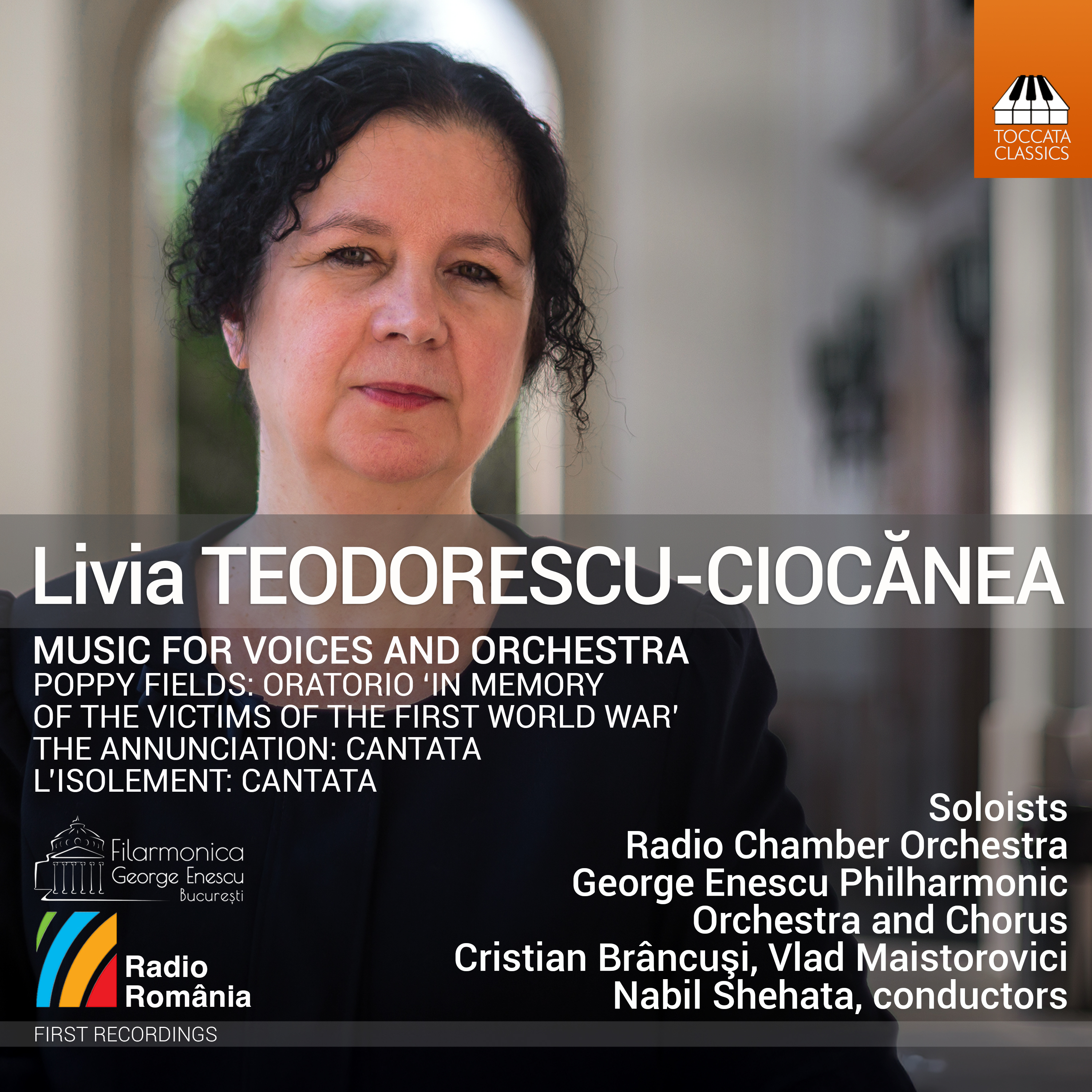
The composer and pianist Livia Teodorescu-Ciocănea, born in Galați, eastern Romania, in 1959, brings together ancient and modern in her music: echoes of the modal sounds of Romanian folk-music blend with considerations of timbre to generate a palette of colours that is both contemporary and ageless. All three works here use the voice – solo and in chorus – to touch on aspects of the human condition, suggesting both drama and ritual.
George Enescu Philharmonic Orchestra & Chorus
Radio Chamber Orchestra
Iosif Ion Prunner, chorus master
Cristian Brâncuși
Vlad Maistorovici
Nabil Shehata
Listen To This Recording:
- L’Isolement: Cantata for Two Sopranos and Orchestra, Op. 80 (2024)* (19:50)
Bunavestire (‘The Annunciation’): Cantata for Bass, Soprano, Four Horns and String Orchestra, Op. 23 (1997) (22:44)
- I. Pietà (8:25)
- II. The Annunciation (14:19)
Poppy Fields: Oratorio for Baritone, Tenor, Mezzo-Soprano, Mixed Choir and Full Orchestra, in memory of the victims of the First World War, Op. 65 (2018)* (25:27)
- I. Big Ben at Eleven – Declaration of War (7:21)
- II. In Flanders Fields
- V. Prayer of Queen Marie for the Dead (9:04)
First Recordings
*Live
Sonograma :
‘Music for Voices and Orchestra de la compositora romanesa Livia Teodorescu‑Ciocănea proposa una immersió intensa i exigent en un univers sonor on la veu humana esdevé tant vehicle expressiu com matèria musical integrada dins l’orquestra. En aquestes obres que aplega aquest nou àlbum, l’escriptura és densa, simbòlica i profundament reflexiva, amb una tensió constant entre dramatisme, espiritualitat i memòria col·lectiva. Teodorescu-Ciocănea construeix grans arcs expressius a partir del color, del gest vocal fragmentat i d’una orquestració que alterna moments de transparència quasi ritual amb masses sonores de gran càrrega emocional.
Les veus solistes assumeixen un paper central i ho fan amb una implicació artística notable. Diana Țugui i Teodora Gheorghiu aporten contrast i complementarietat a L’Isolement ( ′L’aïllament′), amb una dicció clara i una capacitat notable per transitar entre la fragilitat íntima i l’expressió dramàtica. Mariana Colpoș, amb un timbre profund i auster, dota Bunavestire ( ′L’Anunciació′)d’un caràcter gairebé litúrgic, reforçat per la solidesa expressiva de Pompei Hărășteanu. A Poppy Fields (′Camps de roselles′) , Antonela Barnat, George Vîrban i Adrian Mărcan contribueixen decisivament a crear un paisatge sonor marcat pel dolor, la commemoració i el pes històric del text, amb intervencions que oscil·len entre el lament contingut i l’exclamació tràgica.
El suport orquestral és fonamental, i la George Enescu Philharmonic Orchestra & Chorus ofereix una lectura compromesa, atenta als matisos tímbrics i a les complexes superposicions rítmiques i harmòniques que exigeix la partitura. El cor actua com a consciència col·lectiva, ampliant l’impacte emocional de les obres. La direcció de Cristian Brâncuşi, Iosif Ion Prunner i Vlad Maistorovici (cadascun en les diferents obres) garanteix coherència, tensió dramàtica i una lectura clara d’un llenguatge musical complex, sense perdre mai de vista l’equilibri entre veu i orquestra.
Aquest enregistrament és una proposta artística ambiciosa, tenint en compte que la música romanesa ocupa un lloc poc destacat en les programacions actuals. Amb aquest disc, avalat per una llarga trajectòria creativa, Livia Teodorescu-Ciocănea es reafirma com una de les veus més personals i profundes de la creació contemporània romanesa.’
English translation;
‘The album Music for Voices and Orchestra by the Romanian composer Livia Teodorescu-Ciocănea offers an intense and demanding immersion into a sound world where the human voice serves both as an expressive vehicle and as musical material fully integrated into the orchestra. The works gathered in this new album feature dense, symbolic, and deeply reflective writing, with a constant tension between dramatism, spirituality, and collective memory. Teodorescu-Ciocănea constructs large expressive arcs using timbre, fragmented vocal gestures, and orchestration that alternates between moments of near-ritual transparency and massive sound blocks charged with great emotional weight.
The solo voices take on a central role and do so with remarkable artistic commitment. Diana Țugui and Teodora Gheorghiu bring contrast and complementarity to L’Isolement (‘The Isolation’), with clear diction and a notable ability to shift between intimate fragility and dramatic expression. Mariana Colpoș, with her deep and austere timbre, imbues Bunavestire (‘The Annunciation’) with an almost liturgical character, reinforced by the expressive solidity of Pompei Hărășteanu. In Poppy Fields (‘Fields of Poppies’), Antonela Barnat, George Vîrban, and Adrian Mărcan contribute decisively to creating a soundscape marked by pain, commemoration, and the historical weight of the text, with interventions that oscillate between restrained lament and tragic exclamation.
The orchestral support is fundamental, and the George Enescu Philharmonic Orchestra & Chorus deliver a committed performance, attentive to timbral nuances and the complex rhythmic and harmonic superimpositions demanded by the score. The chorus acts as a collective consciousness, amplifying the emotional impact of the works. The conducting by Cristian Brâncuși, Iosif Ion Prunner, and Vlad Maistorovici (each leading different pieces) ensures coherence, dramatic tension, and a clear reading of a complex musical language, never losing sight of the balance between voice and orchestra.
This recording is an ambitious artistic proposal, especially considering that Romanian music occupies a relatively marginal place in current programming. With this disc, backed by a long creative trajectory, Livia Teodorescu-Ciocănea reaffirms herself as one of the most personal and profound voices in contemporary Romanian creation.’
—Marçal Borotau, Sonograma