Mieczysław Weinberg: Complete Violin Sonatas, Volume One
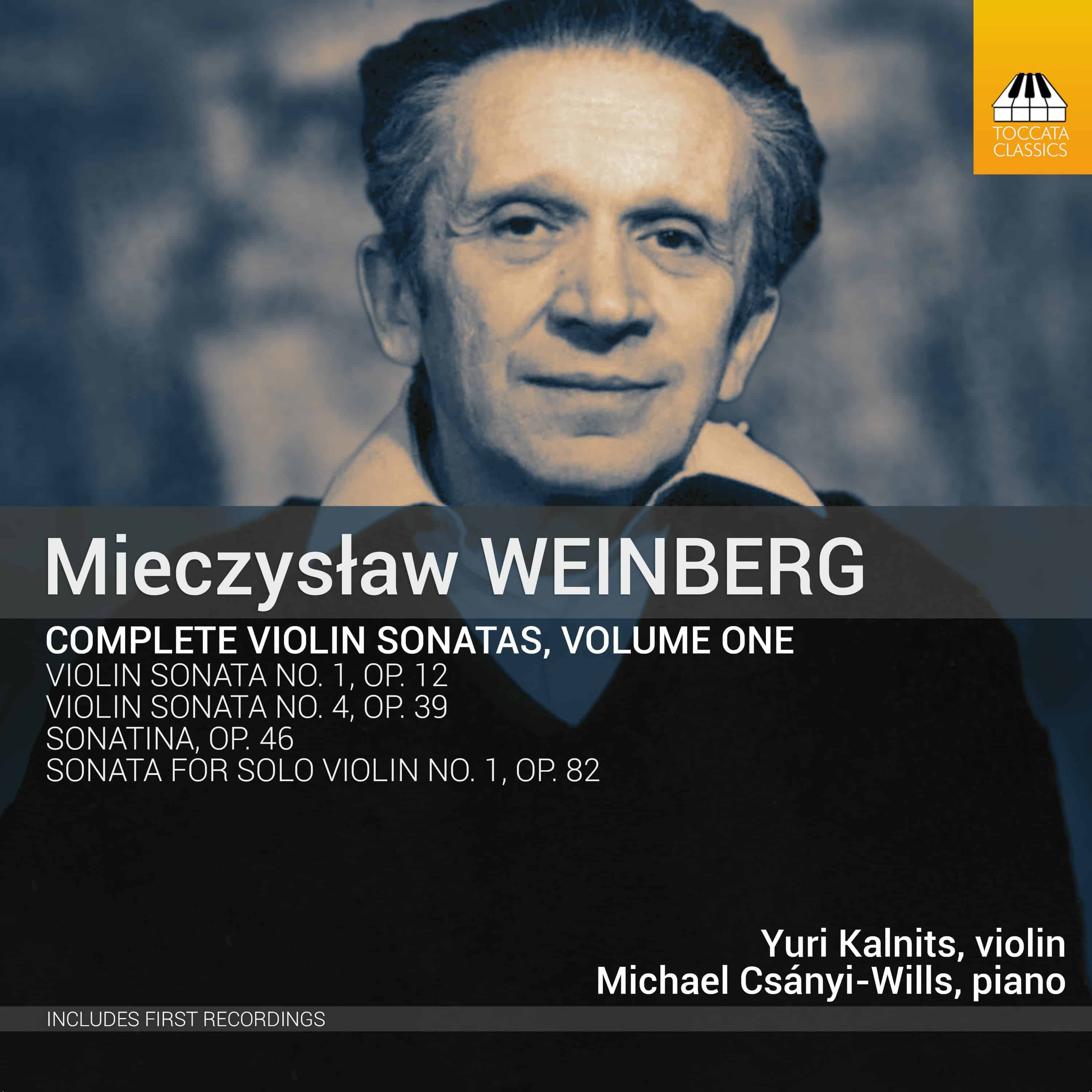
Mieczysław Weinberg, born in Warsaw in 1919, became a close friend of Shostakovich in Moscow, after fleeing eastwards before the invading Nazis in 1939. His vast output includes 26 symphonies, seven operas, seventeen string quartets and much other chamber music and some 200 songs. His style has much in common with Shostakovich, as these four violin works show: fluent contrapuntal skill, a keen feeling for melody, often inflected with Jewish cantilena, and an acute sense of drama which combines a natural narrative manner with an extraordinary ability to create atmosphere, often from just a handful of notes. Since his death in 1996, his music is being discovered by musicians and listeners all around the world.
Yuri Kalnits, violin
Michael Csányi-Wills, piano
Listen To This Recording:
-
Sonata No. 1 for Violin and Piano, Op. 12
- I. Allegro
- II. Adagietto
- III. Allegro
- I. Adagio – Allegro – Adagio
- II. Andante
- III. Allegretto
- IV. Lento
- V. Presto
- I. Adagio –
- II. Allegro ma non troppo – Adagio tenuto molto rubato (quasi Cadenza) – Adagio primo
- I. Allegretto
- II. Lento – Allegro – Tempo Primo
- III. Allegro moderato – Lento
Sonata No. 1 for Violin Solo, Op. 82
Sontata No. 4 for Violin and Piano, Op. 39
Sonatina for Violin and Piano, Op. 46
Classical Music Sentinel :
‘a work of deep lyrical beauty…Highly recommended!’
—Jean-Yves Duperron, Classical Music Sentinel
MusicWeb International :
‘The Sonata No. 1 for solo violin, Op. 82, is something else again, a brutally difficult technical tour de force with all of the violin’s resources, including quadruple stops, deployed in the service of a unique, unrelenting quality.’
—James Manheim, MusicWeb International
Fanfare Magazine :
‘The release should provide a most auspicious introduction to Weinberg’s violin music, offering a chameleon-like variety that extends from the feral onslaught of the Solo Sonata to the profundities of the Fourth Sonata and to the outright melodiousness of the First. Strongly recommended for repertoire, performances, and recorded sound.’
—Robert Maxham, Fanfare Magazine
Gramophone :
‘Yuri Kalnits and Michael Csányi-Wills prove uber-sensitive to Weinberg’s harmonic push-pull, and Kalnits’s performance of the Sonata No 1 for Violin Solo (1964) rolls with the technical punches like a true heavyweight…’
—Philip Clark, Gramophone
MusicWeb International :
‘This is an extremely good start to the projected series.’
—Jonathan Woolf, MusicWeb International
music-weinberg.net :
‘ Yuri Kalnits performs these towering accomplishments with much passion and aplomb, sometimes sounding a little improvisatory, but never mannered. Repeated listening reveals the depth and insight which Kalnits brings to the music.’
—music-weinberg.net
Art Music Lounge :
‘The fact is that Yuri Kalnits has a much firmer, richer tone, more like Leonid Kogan or David Oistrakh, both violinists who Weinberg knew and wrote for. Indeed, I even liked pianist Michael Csányi-Wills’ powerful, more aggressive playing better than Andreas Kirpal’s. […]
I just couldn’t stop listening to Kalnits play this music. It had a sweep, and passion, that just caught me up and transported me…an effervescence, if you will, that bespeaks a performer who doesn’t just like this music but loves it, and wants all his hearers to love it, too. […] In Weinberg’s music, no matter how subtle or technical the demands are on the performer, inevitably it is the emotion of the music that combines with the form to produce an effect on one’s receptors, and in this respect I find Kalnits far superior. […]
Weinberg just had so many ideas and musical devices at his fingertips that he was able to create his own sound-world and somehow make it relevant to listeners who were not inside his head. Pure genius… […]
—Lynn René Bayley, Art Music Lounge
Opus Klassiek :
‘Ik ben het zeker met Dijkstra eens dat de beide musici excelleren in een onopgesmukte weergave van deze partituren . Partituren die niet los gezien kunnen worden van Weinbergs moeilijke leef- en werkomstandigheden als joodse vluchteling in de toenmalige Sovjet-Unie. Tegen deze achtergrond zijn het – gelukkig! – geen vertolkingen geworden die de musici hebben verleid tot – het ligt wel degelijk voor de hand – exessieve uitvergroting ervan. Wat trouwens ook voor het werk van Dmitri Sjostakovitsj behoren te gelden: laat de muziek voor zich spreken, eenvoudig gezegd. Dat het altijd de voorkeur verdient om te streven naar wat in feite niet bestaat: pure authenticiteit. Omdat alleen al dat streven voldoende is om expressieve uitwassen te voorkomen. Dat is, afgezien van zoveel andere aspecten, wat deze vertolkingen zo buitengewoon fascinerend en tegelijkertijd innemend maakt. Er is wat dit betreft een duidelijk parallel met de literatuur (denk, om bij Rusland te blijven, aan bijvoorbeeld het werk van Varlam Sjamalov en Konstantin Paustovski). Bovendien: Weinberg componeerde in een heldere, (vrij) toegankelijke stijl die het absoluut niet moet hebben van siervuurwerk of welke maniertjes ook. Van dat besef zijn deze uitvoeringen van begin tot eind doordesemd. […]
Weinbergs beladen muzikale scheppingen komen in deze uitvoeringen door het duo Kalnits-Csányi-Wills wel heel overtuigend tot leven. Zoals eigenlijk reeds gezegd: de indrukwekkende zeggingskracht ervan schuilt niet in gezochte expressieve nadruk maar in de nagestreefde objectiviteit. […]
Of het muzieklabel Toccata later een 4-cd-set zal uitbrengen moet uiteraard worden afgewacht, maar het lijkt mij zo dat de echte liefhebber daarop niet zal wachten.’
English translation:
‘I certainly agree with Dijkstra that both musicians excel in an unadorned rendition of these scores. Scores that cannot be viewed separately from Weinberg’s difficult living and working conditions as a Jewish refugee in the then-Soviet Union. Against this background, these interpretations—fortunately!—did not tempt the musicians to—it is indeed obvious—excessively exaggerate them. What should also apply to the work of Dmitri Shostakovich, by the way: let the music speak for itself, simply put. That it is always preferable to strive for what does not actually exist: pure authenticity. Because that striving alone is enough to prevent expressive excesses. That, apart from so many other aspects, is what makes these interpretations so extraordinarily fascinating and simultaneously engaging. In this respect, there is a clear parallel with literature (think, for example, of the work of Varlam Shamalov and Konstantin Paustovsky, to stay with Russia). Moreover, Weinberg composed in a clear, (relatively) accessible style that absolutely relied on no ornamental flourishes or any mannerisms whatsoever. This awareness permeates these performances from beginning to end. […]
Weinberg’s emotionally charged musical creations come to life quite convincingly in these performances by the Kalnits-Csányi-Wills duo. As already mentioned, their impressive expressiveness lies not in forced expressive emphasis, but in the desired objectivity. […]
Whether the music label Toccata will later release a 4-CD set remains to be seen, of course, but it seems to me that true music enthusiasts won’t be waiting for that.’
—Aart van der Wal, Opus Klassiek
International Record Review :
‘Kalnits, whose technique and musicality are tested to the limit in this utterly uncompromising Solo Sonata, proves a superb exponent of Weinberg’s violin writing. His rich and noble tone and range of colour are matched by an intense sympathy and identification with the composer’s undoubtedly complex musical personality.’
—International Record Review
AllMusic :
‘Russo-British violinist Yuri Kalnits handles the challenges of this work with ease and genuinely seems to enjoy Weinberg’s music.’
—James Manheim, AllMusic