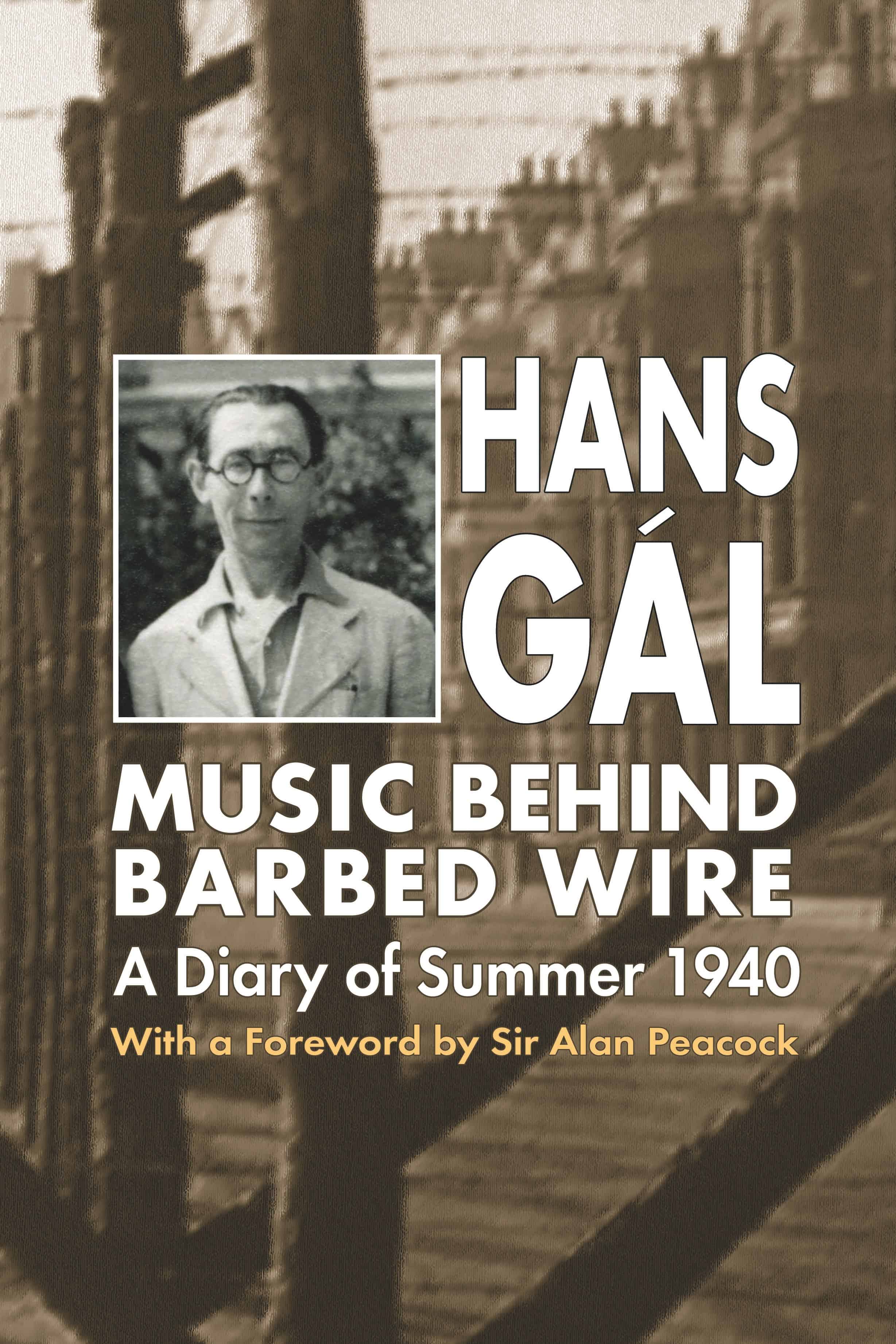
Hans Gál: Music behind Barbed Wire: A Diary of Summer 1940
Discovery Club Members save even more!
Login or Join Today
Translated by Eva Fox-Gál and Anthony Fox
English edition edited by Martin Anderson
Foreword by Sir Alan Peacock
Extant: 243
Composition: Royal octavo ~ Editorial Introduction ~ Eva Fox-Gál: ‘Hans Gál: A Biographical Introduction’ ~ Richard Dove: ‘”Most Regrettable and Deplorable Things have Happened”: Britain’s Internment of Enemy Aliens in 1940’ ~ Hans Gál: Music behind Barbed Wire ~ Eva Fox-Gál: ‘Gál in Britain’ ~ Appendices – One: Personalia; Two: CD Programme; Three: Martin Anderson: Hans Gál in Conversation; Four: The Hans Gál Society; Five: The Contributors ~ Bibliography ~ Index of Gál’s Works ~ General Index
Illustrations: c. 50
The Austrian-born composer Hans Gál (1890–1987) was one of many Jewish refugees who fled to Britain from Hitler’s Third Reich only to find themselves interned in prison camps in Britain as ‘enemy aliens’ – the result of Churchill’s panic decision to ‘collar the lot’ in fear of a ‘fifth column’ of Nazi sympathisers. Gál thus spent five months over the summer of 1940 in internment camps – first in Donaldson’s Hospital in Edinburgh, then at Huyton, near Liverpool, and finally in the Central Promenade Camp on the Isle of Man.
The diary Gál kept during his captivity, a vivid and very human account of personal survival and creativity in extraordinary circumstances, is a monument to the human spirit. Many of his fellow internees went on, like Gál himself, to become shaping forces in the intellectual life of Britain – but in captivity this colourful array of distinguished personalities had to put up with bureaucratic inertia and the indifference of their captors to their undeserved fate. They emerge from the pages of the diary like characters in a tragi-comic human drama.
Gál’s contribution, of course, was music, and the CD with this book presents recordings of the Huyton Suite he wrote for two violins and flute (the only instruments available to him), songs from the satirical review What a Life! composed on the Isle of Man and the piano suite he drew from it.
A biographical introduction to Hans Gál by his daughter, Eva Fox-Gál, and a general historical introduction to British internment policy by Professor Richard Dove provide a framework for the diary; the Foreword is by the distinguished economist, the late Sir Alan Peacock, who studied composition with Gál. Together they throw light on one of the more shameful British responses to the threat of Nazi invasion.
Hans Gál, born near Vienna in 1890, soon established himself as one of the foremost composers of his time, particularly following the decisive success, in 1923, of Die heilige Ente, the second of his four operas, which was staged in many major European opera houses until it was banned by the Nazis. In 1929 he was appointed Director of the Music Academy in Mainz, but was summarily dismissed after Hitler’s seizure of power in 1933. Returning to Vienna, Gál and his family again had to flee with the Anschluss in March 1938, to London. There an encounter with Sir Donald Tovey brought him to Edinburgh where – apart from the five months of internment as an ‘enemy alien’ documented in this diary – he spent the rest of his life, a much-loved and active composer, teacher, author and musical personality. He died in October 1987, aged 97. At the time of his death his music had fallen from sight, but in recent years a revival in interest has seen frequent performances, broadcasts and recordings of much of his substantial output, including symphonies, concertos, chamber music and a range of solo works, revealing a master craftsman with a distinctive voice.
Patrick :
The generation of British “babyboomers”, to which I belong, were brought up to believe that Britain held all the moral high ground in the Second World War. So it may come as a bit of a surprise to some prospective purchasers of this book to find out that the British interned or deported many thousands of “enemy aliens”, most of whom were already victims of Nazi oppression. Fortunately the government came to their senses long before the end of the war but not before Hans Gal, an Austrian composer who had fled Vienna for Edinburgh in 1938, had been interned for five months. The centrepiece of this book is his diary of those months in the summer of 1940 and it makes for compelling reading.
Whilst interned in Huyton near Liverpool, Gal wrote a suite for the unusual combination of the flute and two violins. This and the music he later wrote for the “Camp Revue” on the Isle of Man are presented on a CD produced by his grandson which is attached to the back cover. Whilst not on the level of Messiaen’s Quartet for the End of Time (which was written in a Nazi prisoner of war camp and was also constrained by the instruments available), the music is worth hearing in the context of reading the book. Quite a bit of Gal’s music has now been justifiably revived on disc and is well worth getting to know. The cello music linked from this page is a good place to start and may whet the appetite for the four symphonies, concertos for violin and cello, four string quartets and some excellent piano music which are available on other labels.
Framed by biographical and relevant historical information, and with several useful appendices, this is a beautifully presented book and I recommend it very strongly indeed, and not only to “babyboomers”.
Patrick Waller
Spirited :
‘Readable, often witty and informative. This book is completely successful in providing a significant introduction to a remarkable, but largely forgotten and ignored composer […] an important addition to the music enthusiast’s library.’
—Spirited
Musical Times :
‘Biographies have appeared over the years and performances help to focus what this new book’s blurb correctly calls the ‘distinctive voice’ of a ‘master craftsman,’ here illustrated with a CD of strikingly graceful music […] The diary is fascinating, detailed, informative and indeed unique.’
—Musical Times
TLS :
‘This is an important resource for musicians and historians […] it is a welcome addition to the life and work of Hans Gál, who is finally being recovered as a lost master of the twentieth century.’
—TLS
BBC Music Magazine :
‘Five Starts
Hopefully, this volume will inspire someone to undertake a much needed full-length biographical study of an underrated composer.’
—BBC Music Magazine
Gramophone :
‘[An] invaluable book […] A mine of information throughout, the core of the book is Gál’s diary, written in a lively and eminently readable style.’
—Gramophone
Classical Music :
‘Five Stars
[Hans Gál’s] diary is typically insightful, witty and richly detailed, written in a vivid and engaging style that translates well and grips the reader […] Eva Fox-Gál provides an excellent biographical essay of her father’s life […] An essential volume on this fascinating composer, and actually the first to appear in English. Unreservedly recommended.’
—Classical Music
Gramophone :
‘A mine of information throughout, the core of the book is Gál’s diary, written in a lively and eminently readable style. He emerges as a likeable and immensely capable character, aware of his own mettle yet wearing it lightly, and quite free from the pretensions of grandeur.’
—Gramophone
Classical Music Magazine :
‘This remarkable book presents a fine translation of the diary kept by Austrian composer Hans Gál during his internment in the summer of 1940, after he had fled Nazi-occupied Europe with his family […] His diary is typically insightful, witty and richly detailed, written in a vivid and engaging style that translates well and grips the reader. […] one of the joys of this book is a free accompanying CD which presents fine recording of the works he created […] This is music of such optimism and invention, that it is scarcely credible it was created under such duress. It deserves wider currency. […] Unreservedly recommended.’
—Brendan G Carroll, Classical Music Magazine
Music & Letters :
‘[…] the volume is a treasure trove, lavishly furnished with appendices that total almost as many pages as Ga¤ l’s text itself. In addition to Dove’s useful overview of the internment of ‘enemy aliens’, the editor, Eva Fox-Gal, Gal’s daughter, has gathered over forty useful short biographies, mostly of fellow internees, and has also written the two biographical sections (after and before the internment) that flank the translation of Gal’s diary. Alan Peacock and Walter Kellermann have contributed personal memoirs of their friendship with Gal, and there is a reprint of an interview with Ga¤ l first published in 1987, less than a year before his death. And there is the CD, too. The star of the show is, of course, the translated diary itself. For anyone interested in British twentieth-century music, displaced music, or music in times of war, this is essential reading.’
—Florian Scheding, Music & Letters, 2016