Singing Into Space: Spatially Conceived Music for Men’s Voices
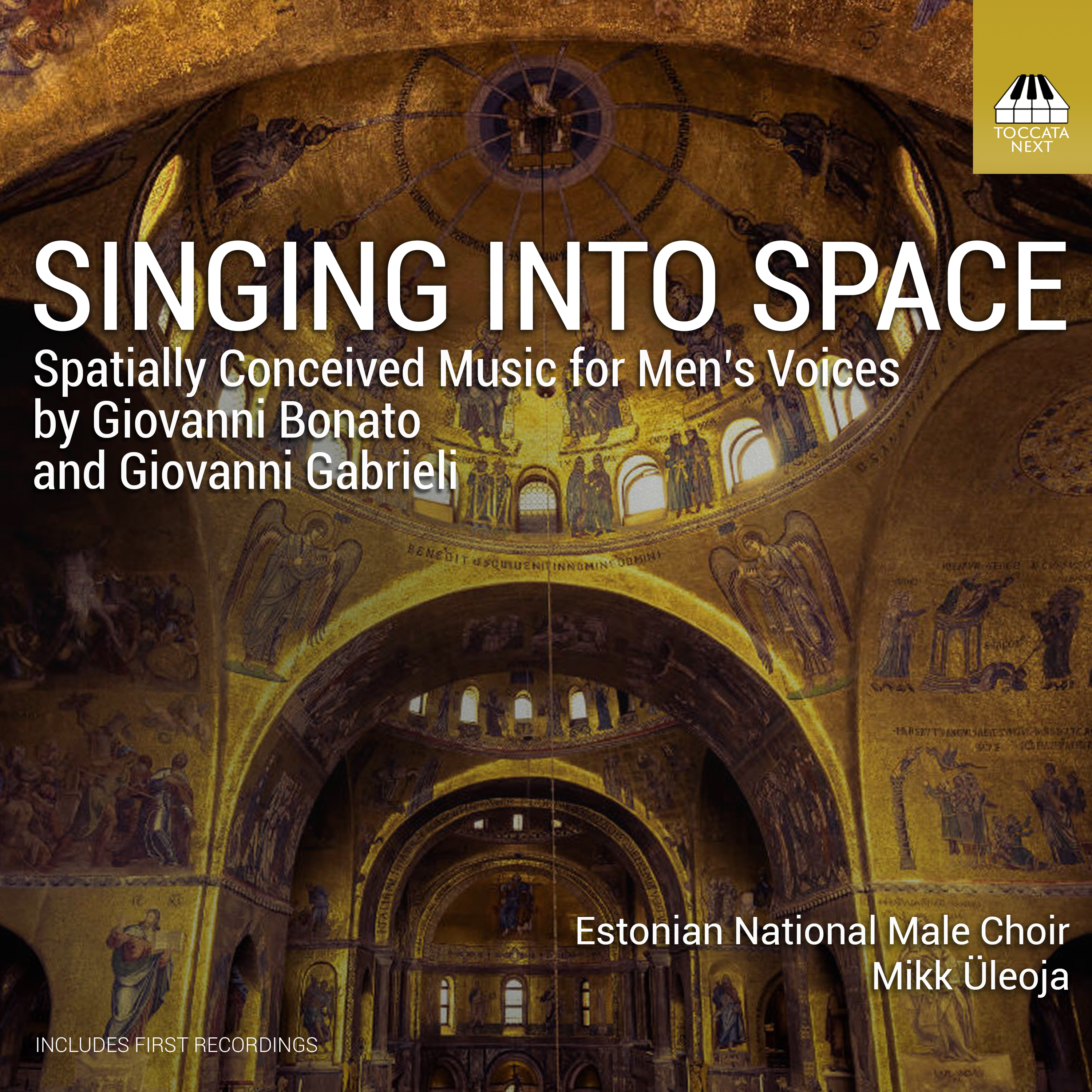
The two composers heard on this album, Giovanni Gabrieli (1553–1612) and Giovanni Bonato (born in 1961) have more in common than their first names: both hail from the Veneto in north-east Italy – there is no documentation of Gabrieli’s birth, but he was probably Venetian, and Bonato was born in nearby Schio. Their music, too, is conceived in terms of its sound in space, with Gabrieli using the cori spezzati that sang from the opposing galleries of St Mark’s Basilica in Venice, and Bonato employing cori spazzializati to build a spatial dimension into the music itself. Juxtaposed, their styles offer a striking contrast, with Gabrieli’s bold declamations set against Bonato’s shifting, timeless suspensions.
Estonian National Male Choir
Mikk Üleoja, conductor
Giovanni Bonato
- Tenebrae factae sunt (2005)* (5:27)
Giovanni Gabrieli
- Exude Deus (publ. 1597) (3:28)
Giovanni Bonato
- Crux fidelis (2001) (9:21)
Giovanni Gabrieli arr. Kruusimäe
- Regina caeli (publ. 1597)** (2:05)
Giovanni Bonato
- O lilium convallium for two cellos and male choir (2008) (8:12)
Giovanni Gabrieli arr. Kruusimäe
- Maria virgo (publ. 1597)** (3:45)
Giovanni Bonato
- Stetit angelus (1995) (11:39)
Giovanni Gabrieli arr. Kruusimäe
- Buccinate in neomenia tuba (publ. 1615)** (3:26)
Giovanni Bonato
- Signum magnum for cello and male choir (2005)* (1:32)
- Genuit puerpera for male choir and tenor soloists (2009) (2:50)
*First Recordings
**First Recordings in these Versions
Fanfare :
‘The performances are splendid, all serving as demonstration of the strong choral tradition in Estonia. […] As usual, Toccata’s production standards are of very high quality. Full texts and translations, excellent notes, and clear, full-bodied recorded sound.’
—Henry Fogel, Fanfare, Jan 2026
Fanfare :
‘These are fine arrangements, and though quite similar in terms of sound, they do outline Gabrieli’s textural contrasts in terms of motivic sequencing. […]
[Tenebrae factae ] is almost magical in terms of sound, mesmerizing and yet contemplative. […]
[Bonato’s music] is mesmerizing on one hand, and calming and pensive on the other. The Estonian Men’s Chorus contributes to this music with a resonant and tightly controlled sound, really almost a sound wave, which is precisely what is required. The result is largely an out-of-body experience, where time is suspended, where the vastness of the spatial soundscape absorbs one, and where one can immerse oneself in a universe that is almost unearthly. Obviously, this is not for everyone, and the Gabrieli does serve as a sort of foil for Bonato, but for contemplation, I find this music eminently suitable.’
—Bertil van Boer, Fanfare, Jan 2026
Fanfare :
‘The choir separates syllables to make a mobile, chugging background to the slower unfoldings above [in Bonato’s O Crux fidelis]. This is highly imaginative, and highly effective; Bonato’s techniques are laudably simple, and that bell is beautifully recorded. There is a sort of Arvo Pärt atemporality about this in that the music is both modern and ancient but, dare I say, deeper than that composer’s music. […]
Consonant harmonic arrival points emerge naturally, the purity a testament to the Estonian choir’s tuning abilities, particularly in the musical approaches. […]
There are no words to describe Tammesalu’s excellence in this performance; some of the finest cello playing I have heard, period. […]
A fascinating experience. The disc should ideally be listened to through in one sitting, with an idea of comparing and contrasting the two composers and their responses to these revered texts. Toccata Classics does it again: a confluence of excellence in performance, recording, and documentation, this is shortlisted for my next Want List.’
—Colin Clarke, Fanfare Jan 2026
Fanfare :
‘The recorded sound on Singing Into Space is impressive, brilliantly conveying the experience of grand voices resounding throughout a majestic, resonant, and colorful acoustic. […]
Bonato is ever respectful of the natural beauty and expressive potential of the human voice. And he is also sensitive to the dramatic flow and import of the sacred texts. The composer’s use of additional sonic elements, including bells, cellos, and glass harmonica, is achieved in a tasteful, compelling manner. In short, Bonato’s choral works are a fitting modern partner to Gabrielli’s masterworks.
The Estonian Male Choir sings gloriously, with a superbly blended, opulent sonority, and an admirable wealth of dynamics and colors. A pleasing disc, one I’m delighted to recommend.’
—Ken Meltzer, Fanfare, Jan 2026
Fono Forum :
‘
‘Musik: 4.5 / Klang: 4
[…]So gut die Werke, das Konzept des Albums und vor allem die Leistung des Chores sind: Hier hätte man sich eine Super-AudioAufnahme gewünscht, die die Effekte des Raumklangs noch besser in Szene gesetzt hätte.’
English translation:
”Music: 4.5 / Sound: 4
[…]As good as the pieces, the concept of the album, and especially the choir’s performance are: A superior audio recording would have been desirable here, one that would have showcased the spatial sound effects even better.’
—Burkhard Schäfer, Fono Forum, Feb 2026
American Record Guide :
‘The singing is fine, the engineering is terrific, and the program notes are helpful.’
—Philip Greenfield, American Record Guide, Jan 2026