Francesco Nicola Fago: Cantatas and Ariettas for Solo Voice and Continuo
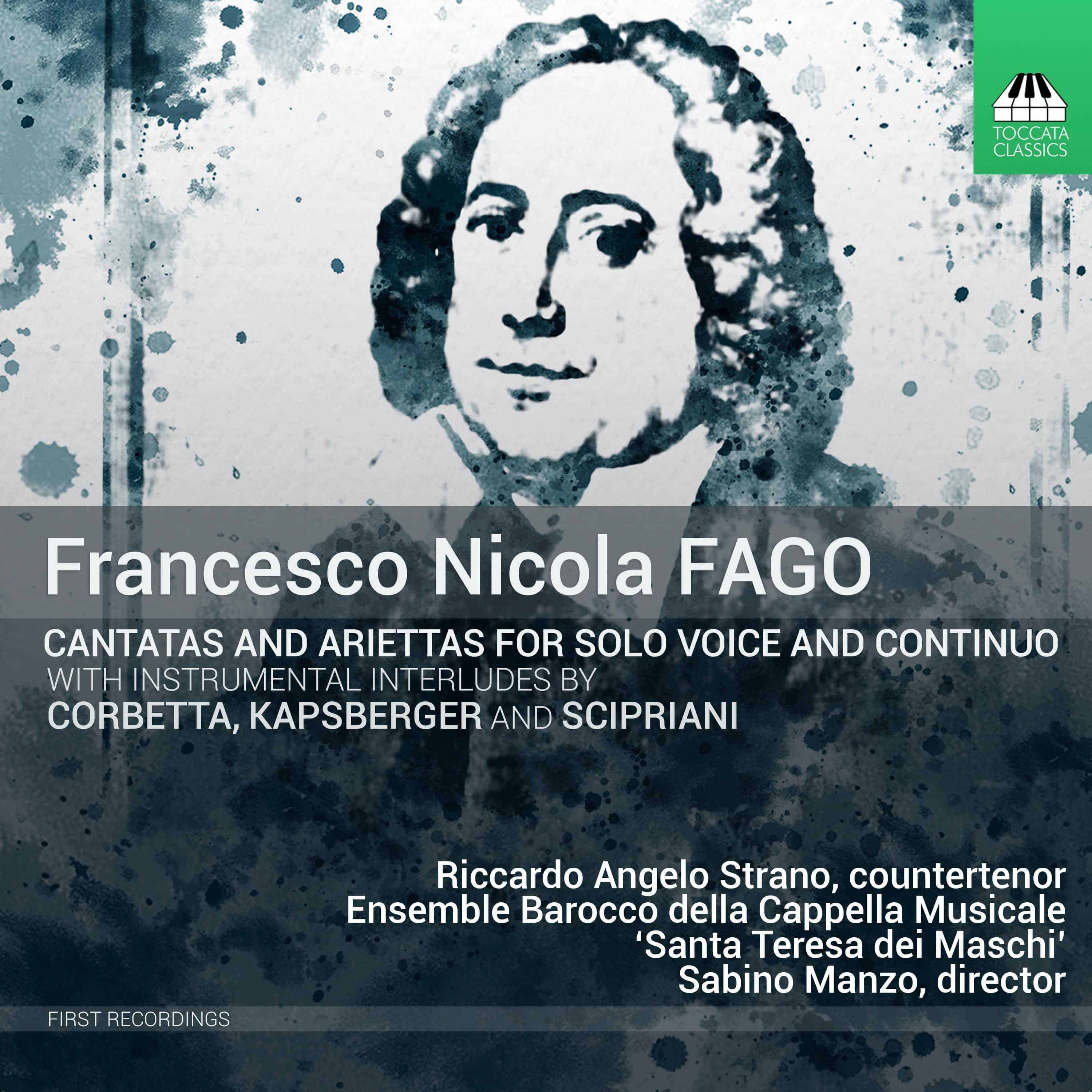
Nicola Fago (1677–1745) was one of the leading practitioners of the chamber cantata, a kind of mini-opera for voice and ensemble perfected by several generations of composers working in the aristocratic courts in Naples. The six examples by Fago recorded here – for the first time – reveal him to have been a master of the genre: they are dramatic, full of rhythmic excitement and stuffed with catchy tunes. Fago’s contemporaries called him ‘Il Tarantino’, since he was born in Taranto, in the area now known as Puglia, in the heel of Italy, and this is the first in a series of Toccata Classics recordings of Puglia composers.
Riccardo Angelo Strano, countertenor (1, 2, 4, 5, 7, 8, 10, 11)
Ensemble Barocco della Cappella Musicale ‘Santa Teresa dei Maschi’
Claudio Mastrangelo, Baroque cello (3)
Giuseppe Petrella, theorbo and Baroque guitar (6, 9)
Davide Milano, violone (3)
Sabino Manzo, harpsichord and director
Listen To This Recording:
-
FAGO
- All’or ch’io dolce oblio: cantata a voce sola
- Questo povero cor: cantata a voce sola
- Sinfonia di violoncello solo e basso
- Tormentata: arietta diversa
- Come viver poss’io: cantata a voce sola
- Capona
- Lagrime di cordoglio: cantata a voce sola
- Quanto invidio la tua sorte: cantata a voce sola
- Autre Chacone
- Lusinga di chi pena: arietta diversa
- Quall’or non peggio: cantata a voce sola
Francesco Paolo SCIPRIANI
FAGO
Giovanni Girolamo KAPSBERGER
FAGO
Francesco CORBETTA
FAGO
Baroquiades :
‘Une double première réussie […]
Dès le premier récitatif de la cantate All’or ch’in dolce oblio, les qualités vocales de Riccardo Strano sont patentes. La diction est ciselée, le registre très homogène, le style d’une grande élégance et le grave profond et sonore. La virtuosité est grande dans la deuxième aria et l’ornementation est riche mais sans aucune affectation. […]
Come viver poss’io est un des plus beaux moments de l’enregistrement. Riccardo Strano s’y montre bouleversant et souverain malgré une écriture complexe, qu’il négocie avec talent, et même si cette écriture sollicite le haut de sa tessiture de façon un peu déraisonnable. La cantate Lagrime di cordoglio est de mon point de vue le meilleur morceau de ce bel enregistrement. Poignant à souhait, Riccardo A Strano y déploie des couleurs d’une très grande richesse et d’une grande variété. D’une écriture plus centrale, cette cantate lui permet d’exploiter, sur toute l’étendue du médium ambré qui est le sien, une très belle et très prometteuse technique. […]
Au total, c’est à une très belle découverte de Fago que cet enregistrement de grande qualité nous convie.’
—Jean-Luc Izard, Baroquiades
MusicWeb International :
‘On both volumes the young Sicilian countertenor Riccardo Angelo Strano and Ensemble Barocco Santa Teresa dei Maschi give good accounts of themselves in this repertoire. […]
On both volumes the young Sicilian countertenor Riccardo Angelo Strano and Ensemble Barocco Santa Teresa dei Maschi give good accounts of themselves in this repertoire. […]
As usual with Toccata, the notes in the booklets are state-of-the-art scholarly but accessible by the ordinary reader. […]
I’m certainly looking forward, however, to the third and concluding volume of the Toccata rehabilitation of this almost unknown composer.’
—Brian Wilson, MusicWeb International
Scherzo :
‘El compositor pullés Nicola Fago (conocido como “Il Tarantino”) ha comenzado hace no mucho a salir de un ostracismo que, escuchando su música, resulta a todas luces tan injusto como incomprensible. […]
En estos dos volúmenes, el joven contratenor italiano Riccardo Angelo Strano ofrece un puñado de cantatas de cámara y de ariette para voz sola y bajo continuo, magnífico prototipo de lo que fue esa mixtura sacroprofana que se dio en la producción de Fago. […]
La voz de Strano es realmente hermosa, muy apropiada para este repertorio, aunque a veces tenga una nada recomendable tendencia a la estridencia. El acompañamiento del Ensemble Barocco della Cappella Musicale Santa Teresa dei Maschi (violonchelo, contrabajo, cuerda pulsada y clave) es imaginativo y sólido. Excelente Claudio Mastrangelo en las piezas para violonchelo solo de Supriani. Merece mucho la pena el esfuerzo que esta gente ha hecho para rescatar del olvido a Fago.’
English translation:
‘The Apulian composer Nicola Fago (known as “Il Tarantino”) has only recently begun to emerge from an ostracism that, upon listening to his music, seems as unjust as it is incomprehensible. […]
In these two volumes, the young Italian countertenor Riccardo Angelo Strano offers a handful of chamber cantatas and ariettes for solo voice and basso continuo, a magnificent prototype of the sacred-profane mixture found in Fago’s output.
Strano’s voice is truly beautiful, very well suited to this repertoire, although it sometimes has an undesirable tendency toward stridency. The accompaniment by the Ensemble Barocco della Cappella Musicale Santa Teresa dei Maschi (cello, double bass, plucked strings, and harpsichord) is imaginative and solid. Claudio Mastrangelo is excellent in the pieces for solo cello by Supriani. The effort these people have made to rescue Fago from oblivion is well worth it.’
—Enrique Velasco, Scherzo
GBOPERA :
‘Accompagnato dall’Ensemble Barocco della Cappella Musicale “Santa Teresa dei Maschi”, formata da Claudio Mastrangelo (violoncello barocco), da Giuseppe Petrella alla tiorba e alla chitarra barocca e da Davide Milano (violone), diretti da Sabino Manzo (clavicembalo), il controtenore Riccardo Angelo Strano mostra di essere particolarmente a suo agio in questo repertorio grazie ad un fraseggio e un’intonazione molto curati che gli consentono di trovare, dal punto di vista interprertativo, accenti di rara espressività, che si fanno particolarmente intensi in Lagrime di cordoglio, e una grande varietà di colori sia nei recitativi che nelle arie. Dotato di una solida tecnica evidente nelle eleganti ornamentazioni dei da capo delle arie da lui stesso composte, l’artista trova un perfetto amalgama e concerta bene, laddove è richiesto, con il basso continuo realizzato con grande senso dello stile dai continuisti dell’Ensemble Barocco. Infine vanno segnalati il virtuosismo e l’espressività dei singoli continuisti nei brani solistici proposti e, in particolar modo, di Claudio Mastrangelo nell’interpretare le belle toccate di Scipriani, di Giuseppe Petrella, autore, con la sua tiorba, di una poetica interpretazione della Capona di Kapsberger e, con la chitarra barocca, di un’altrettanto suggestiva esecuzione della Partie de chacone di Corbetta. Completano il doppio album due booklet interessanti sia dal punto di vista storico che filologico, curati da Dinko Fabris e da Maria Grazia Melucci.’
English translation:
‘Accompanied by the Baroque Ensemble of the Cappella Musicale “Santa Teresa dei Maschi,” consisting of Claudio Mastrangelo (Baroque cello), Giuseppe Petrella (theorbo and Baroque guitar), and Davide Milano (violone), conducted by Sabino Manzo (harpsichord), countertenor Riccardo Angelo Strano demonstrates his particular ease with this repertoire. His meticulous phrasing and intonation allow him to find interpretive nuances of rare expressiveness, particularly intense in “Lagrime di condoglio,” and a wide variety of colors in both the recitatives and arias. Equipped with a solid technique evident in the elegant da capo ornamentations of the arias he composed himself, the artist finds a perfect blend and harmonizes well, where required, with the basso continuo, performed with great style by the continuo players of the Ensemble Barocco. Finally, noteworthy are the virtuosity and expressiveness of the individual continuo players in the solo pieces, especially Claudio Mastrangelo’s interpretation of Scipriani’s beautiful toccatas, and Giuseppe Petrella’s poetic interpretation of Kapsberger’s Capona on his theorbo and an equally evocative performance of Corbetta’s Partie de chacone on baroque guitar. The double album is rounded out by two booklets, both historically and philologically interesting, edited by Dinko Fabris and Maria Grazia Melucci.’
—Riccardo Viagrande, GBOPERA
Orpheus :
‘Gemeinsam mit der Cappella Musicale Santa Teresa dei Maschi unter der Leitung von Sabino Manzo führt der Countertenor Riccardo Angelo Strano einfühlsam und virtuos durch sehnsüchtige Gedanken, Liebesleid und Trauer. Aufgelockert werden die Kantaten durch Instrumentalwerke v.a. von Francesco Paolo Scipriani (1678-1753). Informative Booklet-Texte in Englisch veredeln diese wunderbaren Ersteinspielungen.’
English translation:
‘Together with the Cappella Musicale Santa Teresa dei Maschi under the direction of Sabino Manzo, countertenor Riccardo Angelo Strano sensitively and virtuously guides the listener through yearning thoughts, lovesickness, and grief. The cantatas are interspersed with instrumental works, primarily by Francesco Paolo Scipriani (1678-1753). Informative booklet texts in English enhance these wonderful first recordings.’
—Orpheus